You are here: t ball sets for 10 year olds under 50 dollars > Amazon Sellers
Hard Times
t ball sets for 10 year olds under 50 dollars2026-07-30 00:14:43【Amazon Sellers】2 people viewed
SummaryHard TimesandReprinted Pieces [0] By CHARLES DICKENS With illustrations by MarcusStone, MauriceGreif easter basket gift ideas with animal figures
Hard Times
and
Reprinted Pieces [0]
By CHARLES DICKENS
With illustrations by MarcusStone,easter basket gift ideas with animal figures Maurice
Greiffenhagen, and F. Walker
LONDON: CHAPMAN & HALL, LD.
NEW YORK: CHARLES SCRIBNER’S SONS
1905
CONTENTS
BOOK THEFIRST. SOWING | |
| PAGE |
CHAPTER I | |
The One Thing Needful | 3 |
CHAPTER II | |
Murdering the Innocents | 4 |
CHAPTER III | |
A Loophole | 8 |
CHAPTER IV | |
Mr. Bounderby | 12 |
CHAPTER V | |
The Keynote | 18 |
CHAPTER VI | |
Sleary’s Horsemanship | 23 |
CHAPTER VII | |
Mrs. Sparsit | 33 |
CHAPTER VIII | |
Never Wonder | 38 |
CHAPTER IX | |
Sissy’s Progress | 43 |
CHAPTER X | |
Stephen Blackpool | 49 |
CHAPTER XI | |
No Way Out | 53 |
CHAPTER XII | |
The Old Woman | 59 |
CHAPTER XIII | |
Rachael | 63 |
CHAPTER XIV | |
The Great Manufacturer | 69 |
CHAPTER XV | |
Father and Daughter | 73 |
CHAPTER XVI | |
Husband and Wife | 79 |
BOOK THESECOND. REAPING | |
CHAPTER I | |
Effects in the Bank | 84 |
CHAPTER II | |
Mr. James Harthouse | 94 |
CHAPTER III | |
The Whelp | 101 |
CHAPTER IV | |
Men and Brothers | 111 |
CHAPTER V | |
Men and Masters | 105 |
CHAPTER VI | |
Fading Away | 116 |
CHAPTER VII | |
Gunpowder | 126 |
CHAPTER VIII | |
Explosion | 136 |
CHAPTER IX | |
Hearing the Last of it | 146 |
CHAPTER X | |
Mrs. Sparsit’s Staircase | 152 |
CHAPTER XI | |
Lower and Lower | 156 |
CHAPTER XII | |
Down | 163 |
BOOK THETHIRD. GARNERING | |
CHAPTER I | |
Another Thing Needful | 167 |
CHAPTER II | |
Very Ridiculous | 172 |
CHAPTER III | |
Very Decided | 179 |
CHAPTER IV | |
Lost | 186 |
CHAPTER V | |
Found | 193 |
CHAPTER VI | |
The Starlight | 200 |
CHAPTER VII | |
Whelp-Hunting | 208 |
CHAPTER VIII | |
Philosophical | 216 |
CHAPTER IX | |
Final | 222 |
LIST OF ILLUSTRATIONS
| PAGE |
Stephen and Rachael in the Sick-room | 64 |
Mr. Harthouse Dining at the Bounderbys’ | 100 |
Mr. Harthouse and Tom Gradgrind in the Garden | 132 |
Stephen Blackpool recovered from the Old HellShaft | 206 |
p. 3BOOK THEFIRST
SOWING
CHAPTER I
THE ONE THING NEEDFUL
‘Now, what I want is,Facts. Teach these boys and girls nothing but Facts. Facts alone are wanted in life. Plant nothing else, androot out everything else. You can only form the minds ofreasoning animals upon Facts: nothing else will ever be of anyservice to them. This is the principle on which I bring upmy own children, and this is the principle on which I bring upthese children. Stick to Facts, sir!’
The scene was a plain, bare, monotonous vault of aschool-room, and the speaker’s square forefinger emphasizedhis observations by underscoring every sentence with a line onthe schoolmaster’s sleeve. The emphasis was helped bythe speaker’s square wall of a forehead, which had hiseyebrows for its base, while his eyes found commodious cellaragein two dark caves, overshadowed by the wall. The emphasiswas helped by the speaker’s mouth, which was wide, thin,and hard set. The emphasis was helped by thespeaker’s voice, which was inflexible, dry, anddictatorial. The emphasis was helped by the speaker’shair, which bristled on the skirts of his bald head, a plantationof firs to keep the wind from its shining surface, all coveredwith knobs, like the crust of a plum pie, as if the head hadscarcely warehouse-room for the hard facts stored inside. The speaker’s obstinate carriage, square coat, square legs,square shoulders,—nay, his very neckcloth, trained to takehim by the throat with an unaccommodating grasp, like a stubbornfact, as it was,—all helped the emphasis.
p. 4‘Inthis life, we want nothing but Facts, sir; nothing butFacts!’
The speaker, and the schoolmaster, and the third grown personpresent, all backed a little, and swept with their eyes theinclined plane of little vessels then and there arranged inorder, ready to have imperial gallons of facts poured into themuntil they were full to the brim.
CHAPTER II
MURDERING THE INNOCENTS
Thomas Gradgrind, sir. A manof realities. A man of facts and calculations. A manwho proceeds upon the principle that two and two are four, andnothing over, and who is not to be talked into allowing foranything over. Thomas Gradgrind, sir—peremptorilyThomas—Thomas Gradgrind. With a rule and a pair ofscales, and the multiplication table always in his pocket, sir,ready to weigh and measure any parcel of human nature, and tellyou exactly what it comes to. It is a mere question offigures, a case of simple arithmetic. You might hope to getsome other nonsensical belief into the head of George Gradgrind,or Augustus Gradgrind, or John Gradgrind, or Joseph Gradgrind(all supposititious, non-existent persons), but into the head ofThomas Gradgrind—no, sir!
In such terms Mr. Gradgrind always mentally introducedhimself, whether to his private circle of acquaintance, or to thepublic in general. In such terms, no doubt, substitutingthe words ‘boys and girls,’ for ‘sir,’Thomas Gradgrind now presented Thomas Gradgrind to the littlepitchers before him, who were to be filled so full of facts.
Indeed, as he eagerly sparkled at them from the cellaragebefore mentioned, he seemed a kind of cannon loaded to the muzzlewith facts, and prepared to blow them clean out of the regions ofchildhood at one discharge. He seemed a galvanizingapparatus, too, charged with a grim mechanical substitute for thetender young imaginations that were to be stormed away.
‘Girl number twenty,’ said Mr. Gradgrind, squarelypointing with his square forefinger, ‘I don’t knowthat girl. Who is that girl?’
‘Sissy Jupe, sir,’ explained number twenty,blushing, standing up, and curtseying.
‘Sissy is not a name,’ said Mr. Gradgrind. ‘Don’t call yourself Sissy. Call yourselfCecilia.’
‘It’s father as calls me Sissy, sir,’returned the young girl in a trembling voice, and with anothercurtsey.
‘Then he has no business to do it,’ said Mr.Gradgrind. ‘Tell him he mustn’t. CeciliaJupe. Let me see. What is your father?’
‘He belongs to the horse-riding, if you please,sir.’
Mr. Gradgrind frowned, and waved off the objectionable callingwith his hand.
‘We don’t want to know anything about that,here. You mustn’t tell us about that, here. Your father breaks horses, don’t he?’
‘If you please, sir, when they can get any to break,they do break horses in the ring, sir.’
‘You mustn’t tell us about the ring, here. Very well, then. Describe your father as ahorsebreaker. He doctors sick horses, I daresay?’
‘Oh yes, sir.’
‘Very well, then. He is a veterinary surgeon, afarrier, and horsebreaker. Give me your definition of ahorse.’
(Sissy Jupe thrown into the greatest alarm by thisdemand.)
‘Girl number twenty unable to define a horse!’said Mr. Gradgrind, for the general behoof of all the littlepitchers. ‘Girl number twenty possessed of no facts,in reference to one of the commonest of animals! Someboy’s definition of a horse. Bitzer,yours.’
The square finger, moving here and there, lighted suddenly onBitzer, perhaps because he chanced to sit in the same ray ofsunlight which, darting in at one of the bare windows of theintensely white-washed room, irradiated Sissy. For, theboys and girls sat on the face of the inclined plane in twocompact bodies, divided up the centre by a narrow interval; andSissy, being at the corner of a row on the sunny side, came infor the beginning of a sunbeam, of which Bitzer, being at thecorner of a row on the other side, a few rows in advance, caughtthe end. But, whereas the girl was so dark-eyed anddark-haired, that she seemed to receive a deeper and morelustrous colour from the sun, when it shone upon her, the boy wasso light-eyed and light-haired that the self-same rays appearedto draw out of him what little colour he ever possessed. His cold eyes would hardly have been eyes, but for the short endsof lashes which, by bringing them into immediate contrast withsomething paler than themselves, expressed their form. Hisshort-cropped hair might have been a mere continuation of thesandy freckles on his forehead and face. His skin was sounwholesomely deficient in the natural tinge, that he looked asthough, if he were cut, he would bleed white.
‘Bitzer,’ said Thomas Gradgrind. ‘Yourdefinition of a horse.’
‘Quadruped. Graminivorous. Forty teeth,namely twenty-four grinders, four eye-teeth, and twelveincisive. Sheds coat in the spring; in marshy countries,sheds hoofs, too. Hoofs hard, but requiring to be shod withiron. Age known by marks in mouth.’ Thus (andmuch more) Bitzer.
‘Now girl number twenty,’ said Mr.Gradgrind. ‘You know what a horse is.’
She curtseyed again, and would have blushed deeper, if shecould have blushed deeper than she had blushed all thistime. Bitzer, after rapidly blinking at Thomas Gradgrindwith both eyes at once, and so catching the light upon hisquivering ends of lashes that they looked like the antennæof busy insects, put his knuckles to his freckled forehead, andsat down again.
The third gentleman now stepped forth. A mighty man atcutting and drying, he was; a government officer; in his way (andin most other people’s too), a professed pugilist; alwaysin training, always with a system to force down the generalthroat like a bolus, always to be heard of at the bar of hislittle Public-office, ready to fight all England. Tocontinue in fistic phraseology, he had a genius for coming up tothe scratch, wherever and whatever it was, and proving himself anugly customer. He would go in and damage any subjectwhatever with his right, follow up with his left, stop, exchange,counter, bore his opponent (he always fought All England) to theropes, and fall upon him neatly. He was certain to knockthe wind out of common sense, and render that unlucky adversarydeaf to the call of time. And he had it in charge from highauthority to bring about the great public-office Millennium, whenCommissioners should reign upon earth.
‘Very well,’ said this gentleman, briskly smiling,and folding his arms. ‘That’s a horse. Now, let me ask you girls and boys, Would you paper a room withrepresentations of horses?’
After a pause, one half of the children cried in chorus,‘Yes, sir!’ Upon which the other half, seeingin the gentleman’s face that Yes was wrong, cried out inchorus, ‘No, sir!’—as the custom is, in theseexaminations.
‘Of course, No. Why wouldn’t you?’
A pause. One corpulent slow boy, with a wheezy manner ofbreathing, ventured the answer, Because he wouldn’t paper aroom at all, but would paint it.
‘You mustpaper it,’ said the gentleman,rather warmly.
‘You must paper it,’ said Thomas Gradgrind,‘whether you like it or not. Don’t tellusyou wouldn’t paper it. What do you mean,boy?’
‘I’ll explain to you, then,’ said thegentleman, after another and a dismal pause, ‘why youwouldn’t paper a room with representations of horses. Do you ever see horses walking up and down the sides of rooms inreality—in fact? Do you?’
‘Yes, sir!’ from one half. ‘No,sir!’ from the other.
‘Of course no,’ said the gentleman, with anindignant look at the wrong half. ‘Why, then, you arenot to see anywhere, what you don’t see in fact; you arenot to have anywhere, what you don’t have in fact. What is called Taste, is only another name for Fact.’ Thomas Gradgrind nodded his approbation.
‘This is a new principle, a discovery, a greatdiscovery,’ said the gentleman. ‘Now,I’ll try you again. Suppose you were going to carpeta room. Would you use a carpet having a representation offlowers upon it?’
There being a general conviction by this time that ‘No,sir!’ was always the right answer to this gentleman, thechorus of No was very strong. Only a few feeble stragglers said Yes: among them Sissy Jupe.
‘Girl number twenty,’ said the gentleman, smilingin the calm strength of knowledge.
Sissy blushed, and stood up.
‘So you would carpet your room—or yourhusband’s room, if you were a grown woman, and had ahusband—with representations of flowers, would you?’said the gentleman. ‘Why would you?’
‘If you please, sir, I am very fond of flowers,’returned the girl.
‘And is that why you would put tables and chairs uponthem, and have people walking over them with heavyboots?’
‘It wouldn’t hurt them, sir. Theywouldn’t crush and wither, if you please, sir. Theywould be the pictures of what was very pretty and pleasant, and Iwould fancy—’
‘Ay, ay, ay! But you mustn’t fancy,’cried the gentleman, quite elated by coming so happily to hispoint. ‘That’s it! You are never tofancy.’
‘You are not, Cecilia Jupe,’ Thomas Gradgrindsolemnly repeated, ‘to do anything of that kind.’
‘Fact, fact, fact!’ said the gentleman. And‘Fact, fact, fact!’ repeated Thomas Gradgrind.
‘You are to be in all things regulated andgoverned,’ said the gentleman, ‘by fact. Wehope to have, before long, a board of fact, composed ofcommissioners of fact, who will force the people to be a peopleof fact, and of nothing but fact. You must discard the wordFancy altogether. You have nothing to do with it. Youare not to have, in any object of use or ornament, what would bea contradiction in fact. You don’t walk upon flowersin fact; you cannot be allowed to walk upon flowers incarpets. You don’t find that foreign birds andbutterflies come and perch upon your crockery; you cannot bepermitted to paint foreign birds and butterflies upon yourcrockery. You never meet with quadrupeds going up and downwalls; you must not have quadrupeds represented upon walls. You must use,’ said the gentleman, ‘for all thesepurposes, combinations and modifications (in primary colours) ofmathematical figures which are susceptible of proof anddemonstration. This is the new discovery. This isfact. This is taste.’
The girl curtseyed, and sat down. She was very young,and she p.8looked as if she were frightened by the matter-of-factprospect the world afforded.
‘Now, if Mr. M’Choakumchild,’ said thegentleman, ‘will proceed to give his first lesson here, Mr.Gradgrind, I shall be happy, at your request, to observe his modeof procedure.’
Mr. Gradgrind was much obliged. ‘Mr.M’Choakumchild, we only wait for you.’
So, Mr. M’Choakumchild began in his best manner. He and some one hundred and forty other schoolmasters, had beenlately turned at the same time, in the same factory, on the sameprinciples, like so many pianoforte legs. He had been putthrough an immense variety of paces, and had answered volumes ofhead-breaking questions. Orthography, etymology, syntax,and prosody, biography, astronomy, geography, and generalcosmography, the sciences of compound proportion, algebra,land-surveying and levelling, vocal music, and drawing frommodels, were all at the ends of his ten chilled fingers. Hehad worked his stony way into Her Majesty’s most HonourablePrivy Council’s Schedule B, and had taken the bloom off thehigher branches of mathematics and physical science, French,German, Latin, and Greek. He knew all about all the WaterSheds of all the world (whatever they are), and all the historiesof all the peoples, and all the names of all the rivers andmountains, and all the productions, manners, and customs of allthe countries, and all their boundaries and bearings on the twoand thirty points of the compass. Ah, rather overdone,M’Choakumchild. If he had only learnt a little less,how infinitely better he might have taught much more!
He went to work in this preparatory lesson, not unlikeMorgiana in the Forty Thieves: looking into all the vesselsranged before him, one after another, to see what theycontained. Say, good M’Choakumchild. When fromthy boiling store, thou shalt fill each jar brim full by-and-by,dost thou think that thou wilt always kill outright the robberFancy lurking within—or sometimes only maim him and distorthim!
CHAPTER III
A LOOPHOLE
Mr. Gradgrind walked homeward fromthe school, in a state of considerable satisfaction. It washis school, and he intended it to be a model. He intendedevery child in it to be a model—just as the youngGradgrinds were all models.
There were five young Gradgrinds, and they were models everyone. They had been lectured at, from their tenderest years;coursed, like little hares. Almost as soon as they couldrun alone, they had been made to run to the lecture-room. The first object with which they had an association, or of whichthey had a remembrance, was a large black board with a dry Ogrechalking ghastly white figures on it.
Not that they knew, by name or nature, anything about an OgreFact forbid! I only use the word to express a monster in alecturing castle, with Heaven knows how many heads manipulatedinto one, taking childhood captive, and dragging it into gloomystatistical dens by the hair.
No little Gradgrind had ever seen a face in the moon; it wasup in the moon before it could speak distinctly. No littleGradgrind had ever learnt the silly jingle, Twinkle, twinkle,little star; how I wonder what you are! No little Gradgrindhad ever known wonder on the subject, each little Gradgrindhaving at five years old dissected the Great Bear like aProfessor Owen, and driven Charles’s Wain like a locomotiveengine-driver. No little Gradgrind had ever associated acow in a field with that famous cow with the crumpled horn whotossed the dog who worried the cat who killed the rat who ate themalt, or with that yet more famous cow who swallowed Tom Thumb:it had never heard of those celebrities, and had only beenintroduced to a cow as a graminivorous ruminating quadruped withseveral stomachs.
To his matter-of-fact home, which was called Stone Lodge, Mr.Gradgrind directed his steps. He had virtually retired fromthe wholesale hardware trade before he built Stone Lodge, and wasnow looking about for a suitable opportunity of making anarithmetical figure in Parliament. Stone Lodge was situatedon a moor within a mile or two of a great town—calledCoketown in the present faithful guide-book.
A very regular feature on the face of the country, Stone Lodgewas. Not the least disguise toned down or shaded off thatuncompromising fact in the landscape. A great square house,with a heavy portico darkening the principal windows, as itsmaster’s heavy brows overshadowed his eyes. Acalculated, cast up, balanced, and proved house. Sixwindows on this side of the door, six on that side; a total oftwelve in this wing, a total of twelve in the other wing;four-and-twenty carried over to the back wings. A lawn andgarden and an infant avenue, all ruled straight like a botanicalaccount-book. Gas and ventilation, drainage andwater-service, all of the primest quality. Iron clamps andgirders, fire-proof from top to bottom; mechanical lifts for thehousemaids, with all their brushes and brooms; everything thatheart could desire.
Everything? Well, I suppose so. The littleGradgrinds had cabinets in various departments of sciencetoo. They had a little conchological cabinet, and a littlemetallurgical cabinet, and a little mineralogical cabinet; andthe specimens were all arranged and labelled, and the bits ofstone and ore looked as though they might have been broken fromthe parent substances by those tremendously hard instrumentstheir own names; and, to paraphrase the idle legend of PeterPiper, who had never found his way into their nursery, If thegreedy little Gradgrinds grasped at more than this, what was itfor good gracious goodness’ sake, that the greedy littleGradgrinds grasped it!
Their father walked on in a hopeful and satisfied frame ofmind. He was an affectionate father, after his manner; buthe would probably have described himself (if he had been put,like Sissy Jupe, upon a definition) as ‘an eminentlypractical’ father. He had a particular pride in thephrase eminently practical, which was considered to have aspecial application to him. Whatsoever the public meetingheld in Coketown, and whatsoever the subject of such meeting,some Coketowner was sure to seize the occasion of alluding to hiseminently practical friend Gradgrind. This always pleasedthe eminently practical friend. He knew it to be his due,but his due was acceptable.
He had reached the neutral ground upon the outskirts of thetown, which was neither town nor country, and yet was eitherspoiled, when his ears were invaded by the sound of music. The clashing and banging band attached to the horse-ridingestablishment, which had there set up its rest in a woodenpavilion, was in full bray. A flag, floating from thesummit of the temple, proclaimed to mankind that it was‘Sleary’s Horse-riding’ which claimed theirsuffrages. Sleary himself, a stout modern statue with amoney-box at its elbow, in an ecclesiastical niche of earlyGothic architecture, took the money. Miss Josephine Sleary,as some very long and very narrow strips of printed billannounced, was then inaugurating the entertainments with hergraceful equestrian Tyrolean flower-act. Among the otherpleasing but always strictly moral wonders which must be seen tobe believed, Signor Jupe was that afternoon to ‘elucidatethe diverting accomplishments of his highly trained performingdog Merrylegs.’ He was also to exhibit ‘hisastounding feat of throwing seventy-five hundred-weight in rapidsuccession backhanded over his head, thus forming a fountain ofsolid iron in mid-air, a feat never before attempted in this orany other country, and which having elicited such rapturousplaudits from enthusiastic throngs it cannot bewithdrawn.’ The same Signor Jupe was to‘enliven the varied performances at frequent intervals withhis chaste Shaksperean quips and retorts.’ Lastly, hewas to wind them up by appearing in his favourite character ofMr. William Button, of Tooley Street, in ‘the highly noveland laughable hippo-comedietta of The Tailor’s Journey toBrentford.’
Thomas Gradgrind took no heed of these trivialities of course,but passed on as a practical man ought to pass on, eitherbrushing the noisy insects from his thoughts, or consigning themto the House of Correction. But, the turning of the roadtook him by the back of the booth, and at the back of the booth anumber of children were congregated in a number of stealthyattitudes, striving to peep in at the hidden glories of theplace.
This brought him to a stop. ‘Now, to think ofthese vagabonds,’ said he, ‘attracting the youngrabble from a model school.’
A space of stunted grass and dry rubbish being between him andthe young rabble, he took his eyeglass out of his waistcoat tolook for any child he knew by name, and might order off. Phenomenon almost incredible though distinctly seen, what did hethen behold but his own metallurgical Louisa, peeping with allher might through a hole in a deal board, and his ownmathematical Thomas abasing himself on the ground to catch but ahoof of the graceful equestrian Tyrolean flower-act!
Dumb with amazement, Mr. Gradgrind crossed to the spot wherehis family was thus disgraced, laid his hand upon each erringchild, and said:
‘Louisa!! Thomas!!’
Both rose, red and disconcerted. But, Louisa looked ather father with more boldness than Thomas did. Indeed,Thomas did not look at him, but gave himself up to be taken homelike a machine.
‘In the name of wonder, idleness, and folly!’ saidMr. Gradgrind, leading each away by a hand; ‘what do you dohere?’
‘Wanted to see what it was like,’ returned Louisa,shortly.
‘What it was like?’
‘Yes, father.’
There was an air of jaded sullenness in them both, andparticularly in the girl: yet, struggling through thedissatisfaction of her face, there was a light with nothing torest upon, a fire with nothing to burn, a starved imaginationkeeping life in itself somehow, which brightened itsexpression. Not with the brightness natural to cheerfulyouth, but with uncertain, eager, doubtful flashes, which hadsomething painful in them, analogous to the changes on a blindface groping its way.
She was a child now, of fifteen or sixteen; but at no distantday would seem to become a woman all at once. Her fatherthought so as he looked at her. She was pretty. Wouldhave been self-willed (he thought in his eminently practical way)but for her bringing-up.
‘Thomas, though I have the fact before me, I find itdifficult to believe that you, with your education and resources,should have brought your sister to a scene like this.’
p.12‘I brought him, father,’ said Louisa,quickly. ‘I asked him to come.’
‘I am sorry to hear it. I am very sorry indeed tohear it. It makes Thomas no better, and it makes you worse,Louisa.’
She looked at her father again, but no tear fell down hercheek.
‘You! Thomas and you, to whom the circle of thesciences is open; Thomas and you, who may be said to be repletewith facts; Thomas and you, who have been trained to mathematicalexactness; Thomas and you, here!’ cried Mr.Gradgrind. ‘In this degraded position! I amamazed.’
‘I was tired, father. I have been tired a longtime,’ said Louisa.
‘Tired? Of what?’ asked the astonishedfather.
‘I don’t know of what—of everything, Ithink.’
‘Say not another word,’ returned Mr.Gradgrind. ‘You are childish. I will hear nomore.’ He did not speak again until they had walkedsome half-a-mile in silence, when he gravely broke out with:‘What would your best friends say, Louisa? Do youattach no value to their good opinion? What would Mr.Bounderby say?’ At the mention of this name, hisdaughter stole a look at him, remarkable for its intense andsearching character. He saw nothing of it, for before helooked at her, she had again cast down her eyes!
‘What,’ he repeated presently, ‘would Mr.Bounderby say?’ All the way to Stone Lodge, as withgrave indignation he led the two delinquents home, he repeated atintervals ‘What would Mr. Bounderby say?’—as ifMr. Bounderby had been Mrs. Grundy.
CHAPTER IV
MR. BOUNDERBY
Not being Mrs. Grundy, whowasMr. Bounderby?
Why, Mr. Bounderby was as near being Mr. Gradgrind’sbosom friend, as a man perfectly devoid of sentiment can approachthat spiritual relationship towards another man perfectly devoidof sentiment. So near was Mr. Bounderby—or, if thereader should prefer it, so far off.
He was a rich man: banker, merchant, manufacturer, and whatnot. A big, loud man, with a stare, and a metalliclaugh. A man made out of a coarse material, which seemed tohave been stretched to make so much of him. A man with agreat puffed head and forehead, swelled veins in his temples, andsuch a strained skin to his face that it seemed to hold his eyesopen, and lift his eyebrows up. A man with a pervadingappearance on him of being inflated like a balloon, and ready tostart. A man who could never sufficiently vaunt himself aself-made man. A man who was always proclaiming, throughthat brassy speaking-trumpet of a voice of his, his old ignoranceand his old poverty. A man who was the Bully ofhumility.
A year or two younger than his eminently practical friend, Mr.Bounderby looked older; his seven or eight and forty might havehad the seven or eight added to it again, without surprisinganybody. He had not much hair. One might have fanciedhe had talked it off; and that what was left, all standing up indisorder, was in that condition from being constantly blown aboutby his windy boastfulness.
In the formal drawing-room of Stone Lodge, standing on thehearthrug, warming himself before the fire, Mr. Bounderbydelivered some observations to Mrs. Gradgrind on the circumstanceof its being his birthday. He stood before the fire, partlybecause it was a cool spring afternoon, though the sun shone;partly because the shade of Stone Lodge was always haunted by theghost of damp mortar; partly because he thus took up a commandingposition, from which to subdue Mrs. Gradgrind.
‘I hadn’t a shoe to my foot. As to astocking, I didn’t know such a thing by name. Ipassed the day in a ditch, and the night in a pigsty. That’s the way I spent my tenth birthday. Not that aditch was new to me, for I was born in a ditch.’
Mrs. Gradgrind, a little, thin, white, pink-eyed bundle ofshawls, of surpassing feebleness, mental and bodily; who wasalways taking physic without any effect, and who, whenever sheshowed a symptom of coming to life, was invariably stunned bysome weighty piece of fact tumbling on her; Mrs. Gradgrind hopedit was a dry ditch?
‘No! As wet as a sop. A foot of water init,’ said Mr. Bounderby.
‘Enough to give a baby cold,’ Mrs. Gradgrindconsidered.
‘Cold? I was born with inflammation of the lungs,and of everything else, I believe, that was capable ofinflammation,’ returned Mr. Bounderby. ‘Foryears, ma’am, I was one of the most miserable littlewretches ever seen. I was so sickly, that I was alwaysmoaning and groaning. I was so ragged and dirty, that youwouldn’t have touched me with a pair of tongs.’
Mrs. Gradgrind faintly looked at the tongs, as the mostappropriate thing her imbecility could think of doing.
‘How I fought through it, Idon’tknow,’ said Bounderby. ‘I was determined, Isuppose. I have been a determined character in later life,and I suppose I was then. Here I am, Mrs. Gradgrind,anyhow, and nobody to thank for my being here, butmyself.’
Mrs. Gradgrind meekly and weakly hoped that hismother—
‘Mymother? Bolted, ma’am!’said Bounderby.
Mrs. Gradgrind, stunned as usual, collapsed and gave itup.
‘My mother left me to my grandmother,’ saidBounderby; ‘and, according to the best of my remembrance,my grandmother was the wickedest and the worst old woman thatever lived. If I got a little pair of shoes by any chance,she would take ’em off and sell ’em for drink. Why, I have known that grandmother of mine lie in her bed anddrink her four-teen glasses of liquor beforebreakfast!’
Mrs. Gradgrind, weakly smiling, and giving no other sign ofvitality, looked (as she always did) like an indifferentlyexecuted transparency of a small female figure, without enoughlight behind it.
‘She kept a chandler’s shop,’ pursuedBounderby, ‘and kept me in an egg-box. That was thecot of myinfancy; an old egg-box. As soon as I wasbig enough to run away, of course I ran away. Then I becamea young vagabond; and instead of one old woman knocking me aboutand starving me, everybody of all ages knocked me about andstarved me. They were right; they had no business to doanything else. I was a nuisance, an incumbrance, and apest. I know that very well.’
His pride in having at any time of his life achieved such agreat social distinction as to be a nuisance, an incumbrance, anda pest, was only to be satisfied by three sonorous repetitions ofthe boast.
‘I was to pull through it, I suppose, Mrs.Gradgrind. Whether I was to do it or not, ma’am, Idid it. I pulled through it, though nobody threw me out arope. Vagabond, errand-boy, vagabond, labourer, porter,clerk, chief manager, small partner, Josiah Bounderby ofCoketown. Those are the antecedents, and theculmination. Josiah Bounderby of Coketown learnt hisletters from the outsides of the shops, Mrs. Gradgrind, and wasfirst able to tell the time upon a dial-plate, from studying thesteeple clock of St. Giles’s Church, London, under thedirection of a drunken cripple, who was a convicted thief, and anincorrigible vagrant. Tell Josiah Bounderby of Coketown, ofyour district schools and your model schools, and your trainingschools, and your whole kettle-of-fish of schools; and JosiahBounderby of Coketown, tells you plainly, all right, allcorrect—he hadn’t such advantages—but let ushave hard-headed, solid-fisted people—the education thatmade him won’t do for everybody, he knows well—suchand such his education was, however, and you may force him toswallow boiling fat, but you shall never force him to suppressthe facts of his life.’
Being heated when he arrived at this climax, Josiah Bounderbyof Coketown stopped. He stopped just as his eminentlypractical friend, still accompanied by the two young culprits,entered the room. His eminently practical friend, on seeinghim, stopped also, and gave Louisa a reproachful look thatplainly said, ‘Behold your Bounderby!’
‘Well!’ blustered Mr. Bounderby,‘what’s the matter? What is young Thomas in thedumps about?’
He spoke of young Thomas, but he looked at Louisa.
‘We were peeping at the circus,’ muttered Louisa,haughtily, without lifting up her eyes, ‘and father caughtus.’
‘And, Mrs. Gradgrind,’ said her husband in a loftymanner, ‘I should as soon have expected to find my childrenreading poetry.’
‘Dear me,’ whimpered Mrs. Gradgrind. ‘How can you, Louisa and Thomas! I wonder atyou. I declare you’re enough to make one regret everhaving had a family at all. I have a great mind to say Iwish I hadn’t. Thenwhat would you have done,I should like to know?’
Mr. Gradgrind did not seem favourably impressed by thesecogent remarks. He frowned impatiently.
‘As if, with my head in its present throbbing state, youcouldn’t go and look at the shells and minerals and thingsprovided for you, instead of circuses!’ said Mrs.Gradgrind. ‘You know, as well as I do, no youngpeople have circus masters, or keep circuses in cabinets, orattend lectures about circuses. What can you possibly wantto know of circuses then? I am sure you have enough to do,if that’s what you want. With my head in its presentstate, I couldn’t remember the mere names of half the factsyou have got to attend to.’
‘That’s the reason!’ pouted Louisa.
‘Don’t tell me that’s the reason, because itcan’t be nothing of the sort,’ said Mrs.Gradgrind. ‘Go and be somethingologicaldirectly.’ Mrs. Gradgrind was not a scientificcharacter, and usually dismissed her children to their studieswith this general injunction to choose their pursuit.
In truth, Mrs. Gradgrind’s stock of facts in general waswoefully defective; but Mr. Gradgrind in raising her to her highmatrimonial position, had been influenced by two reasons. Firstly, she was most satisfactory as a question of figures; and,secondly, she had ‘no nonsense’ about her. Bynonsense he meant fancy; and truly it is probable she was as freefrom any alloy of that nature, as any human being not arrived atthe perfection of an absolute idiot, ever was.
The simple circumstance of being left alone with her husbandand Mr. Bounderby, was sufficient to stun this admirable ladyagain without collision between herself and any other fact. So, she once more died away, and nobody minded her.
‘Bounderby,’ said Mr. Gradgrind, drawing a chairto the fireside, ‘you are always so interested in my youngpeople—particularly in Louisa—that I make no apologyfor saying to you, I am very much vexed by this discovery. I have systematically devoted myself (as you know) to theeducation of the reason of my family. The reason is (as youknow) the only faculty to which education should beaddressed. ‘And yet, Bounderby, it would appear fromthis unexpected circumstance of to-day, though in itself atrifling one, as if something had crept into Thomas’s andLouisa’s minds which is—or rather, which isnot—I don’t know that I can express myself betterthan by saying—which has never been intended to bedeveloped, and in which their reason has no part.’
‘There certainly is no reason in looking with interestat a parcel of vagabonds,’ returned Bounderby. ‘When I was a vagabond myself, nobody looked with anyinterest at me; I know that.’
‘Then comes the question; said the eminently practicalfather, with his eyes on the fire, ‘in what has this vulgarcuriosity its rise?’
‘I’ll tell you in what. In idleimagination.’
‘I hope not,’ said the eminently practical;‘I confess, however, that the misgiving hascrossedme on my way home.’
‘In idle imagination, Gradgrind,’ repeatedBounderby. ‘A very bad thing for anybody, but acursed bad thing for a girl like Louisa. I should ask Mrs.Gradgrind’s pardon for strong expressions, but that sheknows very well I am not a refined character. Whoeverexpects refinement in mewill be disappointed. Ihadn’t a refined bringing up.’
‘Whether,’ said Gradgrind, pondering with hishands in his pockets, and his cavernous eyes on the fire,‘whether any instructor or servant can have suggestedanything? Whether Louisa or Thomas can have been readinganything? Whether, in spite of all precautions, any idlestory-book can have got into the house? Because, in mindsthat have been practically formed by rule and line, from thecradle upwards, this is so curious, soincomprehensible.’
‘Stop a bit!’ cried Bounderby, who all this timehad been standing, as before, on the hearth, bursting at the veryfurniture of the room with explosive humility. ‘Youhave one of those strollers’ children in theschool.’
‘Cecilia Jupe, by name,’ said Mr. Gradgrind, withsomething of a stricken look at his friend.
‘Now, stop a bit!’ cried Bounderby again. ‘How did she come there?’
‘Why, the fact is, I saw the girl myself, for the firsttime, only just now. She specially applied here at thehouse to be admitted, as not regularly belonging to our town,and—yes, you are right, Bounderby, you areright.’
‘Now, stop a bit!’ cried Bounderby, oncemore. ‘Louisa saw her when she came?’
‘Louisa certainly did see her, for she mentioned theapplication to me. But Louisa saw her, I have no doubt, inMrs. Gradgrind’s presence.’
‘Pray, Mrs. Gradgrind,’ said Bounderby,‘what passed?’
‘Oh, my poor health!’ returned Mrs.Gradgrind. ‘The girl wanted to come to the school,and Mr. Gradgrind wanted girls to come to the school, and Louisaand Thomas both said that the girl wanted to come, and that Mr.Gradgrind wanted girls to come, and how was it possible tocontradict them when such was the fact!’
‘Now I tell you what, Gradgrind!’ said Mr.Bounderby. ‘Turn this girl to the right about, andthere’s an end of it.’
‘I am much of your opinion.’
‘Do it at once,’ said Bounderby, ‘has alwaysbeen my motto from a child. When I thought I would run awayfrom my egg-box and my grandmother, I did it at once. Doyou the same. Do this at once!’
‘Are you walking?’ asked his friend. ‘I have the father’s address. Perhaps you wouldnot mind walking to town with me?’
‘Not the least in the world,’ said Mr. Bounderby,‘as long as you do it at once!’
So, Mr. Bounderby threw on his hat—he always threw iton, as expressing a man who had been far too busily employed inmaking himself, to acquire any fashion of wearing hishat—and with his hands in his pockets, sauntered out intothe hall. ‘I never wear gloves,’ it was hiscustom to say. ‘I didn’t climb up the ladder inthem.—Shouldn’t be so high up, if Ihad.’
Being left to saunter in the hall a minute or two while Mr.Gradgrind went up-stairs for the address, he opened the door ofthe children’s study and looked into that serenefloor-clothed apartment, which, notwithstanding its book-casesand its cabinets and its variety of learned and philosophicalappliances, had much of the genial aspect of a room devoted tohair-cutting. Louisa languidly leaned upon the windowlooking out, without looking at anything, while young Thomasstood sniffing revengefully at the fire. Adam Smith andMalthus, two younger Gradgrinds, were out at lecture in custody;and little Jane, after manufacturing a good deal of moistpipe-clay on her face with slate-pencil and tears, had fallenasleep over vulgar fractions.
‘It’s all right now, Louisa: it’s all right,young Thomas,’ said Mr. Bounderby; ‘you won’tdo so any more. I’ll answer for it’s being allover with father. Well, Louisa, that’s worth a kiss,isn’t it?’
‘You can take one, Mr. Bounderby,’ returnedLouisa, when she had coldly paused, and slowly walked across theroom, and p.18ungraciously raised her cheek towards him, with her faceturned away.
‘Always my pet; ain’t you, Louisa?’ said Mr.Bounderby. ‘Good-bye, Louisa!’
He went his way, but she stood on the same spot, rubbing thecheek he had kissed, with her handkerchief, until it was burningred. She was still doing this, five minutes afterwards.
‘What are you about, Loo?’ her brother sulkilyremonstrated. ‘You’ll rub a hole in yourface.’
‘You may cut the piece out with your penknife if youlike, Tom. I wouldn’t cry!’
CHAPTER V
THE KEYNOTE
Coketown, to which Messrs.Bounderby and Gradgrind now walked, was a triumph of fact; it hadno greater taint of fancy in it than Mrs. Gradgrindherself. Let us strike the key-note, Coketown, beforepursuing our tune.
It was a town of red brick, or of brick that would have beenred if the smoke and ashes had allowed it; but as matters stood,it was a town of unnatural red and black like the painted face ofa savage. It was a town of machinery and tall chimneys, outof which interminable serpents of smoke trailed themselves forever and ever, and never got uncoiled. It had a black canalin it, and a river that ran purple with ill-smelling dye, andvast piles of building full of windows where there was a rattlingand a trembling all day long, and where the piston of thesteam-engine worked monotonously up and down, like the head of anelephant in a state of melancholy madness. It containedseveral large streets all very like one another, and many smallstreets still more like one another, inhabited by people equallylike one another, who all went in and out at the same hours, withthe same sound upon the same pavements, to do the same work, andto whom every day was the same as yesterday and to-morrow, andevery year the counterpart of the last and the next.
These attributes of Coketown were in the main inseparable fromthe work by which it was sustained; against them were to be setoff, comforts of life which found their way all over the world,and elegancies of life which made, we will not ask how much ofthe fine lady, who could scarcely bear to hear the placementioned. The rest of its features were voluntary, andthey were these.
You saw nothing in Coketown but what was severelyworkful. If the members of a religious persuasion built achapel there—as the members of eighteen religiouspersuasions had done—they made it a pious warehouse of redbrick, with sometimes (but this is only in highly ornamentalexamples) a bell in a birdcage on the top of it. Thesolitary exception was the New Church; a stuccoed edifice with asquare steeple over the door, terminating in four short pinnacleslike florid wooden legs. All the public inscriptions in thetown were painted alike, in severe characters of black andwhite. The jail might have been the infirmary, theinfirmary might have been the jail, the town-hall might have beeneither, or both, or anything else, for anything that appeared tothe contrary in the graces of their construction. Fact,fact, fact, everywhere in the material aspect of the town; fact,fact, fact, everywhere in the immaterial. TheM’Choakumchild school was all fact, and the school ofdesign was all fact, and the relations between master and manwere all fact, and everything was fact between the lying-inhospital and the cemetery, and what you couldn’t state infigures, or show to be purchaseable in the cheapest market andsaleable in the dearest, was not, and never should be, worldwithout end, Amen.
A town so sacred to fact, and so triumphant in its assertion,of course got on well? Why no, not quite well. No? Dear me!
No. Coketown did not come out of its own furnaces, inall respects like gold that had stood the fire. First, theperplexing mystery of the place was, Who belonged to the eighteendenominations? Because, whoever did, the labouring peopledid not. It was very strange to walk through the streets ona Sunday morning, and note how few of themthe barbarousjangling of bells that was driving the sick and nervous mad,called away from their own quarter, from their own close rooms,from the corners of their own streets, where they loungedlistlessly, gazing at all the church and chapel going, as at athing with which they had no manner of concern. Nor was itmerely the stranger who noticed this, because there was a nativeorganization in Coketown itself, whose members were to be heardof in the House of Commons every session, indignantly petitioningfor acts of parliament that should make these people religious bymain force. Then came the Teetotal Society, who complainedthat these same people wouldget drunk, and showed intabular statements that they did get drunk, and proved at teaparties that no inducement, human or Divine (except a medal),would induce them to forego their custom of getting drunk. Then came the chemist and druggist, with other tabularstatements, showing that when they didn’t get drunk, theytook opium. Then came the experienced chaplain of the jail,with more tabular statements, outdoing all the previous tabularstatements, and showing that the same people wouldresortto low haunts, hidden from the public eye, where they heard lowsinging and saw low dancing, and mayhap joined in it; and whereA. B., aged twenty-four next birthday, and committed for eighteenmonths’ solitary, had himself said (not that he had evershown himself particularly worthy of belief) his ruin began, ashe was perfectly sure and confident that otherwise he would havebeen a tip-top moral specimen. Then came Mr. Gradgrind andMr. Bounderby, the two gentlemen at this present moment walkingthrough Coketown, and both eminently practical, who could, onoccasion, furnish more tabular statements derived from their ownpersonal experience, and illustrated by cases they had known andseen, from which it clearly appeared—in short, it was theonly clear thing in the case—that these same people were abad lot altogether, gentlemen; that do what you would for themthey were never thankful for it, gentlemen; that they wererestless, gentlemen; that they never knew what they wanted; thatthey lived upon the best, and bought fresh butter; and insistedon Mocha coffee, and rejected all but prime parts of meat, andyet were eternally dissatisfied and unmanageable. In short,it was the moral of the old nursery fable:
There was an old woman, and what do you think?
She lived upon nothing but victuals and drink;
Victuals and drink were the whole of her diet,
And yet this old woman would NEVERbe quiet.
Is it possible, I wonder, that there was any analogy betweenthe case of the Coketown population and the case of the littleGradgrinds? Surely, none of us in our sober senses andacquainted with figures, are to be told at this time of day, thatone of the foremost elements in the existence of the Coketownworking-people had been for scores of years, deliberately set atnought? That there was any Fancy in them demanding to bebrought into healthy existence instead of struggling on inconvulsions? That exactly in the ratio as they worked longand monotonously, the craving grew within them for some physicalrelief—some relaxation, encouraging good humour and goodspirits, and giving them a vent—some recognized holiday,though it were but for an honest dance to a stirring band ofmusic—some occasional light pie in which evenM’Choakumchild had no finger—which craving must andwould be satisfied aright, or must and would inevitably go wrong,until the laws of the Creation were repealed?
‘This man lives at Pod’s End, and I don’tquite know Pod’s End,’ said Mr. Gradgrind. ‘Which is it, Bounderby?’
Mr. Bounderby knew it was somewhere down town, but knew nomore respecting it. So they stopped for a moment, lookingabout.
Almost as they did so, there came running round the corner ofthe street at a quick pace and with a frightened look, a girlwhom Mr. Gradgrind recognized. ‘Halloa!’ saidhe. ‘Stop! Where are you going!Stop!’ Girl number twenty stopped then, palpitating,and made him a curtsey.
‘Why are you tearing about the streets,’ said Mr.Gradgrind, ‘in this improper manner?’
‘I was—I was run after, sir,’ the girlpanted, ‘and I wanted to get away.’
‘Run after?’ repeated Mr. Gradgrind. ‘Who would run after you?’
The question was unexpectedly and suddenly answered for her,by the colourless boy, Bitzer, who came round the corner withsuch blind speed and so little anticipating a stoppage on thepavement, that he brought himself up against Mr.Gradgrind’s waistcoat and rebounded into the road.
‘What do you mean, boy?’ said Mr. Gradgrind. ‘What are you doing? How dare you dashagainst—everybody—in this manner?’ Bitzerpicked up his cap, which the concussion had knocked off; andbacking, and knuckling his forehead, pleaded that it was anaccident.
‘Was this boy running after you, Jupe?’ asked Mr.Gradgrind.
‘Yes, sir,’ said the girl reluctantly.
‘No, I wasn’t, sir!’ cried Bitzer. ‘Not till she run away from me. But the horse-ridersnever mind what they say, sir; they’re famous for it. You know the horse-riders are famous for never minding what theysay,’ addressing Sissy. ‘It’s as wellknown in the town as—please, sir, as the multiplicationtable isn’t known to the horse-riders.’ Bitzertried Mr. Bounderby with this.
‘He frightened me so,’ said the girl, ‘withhis cruel faces!’
‘Oh!’ cried Bitzer. ‘Oh! An’t you one of the rest! An’t you ahorse-rider! I never looked at her, sir. I asked herif she would know how to define a horse to-morrow, and offered totell her again, and she ran away, and I ran after her, sir, thatshe might know how to answer when she was asked. Youwouldn’t have thought of saying such mischief if youhadn’t been a horse-rider?’
‘Her calling seems to be pretty well known among’em,’ observed Mr. Bounderby. ‘You’d have had the whole school peeping in a row, ina week.’
‘Truly, I think so,’ returned his friend. ‘Bitzer, turn you about and take yourself home. Jupe, stayhere a moment. Let me hear of your running in this mannerany more, boy, and you will hear of me through the master of theschool. You understand what I mean. Goalong.’
The boy stopped in his rapid blinking, knuckled his foreheadagain, glanced at Sissy, turned about, and retreated.
‘Now, girl,’ said Mr. Gradgrind, ‘take thisgentleman and me to your father’s; we are goingthere. What have you got in that bottle you arecarrying?’
‘Gin,’ said Mr. Bounderby.
‘Dear, no, sir! It’s the nineoils.’
‘The what?’ cried Mr. Bounderby.
‘The nine oils, sir, to rub father with.’
‘Then,’ said Mr. Bounderby, with a loud shortlaugh, ‘what the devil do you rub your father with nineoils for?’
‘It’s what our people aways use, sir, when theyget any hurts in the ring,’ replied the girl, looking overher shoulder, to assure herself that her pursuer was gone. ‘They bruise themselves very bad sometimes.’
‘Serve ’em right,’ said Mr. Bounderby,‘for being idle.’ She glanced up at his face,with mingled astonishment and dread.
‘By George!’ said Mr. Bounderby, ‘when I wasfour or five years younger than you, I had worse bruises upon methan ten oils, twenty oils, forty oils, would have rubbedoff. I didn’t get ’em by posture-making, but bybeing banged about. There was no rope-dancing for me; Idanced on the bare ground and was larruped with therope.’
Mr. Gradgrind, though hard enough, was by no means so rough aman as Mr. Bounderby. His character was not unkind, allthings considered; it might have been a very kind one indeed, ifhe had only made some round mistake in the arithmetic thatbalanced it, years ago. He said, in what he meant for areassuring tone, as they turned down a narrow road, ‘Andthis is Pod’s End; is it, Jupe?’
‘This is it, sir, and—if you wouldn’t mind,sir—this is the house.’
She stopped, at twilight, at the door of a mean littlepublic-house, with dim red lights in it. As haggard and asshabby, as if, for want of custom, it had itself taken todrinking, and had gone the way all drunkards go, and was verynear the end of it.
‘It’s only crossing the bar, sir, and up thestairs, if you wouldn’t mind, and waiting there for amoment till I get a candle. If you should hear a dog, sir,it’s only Merrylegs, and he only barks.’
‘Merrylegs and nine oils, eh!’ said Mr. Bounderby,entering last with his metallic laugh. ‘Pretty wellthis, for a self-made man!’
p.23CHAPTER VI
SLEARY’S HORSEMANSHIP
The name of the public-house wasthe Pegasus’s Arms. The Pegasus’s legs mighthave been more to the purpose; but, underneath the winged horseupon the sign-board, the Pegasus’s Arms was inscribed inRoman letters. Beneath that inscription again, in a flowingscroll, the painter had touched off the lines:
Good malt makes good beer,
Walk in, and they’ll draw it here;
Good wine makes good brandy,
Give us a call, and you’ll find it handy.
Framed and glazed upon the wall behind the dingy little bar,was another Pegasus—a theatrical one—with real gauzelet in for his wings, golden stars stuck on all over him, and hisethereal harness made of red silk.
As it had grown too dusky without, to see the sign, and as ithad not grown light enough within to see the picture, Mr.Gradgrind and Mr. Bounderby received no offence from theseidealities. They followed the girl up some steepcorner-stairs without meeting any one, and stopped in the darkwhile she went on for a candle. They expected every momentto hear Merrylegs give tongue, but the highly trained performingdog had not barked when the girl and the candle appearedtogether.
‘Father is not in our room, sir,’ she said, with aface of great surprise. ‘If you wouldn’t mindwalking in, I’ll find him directly.’ Theywalked in; and Sissy, having set two chairs for them, sped awaywith a quick light step. It was a mean, shabbily furnishedroom, with a bed in it. The white night-cap, embellishedwith two peacock’s feathers and a pigtail bolt upright, inwhich Signor Jupe had that very afternoon enlivened the variedperformances with his chaste Shaksperean quips and retorts, hungupon a nail; but no other portion of his wardrobe, or other tokenof himself or his pursuits, was to be seen anywhere. As toMerrylegs, that respectable ancestor of the highly trained animalwho went aboard the ark, might have been accidentally shut out ofit, for any sign of a dog that was manifest to eye or ear in thePegasus’s Arms.
They heard the doors of rooms above, opening and shutting asSissy went from one to another in quest of her father; andpresently they heard voices expressing surprise. She camebounding down again in a great hurry, opened a battered and mangyold hair trunk, found it empty, and looked round with her handsclasped and her face full of terror.
‘Father must have gone down to the Booth, sir. Idon’t know why he should go there, but he must be there;I’ll bring him in a minute!’ She was gonedirectly, without her bonnet; with her long, dark, childish hairstreaming behind her.
‘What does she mean!’ said Mr. Gradgrind. ‘Back in a minute? It’s more than a mileoff.’
Before Mr. Bounderby could reply, a young man appeared at thedoor, and introducing himself with the words, ‘By yourleaves, gentlemen!’ walked in with his hands in hispockets. His face, close-shaven, thin, and sallow, wasshaded by a great quantity of dark hair, brushed into a roll allround his head, and parted up the centre. His legs werevery robust, but shorter than legs of good proportions shouldhave been. His chest and back were as much too broad, ashis legs were too short. He was dressed in a Newmarket coatand tight-fitting trousers; wore a shawl round his neck; smelt oflamp-oil, straw, orange-peel, horses’ provender, andsawdust; and looked a most remarkable sort of Centaur, compoundedof the stable and the play-house. Where the one began, andthe other ended, nobody could have told with any precision. This gentleman was mentioned in the bills of the day as Mr. E. W.B. Childers, so justly celebrated for his daring vaulting act asthe Wild Huntsman of the North American Prairies; in whichpopular performance, a diminutive boy with an old face, who nowaccompanied him, assisted as his infant son: being carried upsidedown over his father’s shoulder, by one foot, and held bythe crown of his head, heels upwards, in the palm of hisfather’s hand, according to the violent paternal manner inwhich wild huntsmen may be observed to fondle theiroffspring. Made up with curls, wreaths, wings, whitebismuth, and carmine, this hopeful young person soared into sopleasing a Cupid as to constitute the chief delight of thematernal part of the spectators; but in private, where hischaracteristics were a precocious cutaway coat and an extremelygruff voice, he became of the Turf, turfy.
‘By your leaves, gentlemen,’ said Mr. E. W. B.Childers, glancing round the room. ‘It was you, Ibelieve, that were wishing to see Jupe!’
‘It was,’ said Mr. Gradgrind. ‘Hisdaughter has gone to fetch him, but I can’t wait;therefore, if you please, I will leave a message for him withyou.’
‘You see, my friend,’ Mr. Bounderby put in,‘we are the kind of people who know the value of time, andyou are the kind of people who don’t know the value oftime.’
‘I have not,’ retorted Mr. Childers, aftersurveying him from head to foot, ‘the honour of knowingyou,—but if you mean that you can make more money ofyour time than I can of mine, I should judge from yourappearance, that you are about right.’
‘And when you have made it, you can keep it too, Ishould think,’ said Cupid.
‘Kidderminster, stow that!’ said Mr.Childers. (Master Kidderminster was Cupid’s mortalname.)
‘What does he come here cheeking us for, then?’cried Master Kidderminster, showing a very irascibletemperament. ‘If you want to cheek us, pay your ochreat the doors and take it out.’
‘Kidderminster,’ said Mr. Childers, raising hisvoice, ‘stow that!—Sir,’ to Mr. Gradgrind,‘I was addressing myself to you. You may or you maynot be aware (for perhaps you have not been much in theaudience), that Jupe has missed his tip very often,lately.’
‘Has—what has he missed?’ asked Mr.Gradgrind, glancing at the potent Bounderby for assistance.
‘Missed his tip.’
‘Offered at the Garters four times last night, and neverdone ’em once,’ said Master Kidderminster. ‘Missed his tip at the banners, too, and was loose in hisponging.’
‘Didn’t do what he ought to do. Was short inhis leaps and bad in his tumbling,’ Mr. Childersinterpreted.
‘Oh!’ said Mr. Gradgrind, ‘that is tip, isit?’
‘In a general way that’s missing his tip,’Mr. E. W. B. Childers answered.
‘Nine oils, Merrylegs, missing tips, garters, banners,and Ponging, eh!’ ejaculated Bounderby, with his laugh oflaughs. ‘Queer sort of company, too, for a man whohas raised himself!’
‘Lower yourself, then,’ retorted Cupid. ‘Oh Lord! if you’ve raised yourself so high as allthat comes to, let yourself down a bit.’
‘This is a very obtrusive lad!’ said Mr.Gradgrind, turning, and knitting his brows on him.
‘We’d have had a young gentleman to meet you, ifwe had known you were coming,’ retorted MasterKidderminster, nothing abashed. ‘It’s a pityyou don’t have a bespeak, being so particular. You’re on the Tight-Jeff, ain’t you?’
‘What does this unmannerly boy mean,’ asked Mr.Gradgrind, eyeing him in a sort of desperation, ‘byTight-Jeff?’
‘There! Get out, get out!’ said Mr.Childers, thrusting his young friend from the room, rather in theprairie manner. ‘Tight-Jeff or Slack-Jeff, itdon’t much signify: it’s only tight-rope andslack-rope. You were going to give me a message forJupe?’
‘Yes, I was.’
‘Then,’ continued Mr. Childers, quickly, ‘myopinion is, he will never receive it. Do you know much ofhim?’
‘I never saw the man in my life.’
‘I doubt if you ever willsee him now. It’s pretty plain to me, he’s off.’
‘Do you mean that he has deserted hisdaughter?’
‘Ay! I mean,’ said Mr. Childers, with a nod,‘that he has cut. He was goosed last night, he wasgoosed the night before last, he was goosed to-day. He haslately got in the way of being always goosed, and he can’tstand it.’
‘Why has he been—so very much—Goosed?’asked Mr. Gradgrind, forcing the word out of himself, with greatsolemnity and reluctance.
‘His joints are turning stiff, and he is getting usedup,’ said Childers. ‘He has his points as aCackler still, but he can’t get a living out ofthem.’
‘A Cackler!’ Bounderby repeated. ‘Herewe go again!’
‘A speaker, if the gentleman likes it better,’said Mr. E. W. B. Childers, superciliously throwing theinterpretation over his shoulder, and accompanying it with ashake of his long hair—which all shook at once. ‘Now, it’s a remarkable fact, sir, that it cut thatman deeper, to know that his daughter knew of his being goosed,than to go through with it.’
‘Good!’ interrupted Mr. Bounderby. ‘This is good, Gradgrind! A man so fond of hisdaughter, that he runs away from her! This is devilishgood! Ha! ha! Now, I’ll tell you what, youngman. I haven’t always occupied my present station oflife. I know what these things are. You may beastonished to hear it, but my mother—ran away fromme.’
E. W. B. Childers replied pointedly, that he was not at allastonished to hear it.
‘Very well,’ said Bounderby. ‘I wasborn in a ditch, and my mother ran away from me. Do Iexcuse her for it? No. Have I ever excused her forit? Not I. What do I call her for it? I callher probably the very worst woman that ever lived in the world,except my drunken grandmother. There’s no familypride about me, there’s no imaginative sentimental humbugabout me. I call a spade a spade; and I call the mother ofJosiah Bounderby of Coketown, without any fear or any favour,what I should call her if she had been the mother of Dick Jonesof Wapping. So, with this man. He is a runaway rogueand a vagabond, that’s what he is, in English.’
‘It’s all the same to me what he is or what he isnot, whether in English or whether in French,’ retorted Mr.E. W. B. Childers, facing about. ‘I am telling yourfriend what’s the fact; if you don’t like to hear it,you can avail yourself of the open air. You give it mouthenough, you do; but give it mouth in your own building atleast,’ remonstrated E. W. B. with stern irony. ‘Don’t give it mouth in this building, tillyou’re called upon. You have got some building ofyour own I dare say, now?’
‘Perhaps so,’ replied Mr. Bounderby, rattling hismoney and laughing.
‘Then give it mouth in your own building, will you, ifyou please?’ said Childers. ‘Because thisisn’t a strong building, and too much of you might bring itdown!’
Eyeing Mr. Bounderby from head to foot again, he turned fromhim, as from a man finally disposed of, to Mr. Gradgrind.
‘Jupe sent his daughter out on an errand not an hourago, and then was seen to slip out himself, with his hat over hiseyes, and a bundle tied up in a handkerchief under his arm. She will never believe it of him, but he has cut away and lefther.’
‘Pray,’ said Mr. Gradgrind, ‘why will shenever believe it of him?’
‘Because those two were one. Because they werenever asunder. Because, up to this time, he seemed to doteupon her,’ said Childers, taking a step or two to look intothe empty trunk. Both Mr. Childers and Master Kidderminsterwalked in a curious manner; with their legs wider apart than thegeneral run of men, and with a very knowing assumption of beingstiff in the knees. This walk was common to all the malemembers of Sleary’s company, and was understood to express,that they were always on horseback.
‘Poor Sissy! He had better have apprenticedher,’ said Childers, giving his hair another shake, as helooked up from the empty box. ‘Now, he leaves herwithout anything to take to.’
‘It is creditable to you, who have never beenapprenticed, to express that opinion,’ returned Mr.Gradgrind, approvingly.
‘Inever apprenticed? I was apprenticedwhen I was seven year old.’
‘Oh! Indeed?’ said Mr. Gradgrind, ratherresentfully, as having been defrauded of his good opinion. ‘I was not aware of its being the custom to apprenticeyoung persons to—’
‘Idleness,’ Mr. Bounderby put in with a loudlaugh. ‘No, by the Lord Harry! NorI!’
‘Her father always had it in his head,’ resumedChilders, feigning unconsciousness of Mr. Bounderby’sexistence, ‘that she was to be taught the deuce-and-all ofeducation. How it got into his head, I can’t say; Ican only say that it never got out. He has been picking upa bit of reading for her, here—and a bit of writing forher, there—and a bit of ciphering for her, somewhereelse—these seven years.’
Mr. E. W. B. Childers took one of his hands out of hispockets, stroked his face and chin, and looked, with a good dealof doubt and a little hope, at Mr. Gradgrind. From thefirst he had sought to conciliate that gentleman, for the sake ofthe deserted girl.
‘When Sissy got into the school here,’ he pursued,‘her father was as pleased as Punch. I couldn’taltogether make out why, myself, as we were not stationary here,being but comers and goers anywhere. I suppose, however, hehad this move in his mind—he was alwayshalf-cracked—and then considered her provided for. Ifyou should happen to have looked in to-night, for the purpose oftelling him that you were going to do her any littleservice,’ said Mr. Childers, stroking his face again, andrepeating his look, ‘it would be very fortunate andwell-timed; very fortunate and well-timed.’
‘On the contrary,’ returned Mr. Gradgrind. ‘I came to tell him that her connections made her not anobject for the school, and that she must not attend anymore. Still, if her father really has left her, without anyconnivance on her part—Bounderby, let me have a word withyou.’
Upon this, Mr. Childers politely betook himself, with hisequestrian walk, to the landing outside the door, and there stoodstroking his face, and softly whistling. While thusengaged, he overheard such phrases in Mr. Bounderby’s voiceas ‘No. Isay no. I advise younot. I say by no means.’ While, from Mr.Gradgrind, he heard in his much lower tone the words, ‘Buteven as an example to Louisa, of what this pursuit which has beenthe subject of a vulgar curiosity, leads to and ends in. Think of it, Bounderby, in that point of view.’
Meanwhile, the various members of Sleary’s companygradually gathered together from the upper regions, where theywere quartered, and, from standing about, talking in low voicesto one another and to Mr. Childers, gradually insinuatedthemselves and him into the room. There were two or threehandsome young women among them, with their two or threehusbands, and their two or three mothers, and their eight or ninelittle children, who did the fairy business when required. The father of one of the families was in the habit of balancingthe father of another of the families on the top of a great pole;the father of a third family often made a pyramid of both thosefathers, with Master Kidderminster for the apex, and himself forthe base; all the fathers could dance upon rolling casks, standupon bottles, catch knives and balls, twirl hand-basins, rideupon anything, jump over everything, and stick at nothing. All the mothers could (and did) dance, upon the slack wire andthe tight-rope, and perform rapid acts on bare-backed steeds;none of them were at all particular in respect of showing theirlegs; and one of them, alone in a Greek chariot, drove six inhand into every town they came to. They all assumed to bemighty rakish and knowing, they were not very tidy in theirprivate dresses, they were not at all orderly in their domesticarrangements, and the combined literature of the whole companywould have produced but a poor letter on any subject. Yetthere was a remarkable gentleness and childishness about thesepeople, a special inaptitude for any kind of sharp practice, andan untiring readiness to help and pity one another, deservingoften of as much respect, and always of as much generousconstruction, as the every-day virtues of any class of people inthe world.
Last of all appeared Mr. Sleary: a stout man as alreadymentioned, with one fixed eye, and one loose eye, a voice (if itcan be called so) like the efforts of a broken old pair ofbellows, a flabby surface, and a muddled head which was neversober and never drunk.
‘Thquire!’ said Mr. Sleary, who was troubled withasthma, and whose breath came far too thick and heavy for theletter s, ‘Your thervant! Thith ith a bad piethe ofbithnith, thith ith. You’ve heard of my Clown andhith dog being thuppothed to have morrithed?’
He addressed Mr. Gradgrind, who answered‘Yes.’
‘Well, Thquire,’ he returned, taking off his hat,and rubbing the lining with his pocket-handkerchief, which hekept inside for the purpose. ‘Ith it your intenthionto do anything for the poor girl, Thquire?’
‘I shall have something to propose to her when she comesback,’ said Mr. Gradgrind.
‘Glad to hear it, Thquire. Not that I want to getrid of the child, any more than I want to thtand in herway. I’m willing to take her prentith, though at herage ith late. My voithe ith a little huthky, Thquire, andnot eathy heard by them ath don’t know me; but ifyou’d been chilled and heated, heated and chilled, chilledand heated in the ring when you wath young, ath often ath I havebeen, yourvoithe wouldn’t have lathted out,Thquire, no more than mine.’
‘I dare say not,’ said Mr. Gradgrind.
‘What thall it be, Thquire, while you wait? Thallit be Therry? Give it a name, Thquire!’ said Mr.Sleary, with hospitable ease.
‘Nothing for me, I thank you,’ said Mr.Gradgrind.
‘Don’t thay nothing, Thquire. What doth yourfriend thay? If you haven’t took your feed yet, havea glath of bitterth.’
Here his daughter Josephine—a pretty fair-haired girl ofeighteen, who had been tied on a horse at two years old, and hadmade a will at twelve, which she always carried about with her,expressive of her dying desire to be drawn to the grave by thetwo piebald ponies—cried, ‘Father, hush! she has comeback!’ Then came Sissy Jupe, running into the room asshe had run out of it. And when she saw them all assembled,and saw their looks, and saw no father there, she broke into amost deplorable cry, and took refuge on the bosom of the mostaccomplished tight-rope lady (herself in the family-way), whoknelt down on the floor to nurse her, and to weep over her.
‘Ith an internal thame, upon my thoul it ith,’said Sleary.
‘O my dear father, my good kind father, where are yougone? You are gone to try to do me some good, I know! You are gone away for my sake, I am sure! And how miserableand helpless you will be without me, poor, poor father, until youcome back!’ It was so pathetic to hear her sayingmany things of this kind, with her face turned upward, and herarms stretched out as if she were trying to stop his departingshadow and embrace it, that no one spoke a word until Mr.Bounderby (growing impatient) took the case in hand.
‘Now, good people all,’ said he, ‘this iswanton waste of time. Let the girl understand thefact. Let her take it from me, if you like, who have beenrun away from, myself. Here, what’s your name! Your father has absconded—deserted you—and youmustn’t expect to see him again as long as youlive.’
They cared so little for plain Fact, these people, and were inthat advanced state of degeneracy on the subject, that instead ofbeing impressed by the speaker’s strong common sense, theytook it in extraordinary dudgeon. The men muttered‘Shame!’ and the women ‘Brute!’ andSleary, in some haste, communicated the following hint, apart toMr. Bounderby.
‘I tell you what, Thquire. To thpeak plain to you,my opinion ith that you had better cut it thort, and dropit. They’re a very good natur’d people, mypeople, but they’re accuthtomed to be quick in theirmovementh; and if you don’t act upon my advithe, I’mdamned if I don’t believe they’ll pith you outo’ winder.’
Mr. Bounderby being restrained by this mild suggestion, Mr.Gradgrind found an opening for his eminently practical expositionof the subject.
‘It is of no moment,’ said he, ‘whether thisperson is to be expected back at any time, or the contrary. He is gone away, and there is no present expectation of hisreturn. That, I believe, is agreed on all hands.’
‘Thath agreed, Thquire. Thick tothat!’ From Sleary.
‘Well then. I, who came here to inform the fatherof the poor girl, Jupe, that she could not be received at theschool any more, in consequence of there being practicalobjections, into which I need not enter, to the reception thereof the children of persons so employed, am prepared in thesealtered circumstances to make a proposal. I am willing totake charge of you, Jupe, and to educate you, and provide foryou. The only condition (over and above your goodbehaviour) I make is, that you decide now, at once, whether toaccompany me or remain here. Also, that if you accompany menow, it is understood that you communicate no more with any ofyour friends who are here present. These observationscomprise the whole of the case.’
‘At the thame time,’ said Sleary, ‘I muthtput in my word, Thquire, tho that both thides of the banner maybe equally theen. If you like, Thethilia, to be prentitht,you know the natur of the work and you know yourcompanionth. Emma Gordon, in whothe lap you’re alying at prethent, would be a mother to you, and Joth’phinewould be a thithter to you. I don’t pretend to be ofthe angel breed myself, and I don’t thay but what, when youmith’d your tip, you’d find me cut up rough, andthwear an oath or two at you. But what I thay, Thquire,ith, that good tempered or bad tempered, I never did a horthe ainjury yet, no more than thwearing at him went, and that Idon’t expect I thall begin otherwithe at my time of life,with a rider. I never wath much of a Cackler, Thquire, andI have thed my thay.’
The latter part of this speech was addressed to Mr. Gradgrind,who received it with a grave inclination of his head, and thenremarked:
‘The only observation I will make to you, Jupe, in theway of influencing your decision, is, that it is highly desirableto have a sound practical education, and that even your fatherhimself (from what I understand) appears, on your behalf, to haveknown and felt that much.’
The last words had a visible effect upon her. Shestopped in her wild crying, a little detached herself from EmmaGordon, and turned her face full upon her patron. The wholecompany perceived the force of the change, and drew a long breathtogether, that plainly said, ‘she will go!’
‘Be sure you know your own mind, Jupe,’ Mr.Gradgrind cautioned her; ‘I say no more. Be sure youknow your own mind!’
‘When father comes back,’ cried the girl, burstinginto tears again after a minute’s silence, ‘how willhe ever find me if I go away!’
‘You may be quite at ease,’ said Mr. Gradgrind,calmly; he worked out the whole matter like a sum: ‘you maybe quite at ease, Jupe, on that score. In such a case, yourfather, I apprehend, must find out Mr.—’
‘Thleary. Thath my name, Thquire. Notathamed of it. Known all over England, and alwayth paytheith way.’
‘Must find out Mr. Sleary, who would then let him knowwhere you went. I should have no power of keeping youagainst his wish, and he would have no difficulty, at any time,in finding Mr. Thomas Gradgrind of Coketown. I am wellknown.’
‘Well known,’ assented Mr. Sleary, rolling hisloose eye. ‘You’re one of the thort, Thquire,that keepth a prethiouth thight of money out of the houthe. But never mind that at prethent.’
There was another silence; and then she exclaimed, sobbingwith her hands before her face, ‘Oh, give me my clothes,give me my clothes, and let me go away before I break myheart!’
The women sadly bestirred themselves to get the clothestogether—it was soon done, for they were not many—andto pack them in a basket which had often travelled withthem. Sissy sat all the time upon the ground, stillsobbing, and covering her eyes. Mr. Gradgrind and hisfriend Bounderby stood near the door, ready to take heraway. Mr. Sleary stood in the middle of the room, with themale members of the company about him, exactly as he would havestood in the centre of the ring during his daughterJosephine’s performance. He wanted nothing but hiswhip.
The basket packed in silence, they brought her bonnet to her,and smoothed her disordered hair, and put it on. Then theypressed about her, and bent over her in very natural attitudes,kissing and embracing her: and brought the children to take leaveof her; and were a tender-hearted, simple, foolish set of womenaltogether.
‘Now, Jupe,’ said Mr. Gradgrind. ‘Ifyou are quite determined, come!’
But she had to take her farewell of the male part of thecompany yet, and every one of them had to unfold his arms (forthey all assumed the professional attitude when they foundthemselves near Sleary), and give her a parting kiss—MasterKidderminster excepted, in whose young nature there was anoriginal flavour of the misanthrope, who was also known to haveharboured matrimonial views, and who moodily withdrew. Mr.Sleary was reserved until the last. Opening his arms widehe took her by both her hands, and would have sprung her up anddown, after the riding-master manner of congratulating youngladies on their dismounting from a rapid act; but there was norebound in Sissy, and she only stood before him crying.
‘Good-bye, my dear!’ said Sleary. ‘You’ll make your fortun, I hope, and none of ourpoor folkth will ever trouble you, I’ll pound it. Iwith your father hadn’t taken hith dog with him; ith aill-conwenienth to have the dog out of the billth. But onthecond thoughth, he wouldn’t have performed without hithmathter, tho ith ath broad ath ith long!’
With that he regarded her attentively with his fixed eye,surveyed his company with his loose one, kissed her, shook hishead, and handed her to Mr. Gradgrind as to a horse.
‘There the ith, Thquire,’ he said, sweeping herwith a professional glance as if she were being adjusted in herseat, ‘and the’ll do you juthtithe. Good-bye,Thethilia!’
‘Good-bye, Cecilia!’ ‘Good-bye,Sissy!’ ‘God bless you, dear!’ In avariety of voices from all the room.
But the riding-master eye had observed the bottle of the nineoils in her bosom, and he now interposed with ‘Leave thebottle, my dear; ith large to carry; it will be of no uthe to younow. Give it to me!’
‘No, no!’ she said, in another burst oftears. ‘Oh, no! Pray let me keep it for fathertill he comes back! He will want it when he comesback. He had never thought of going away, when he sent mefor it. I must keep it for him, if you please!’
‘Tho be it, my dear. (You thee how it ith,Thquire!) Farewell, Thethilia! My latht wordth to youith thith, Thtick to the termth of your engagement, be obedientto the Thquire, and forget uth. But if, when you’regrown up and married and well off, you come upon anyhorthe-riding ever, don’t be hard upon it, don’t becroth with it, give it a Bethpeak if you can, and think you mightdo wurth. People mutht be amuthed, Thquire,thomehow,’ continued Sleary, rendered more pursy than ever,by so much talking; ‘they can’t be alwayth a working,nor yet they can’t be alwayth a learning. Make thebetht of uth; not the wurtht. I’ve got my living outof the horthe-riding all my life, I know; but I conthider that Ilay down the philothophy of the thubject when I thay to you,Thquire, make the betht of uth: not the wurtht!’
The Sleary philosophy was propounded as they went downstairsand the fixed eye of Philosophy—and its rolling eye,too—soon lost the three figures and the basket in thedarkness of the street.
p.33CHAPTER VII
MRS. SPARSIT
Mr. Bounderby being a bachelor, anelderly lady presided over his establishment, in consideration ofa certain annual stipend. Mrs. Sparsit was thislady’s name; and she was a prominent figure in attendanceon Mr. Bounderby’s car, as it rolled along in triumph withthe Bully of humility inside.
For, Mrs. Sparsit had not only seen different days, but washighly connected. She had a great aunt living in these verytimes called Lady Scadgers. Mr. Sparsit, deceased, of whomshe was the relict, had been by the mother’s side what Mrs.Sparsit still called ‘a Powler.’ Strangers oflimited information and dull apprehension were sometimes observednot to know what a Powler was, and even to appear uncertainwhether it might be a business, or a political party, or aprofession of faith. The better class of minds, however,did not need to be informed that the Powlers were an ancientstock, who could trace themselves so exceedingly far back that itwas not surprising if they sometimes lost themselves—whichthey had rather frequently done, as respected horse-flesh,blind-hookey, Hebrew monetary transactions, and the InsolventDebtors’ Court.
The late Mr. Sparsit, being by the mother’s side aPowler, married this lady, being by the father’s side aScadgers. Lady Scadgers (an immensely fat old woman, withan inordinate appetite for butcher’s meat, and a mysteriousleg which had now refused to get out of bed for fourteen years)contrived the marriage, at a period when Sparsit was just of age,and chiefly noticeable for a slender body, weakly supported ontwo long slim props, and surmounted by no head worthmentioning. He inherited a fair fortune from his uncle, butowed it all before he came into it, and spent it twice overimmediately afterwards. Thus, when he died, at twenty-four(the scene of his decease, Calais, and the cause, brandy), he didnot leave his widow, from whom he had been separated soon afterthe honeymoon, in affluent circumstances. That bereavedlady, fifteen years older than he, fell presently at deadly feudwith her only relative, Lady Scadgers; and, partly to spite herladyship, and partly to maintain herself, went out at asalary. And here she was now, in her elderly days, with theCoriolanian style of nose and the dense black eyebrows which hadcaptivated Sparsit, making Mr. Bounderby’s tea as he tookhis breakfast.
If Bounderby had been a Conqueror, and Mrs. Sparsit a captivePrincess whom he took about as a feature in hisstate-processions, he could not have made a greater flourish withher than he habitually did. Just as it belonged to hisboastfulness to depreciate his own extraction, so it belonged toit to exalt Mrs. Sparsit’s. In the measure that hewould not allow his own youth to have been attended by a singlefavourable circumstance, he brightened Mrs. Sparsit’sjuvenile career with every possible advantage, and showeredwaggon-loads of early roses all over that lady’spath. ‘And yet, sir,’ he would say, ‘howdoes it turn out after all? Why here she is at a hundred ayear (I give her a hundred, which she is pleased to termhandsome), keeping the house of Josiah Bounderby ofCoketown!’
Nay, he made this foil of his so very widely known, that thirdparties took it up, and handled it on some occasions withconsiderable briskness. It was one of the most exasperatingattributes of Bounderby, that he not only sang his own praisesbut stimulated other men to sing them. There was a moralinfection of clap-trap in him. Strangers, modest enoughelsewhere, started up at dinners in Coketown, and boasted, inquite a rampant way, of Bounderby. They made him out to bethe Royal arms, the Union-Jack, Magna Charta, John Bull, HabeasCorpus, the Bill of Rights, An Englishman’s house is hiscastle, Church and State, and God save the Queen, all puttogether. And as often (and it was very often) as an oratorof this kind brought into his peroration,
‘Princes and lords may flourish or mayfade,
A breath can make them, as a breath has made,’
—it was, for certain, more or less understood among thecompany that he had heard of Mrs. Sparsit.
‘Mr. Bounderby,’ said Mrs. Sparsit, ‘you areunusually slow, sir, with your breakfast this morning.’
‘Why, ma’am,’ he returned, ‘I amthinking about Tom Gradgrind’s whim;’ Tom Gradgrind,for a bluff independent manner of speaking—as if somebodywere always endeavouring to bribe him with immense sums to sayThomas, and he wouldn’t; ‘Tom Gradgrind’s whim,ma’am, of bringing up the tumbling-girl.’
‘The girl is now waiting to know,’ said Mrs.Sparsit, ‘whether she is to go straight to the school, orup to the Lodge.’
‘She must wait, ma’am,’ answered Bounderby,‘till I know myself. We shall have Tom Gradgrind downhere presently, I suppose. If he should wish her to remainhere a day or two longer, of course she can,ma’am.’
‘Of course she can if you wish it, Mr.Bounderby.’
‘I told him I would give her a shake-down here, lastnight, in order that he might sleep on it before he decided tolet her have any association with Louisa.’
‘Indeed, Mr. Bounderby? Very thoughtful ofyou!’ Mrs. Sparsit’s Coriolanian nose underwenta slight expansion of the nostrils, and her black eyebrowscontracted as she took a sip of tea.
‘It’s tolerably clear to me,’ saidBounderby, ‘that the little puss can get small good out ofsuch companionship.’
‘Are you speaking of young Miss Gradgrind, Mr.Bounderby?’
‘Yes, ma’am, I’m speaking ofLouisa.’
‘Your observation being limited to “littlepuss,”’ said Mrs. Sparsit, ‘and there being twolittle girls in question, I did not know which might be indicatedby that expression.’
‘Louisa,’ repeated Mr. Bounderby. ‘Louisa, Louisa.’
‘You are quite another father to Louisa,sir.’ Mrs. Sparsit took a little more tea; and, asshe bent her again contracted eyebrows over her steaming cup,rather looked as if her classical countenance were invoking theinfernal gods.
‘If you had said I was another father to Tom—youngTom, I mean, not my friend Tom Gradgrind—you might havebeen nearer the mark. I am going to take young Tom into myoffice. Going to have him under my wing,ma’am.’
‘Indeed? Rather young for that, is he not,sir?’ Mrs. Sparsit’s ‘sir,’ inaddressing Mr. Bounderby, was a word of ceremony, rather exactingconsideration for herself in the use, than honouring him.
‘I’m not going to take him at once; he is tofinish his educational cramming before then,’ saidBounderby. ‘By the Lord Harry, he’ll haveenough of it, first and last! He’d open his eyes,that boy would, if he knew how empty of learning myyoungmaw was, at his time of life.’ Which, by the by, heprobably did know, for he had heard of it often enough. ‘But it’s extraordinary the difficulty I have onscores of such subjects, in speaking to any one on equalterms. Here, for example, I have been speaking to you thismorning about tumblers. Why, what do youknow abouttumblers? At the time when, to have been a tumbler in themud of the streets, would have been a godsend to me, a prize inthe lottery to me, you were at the Italian Opera. You werecoming out of the Italian Opera, ma’am, in white satin andjewels, a blaze of splendour, when I hadn’t a penny to buya link to light you.’
‘I certainly, sir,’ returned Mrs. Sparsit, with adignity serenely mournful, ‘was familiar with the ItalianOpera at a very early age.’
‘Egad, ma’am, so was I,’ said Bounderby,‘—with the wrong side of it. A hard bed thepavement of its Arcade used to make, I assure you. Peoplelike you, ma’am, accustomed from infancy to lie on Downfeathers, have no idea howhard a paving-stone is, withouttrying it. No, no, it’s of no use my talking toyouabout tumblers. I should speak of foreigndancers, and the West End of London, and May Fair, and lords andladies and honourables.’
‘I trust, sir,’ rejoined Mrs. Sparsit, with decentresignation, ‘it is not necessary that you should doanything of that kind. I hope I have learnt how toaccommodate myself to the changes of life. If I haveacquired an interest in hearing of your instructive experiences,and can scarcely hear enough of them, I claim no merit for that,since I believe it is a general sentiment.’
‘Well, ma’am,’ said her patron,‘perhaps some people may be pleased to say that they dolike to hear, in his own unpolished way, what Josiah Bounderby,of Coketown, has gone through. But you must confess thatyou were born in the lap of luxury, yourself. Come,ma’am, you know you were born in the lap ofluxury.’
‘I do not, sir,’ returned Mrs. Sparsit with ashake of her head, ‘deny it.’
Mr. Bounderby was obliged to get up from table, and stand withhis back to the fire, looking at her; she was such an enhancementof his position.
‘And you were in crack society. Devilish highsociety,’ he said, warming his legs.
‘It is true, sir,’ returned Mrs. Sparsit, with anaffectation of humility the very opposite of his, and thereforein no danger of jostling it.
‘You were in the tiptop fashion, and all the rest ofit,’ said Mr. Bounderby.
‘Yes, sir,’ returned Mrs. Sparsit, with a kind ofsocial widowhood upon her. ‘It is unquestionablytrue.’
Mr. Bounderby, bending himself at the knees, literallyembraced his legs in his great satisfaction and laughedaloud. Mr. and Miss Gradgrind being then announced, hereceived the former with a shake of the hand, and the latter witha kiss.
‘Can Jupe be sent here, Bounderby?’ asked Mr.Gradgrind.
Certainly. So Jupe was sent there. On coming in,she curtseyed to Mr. Bounderby, and to his friend Tom Gradgrind,and also to Louisa; but in her confusion unluckily omitted Mrs.Sparsit. Observing this, the blustrous Bounderby had thefollowing remarks to make:
‘Now, I tell you what, my girl. The name of thatlady by the teapot, is Mrs. Sparsit. That lady acts asmistress of this house, and she is a highly connected lady. Consequently, if ever you come again into any room in this house,you will make a short stay in it if you don’t behavetowards that lady in your most respectful manner. Now, Idon’t care a button what you do to me, because Idon’t affect to be anybody. So far from having highconnections I have no connections at all, and I come of the scumof the earth. But towards that lady, I do care what you do;and you shall do what is deferential and respectful, or you shallnot come here.’
‘I hope, Bounderby,’ said Mr. Gradgrind, in aconciliatory voice, ‘that this was merely anoversight.’
‘My friend Tom Gradgrind suggests, Mrs. Sparsit,’said Bounderby, ‘that this was merely an oversight. Very likely. However, as you are aware, ma’am, Idon’t allow of even oversights towards you.’
‘You are very good indeed, sir,’ returned Mrs.Sparsit, shaking her head with her State humility. ‘It is not worth speaking of.’
Sissy, who all this time had been faintly excusing herselfwith tears in her eyes, was now waved over by the master of thehouse to Mr. Gradgrind. She stood looking intently at him,and Louisa stood coldly by, with her eyes upon the ground, whilehe proceeded thus:
‘Jupe, I have made up my mind to take you into my house;and, when you are not in attendance at the school, to employ youabout Mrs. Gradgrind, who is rather an invalid. I haveexplained to Miss Louisa—this is Miss Louisa—themiserable but natural end of your late career; and you are toexpressly understand that the whole of that subject is past, andis not to be referred to any more. From this time you beginyour history. You are, at present, ignorant, Iknow.’
p.38‘Yes, sir, very,’ she answered,curtseying.
‘I shall have the satisfaction of causing you to bestrictly educated; and you will be a living proof to all who comeinto communication with you, of the advantages of the trainingyou will receive. You will be reclaimed and formed. You have been in the habit now of reading to your father, andthose people I found you among, I dare say?’ said Mr.Gradgrind, beckoning her nearer to him before he said so, anddropping his voice.
‘Only to father and Merrylegs, sir. At least Imean to father, when Merrylegs was always there.’
‘Never mind Merrylegs, Jupe,’ said Mr. Gradgrind,with a passing frown. ‘I don’t ask abouthim. I understand you to have been in the habit of readingto your father?’
‘O, yes, sir, thousands of times. They were thehappiest—O, of all the happy times we had together,sir!’
It was only now when her sorrow broke out, that Louisa lookedat her.
‘And what,’ asked Mr. Gradgrind, in a still lowervoice, ‘did you read to your father, Jupe?’
‘About the Fairies, sir, and the Dwarf, and theHunchback, and the Genies,’ she sobbed out; ‘andabout—’
‘Hush!’ said Mr. Gradgrind, ‘that isenough. Never breathe a word of such destructive nonsenseany more. Bounderby, this is a case for rigid training, andI shall observe it with interest.’
‘Well,’ returned Mr. Bounderby, ‘I havegiven you my opinion already, and I shouldn’t do as youdo. But, very well, very well. Since you are bentupon it, verywell!’
So, Mr. Gradgrind and his daughter took Cecilia Jupe off withthem to Stone Lodge, and on the way Louisa never spoke one word,good or bad. And Mr. Bounderby went about his dailypursuits. And Mrs. Sparsit got behind her eyebrows andmeditated in the gloom of that retreat, all the evening.
CHAPTER VIII
NEVER WONDER
Let us strike the key-note again,before pursuing the tune.
When she was half a dozen years younger, Louisa had beenoverheard to begin a conversation with her brother one day, bysaying ‘Tom, I wonder’—upon which Mr.Gradgrind, who was the person overhearing, stepped forth into thelight and said, ‘Louisa, never wonder!’
Herein lay the spring of the mechanical art and mystery ofeducating the reason without stooping to the cultivation of thesentiments and affections. Never wonder. By means ofaddition, subtraction, multiplication, and division, settleeverything somehow, and never wonder. Bring to me, saysM’Choakumchild, yonder baby just able to walk, and I willengage that it shall never wonder.
Now, besides very many babies just able to walk, therehappened to be in Coketown a considerable population of babieswho had been walking against time towards the infinite world,twenty, thirty, forty, fifty years and more. Theseportentous infants being alarming creatures to stalk about in anyhuman society, the eighteen denominations incessantly scratchedone another’s faces and pulled one another’s hair byway of agreeing on the steps to be taken for theirimprovement—which they never did; a surprisingcircumstance, when the happy adaptation of the means to the endis considered. Still, although they differed in every otherparticular, conceivable and inconceivable (especiallyinconceivable), they were pretty well united on the point thatthese unlucky infants were never to wonder. Body numberone, said they must take everything on trust. Body numbertwo, said they must take everything on political economy. Body number three, wrote leaden little books for them, showinghow the good grown-up baby invariably got to the Savings-bank,and the bad grown-up baby invariably got transported. Bodynumber four, under dreary pretences of being droll (when it wasvery melancholy indeed), made the shallowest pretences ofconcealing pitfalls of knowledge, into which it was the duty ofthese babies to be smuggled and inveigled. But, all thebodies agreed that they were never to wonder.
There was a library in Coketown, to which general access waseasy. Mr. Gradgrind greatly tormented his mind about whatthe people read in this library: a point whereon little rivers oftabular statements periodically flowed into the howling ocean oftabular statements, which no diver ever got to any depth in andcame up sane. It was a disheartening circumstance, but amelancholy fact, that even these readers persisted inwondering. They wondered about human nature, humanpassions, human hopes and fears, the struggles, triumphs anddefeats, the cares and joys and sorrows, the lives and deaths ofcommon men and women! They sometimes, after fifteenhours’ work, sat down to read mere fables about men andwomen, more or less like themselves, and about children, more orless like their own. They took De Foe to their bosoms,instead of Euclid, and seemed to be on the whole more comfortedby Goldsmith than by Cocker. Mr. Gradgrind was for everworking, in print and out of print, at this eccentric sum, and henever could make out how it yielded this unaccountableproduct.
‘I am sick of my life, Loo. I, hate it altogether,and I hate everybody except you,’ said the unnatural youngThomas Gradgrind in the hair-cutting chamber at twilight.
‘You don’t hate Sissy, Tom?’
‘I hate to be obliged to call her Jupe. And shehates me,’ said Tom, moodily.
‘No, she does not, Tom, I am sure!’
‘She must,’ said Tom. ‘She must justhate and detest the whole set-out of us. They’llbother her head off, I think, before they have done withher. Already she’s getting as pale as wax, and asheavy as—I am.’
Young Thomas expressed these sentiments sitting astride of achair before the fire, with his arms on the back, and his sulkyface on his arms. His sister sat in the darker corner bythe fireside, now looking at him, now looking at the brightsparks as they dropped upon the hearth.
‘As to me,’ said Tom, tumbling his hair all mannerof ways with his sulky hands, ‘I am a Donkey, that’swhat Iam. I am as obstinate as one, I am morestupid than one, I get as much pleasure as one, and I should liketo kick like one.’
‘Not me, I hope, Tom?’
‘No, Loo; I wouldn’t hurt you. I madean exception of you at first. I don’t know whatthis—jolly old—Jaundiced Jail,’ Tom had pausedto find a sufficiently complimentary and expressive name for theparental roof, and seemed to relieve his mind for a moment by thestrong alliteration of this one, ‘would be withoutyou.’
‘Indeed, Tom? Do you really and truly sayso?’
‘Why, of course I do. What’s the use oftalking about it!’ returned Tom, chafing his face on hiscoat-sleeve, as if to mortify his flesh, and have it in unisonwith his spirit.
‘Because, Tom,’ said his sister, after silentlywatching the sparks awhile, ‘as I get older, and nearergrowing up, I often sit wondering here, and think how unfortunateit is for me that I can’t reconcile you to home better thanI am able to do. I don’t know what other girlsknow. I can’t play to you, or sing to you. Ican’t talk to you so as to lighten your mind, for I neversee any amusing sights or read any amusing books that it would bea pleasure or a relief to you to talk about, when you aretired.’
‘Well, no more do I. I am as bad as you in thatrespect; and I am a Mule too, which you’re not. Iffather was determined to make me either a Prig or a Mule, and Iam not a Prig, why, it stands to reason, I must be a Mule. And so I am,’ said Tom, desperately.
‘It’s a great pity,’ said Louisa, afteranother pause, and speaking thoughtfully out of her dark corner:‘it’s a great pity, Tom. It’s veryunfortunate for both of us.’
‘Oh! You,’ said Tom; ‘you are a girl,Loo, and a girl comes out of it better than a boy does. Idon’t miss anything in you. You are the only pleasureI have—you can brighten even this place—and you canalways lead me as you like.’
‘You are a dear brother, Tom; and while you think I cando such things, I don’t so much mind knowing better. Though I do know better, Tom, and am very sorry forit.’ She came and kissed him, and went back into hercorner again.
‘I wish I could collect all the Facts we hear so muchabout,’ said Tom, spitefully setting his teeth, ‘andall the Figures, and all the people who found them out: and Iwish I could put a thousand barrels of gunpowder under them, andblow them all up together! However, when I go to live withold Bounderby, I’ll have my revenge.’
‘Your revenge, Tom?’
‘I mean, I’ll enjoy myself a little, and go aboutand see something, and hear something. I’llrecompense myself for the way in which I have been broughtup.’
‘But don’t disappoint yourself beforehand,Tom. Mr. Bounderby thinks as father thinks, and is a greatdeal rougher, and not half so kind.’
‘Oh!’ said Tom, laughing; ‘I don’tmind that. I shall very well know how to manage and smoothold Bounderby!’
Their shadows were defined upon the wall, but those of thehigh presses in the room were all blended together on the walland on the ceiling, as if the brother and sister were overhung bya dark cavern. Or, a fanciful imagination—if suchtreason could have been there—might have made it out to bethe shadow of their subject, and of its lowering association withtheir future.
‘What is your great mode of smoothing and managing,Tom? Is it a secret?’
‘Oh!’ said Tom, ‘if it is a secret,it’s not far off. It’s you. You are hislittle pet, you are his favourite; he’ll do anything foryou. When he says to me what I don’t like, I shallsay to him, “My sister Loo will be hurt and disappointed,Mr. Bounderby. She always used to tell me she was sure youwould be easier with me than this.” That’llbring him about, or nothing will.’
After waiting for some answering remark, and getting none, Tomwearily relapsed into the present time, and twined himselfyawning round and about the rails of his chair, and rumpled hishead more and more, until he suddenly looked up, and asked:
‘Have you gone to sleep, Loo?’
‘No, Tom. I am looking at the fire.’
‘You seem to find more to look at in it than ever Icould find,’ said Tom. ‘Another of theadvantages, I suppose, of being a girl.’
‘Tom,’ enquired his sister, slowly, and in acurious tone, as if she were reading what she asked in the fire,and it was not quite plainly written there, ‘do you lookforward with any satisfaction to this change to Mr.Bounderby’s?’
‘Why, there’s one thing to be said of it,’returned Tom, pushing his chair from him, and standing up;‘it will be getting away from home.’
‘There is one thing to be said of it,’ Louisarepeated in her former curious tone; ‘it will be gettingaway from home. Yes.’
‘Not but what I shall be very unwilling, both to leaveyou, Loo, and to leave you here. But I must go, you know,whether I like it or not; and I had better go where I can takewith me some advantage of your influence, than where I shouldlose it altogether. Don’t you see?’
‘Yes, Tom.’
The answer was so long in coming, though there was noindecision in it, that Tom went and leaned on the back of herchair, to contemplate the fire which so engrossed her, from herpoint of view, and see what he could make of it.
‘Except that it is a fire,’ said Tom, ‘itlooks to me as stupid and blank as everything else looks. What do you see in it? Not a circus?’
‘I don’t see anything in it, Tom,particularly. But since I have been looking at it, I havebeen wondering about you and me, grown up.’
‘Wondering again!’ said Tom.
‘I have such unmanageable thoughts,’ returned hissister, ‘that they willwonder.’
‘Then I beg of you, Louisa,’ said Mrs. Gradgrind,who had opened the door without being heard, ‘to do nothingof that description, for goodness’ sake, you inconsiderategirl, or I shall never hear the last of it from yourfather. And, Thomas, it is really shameful, with my poorhead continually wearing me out, that a boy brought up as youhave been, and whose education has cost what yours has, should befound encouraging his sister to wonder, when he knows his fatherhas expressly said that she is not to do it.’
Louisa denied Tom’s participation in the offence; buther mother stopped her with the conclusive answer, ‘Louisa,don’t tell me, in my state of health; for unless you hadbeen encouraged, it is morally and physically impossible that youcould have done it.’
‘I was encouraged by nothing, mother, but by looking atthe red sparks dropping out of the fire, and whitening anddying. It made me think, after all, how short my life wouldbe, and how little I could hope to do in it.’
‘Nonsense!’ said Mrs. Gradgrind, rendered almostenergetic. ‘Nonsense! Don’t stand thereand tell me such stuff, Louisa, to p. 43my face, when you know very well thatif it was ever to reach your father’s ears I should neverhear the last of it. After all the trouble that has beentaken with you! After the lectures you have attended, andthe experiments you have seen! After I have heard youmyself, when the whole of my right side has been benumbed, goingon with your master about combustion, and calcination, andcalorification, and I may say every kind of ation that coulddrive a poor invalid distracted, to hear you talking in thisabsurd way about sparks and ashes! I wish,’ whimperedMrs. Gradgrind, taking a chair, and discharging her strongestpoint before succumbing under these mere shadows of facts,‘yes, I really dowish that I had never had afamily, and then you would have known what it was to do withoutme!’
CHAPTER IX
SISSY’S PROGRESS
Sissy Jupe had not an easy time ofit, between Mr. M’Choakumchild and Mrs. Gradgrind, and wasnot without strong impulses, in the first months of herprobation, to run away. It hailed facts all day long sovery hard, and life in general was opened to her as such aclosely ruled ciphering-book, that assuredly she would have runaway, but for only one restraint.
It is lamentable to think of; but this restraint was theresult of no arithmetical process, was self-imposed in defianceof all calculation, and went dead against any table ofprobabilities that any Actuary would have drawn up from thepremises. The girl believed that her father had notdeserted her; she lived in the hope that he would come back, andin the faith that he would be made the happier by her remainingwhere she was.
The wretched ignorance with which Jupe clung to thisconsolation, rejecting the superior comfort of knowing, on asound arithmetical basis, that her father was an unnaturalvagabond, filled Mr. Gradgrind with pity. Yet, what was tobe done? M’Choakumchild reported that she had a verydense head for figures; that, once possessed with a general ideaof the globe, she took the smallest conceivable interest in itsexact measurements; that she was extremely slow in theacquisition of dates, unless some pitiful incident happened to beconnected therewith; that she would burst into tears on beingrequired (by the mental process) immediately to name the cost oftwo hundred and forty-seven muslin caps at fourteen-pencehalfpenny; that she was as low down, in the school, as low couldbe; that after eight weeks of induction into the elements ofPolitical Economy, she had only yesterday been set right by aprattler three feet high, for returning to the question,‘What is the first principle of this science?’ theabsurd answer, ‘To do unto others as I would that theyshould do unto me.’
Mr. Gradgrind observed, shaking his head, that all this wasvery bad; that it showed the necessity of infinite grinding atthe mill of knowledge, as per system, schedule, blue book,report, and tabular statements A to Z; and that Jupe ‘mustbe kept to it.’ So Jupe was kept to it, and becamelow-spirited, but no wiser.
‘It would be a fine thing to be you, Miss Louisa!’she said, one night, when Louisa had endeavoured to make herperplexities for next day something clearer to her.
‘Do you think so?’
‘I should know so much, Miss Louisa. All that isdifficult to me now, would be so easy then.’
‘You might not be the better for it, Sissy.’
Sissy submitted, after a little hesitation, ‘I shouldnot be the worse, Miss Louisa.’ To which Miss Louisaanswered, ‘I don’t know that.’
There had been so little communication between thesetwo—both because life at Stone Lodge went monotonouslyround like a piece of machinery which discouraged humaninterference, and because of the prohibition relative toSissy’s past career—that they were still almoststrangers. Sissy, with her dark eyes wonderingly directedto Louisa’s face, was uncertain whether to say more or toremain silent.
‘You are more useful to my mother, and more pleasantwith her than I can ever be,’ Louisa resumed. ‘You are pleasanter to yourself, than Iam tomyself.’
‘But, if you please, Miss Louisa,’ Sissy pleaded,‘I am—O so stupid!’
Louisa, with a brighter laugh than usual, told her she wouldbe wiser by-and-by.
‘You don’t know,’ said Sissy, half crying,‘what a stupid girl I am. All through school hours Imake mistakes. Mr. and Mrs. M’Choakumchild call meup, over and over again, regularly to make mistakes. Ican’t help them. They seem to come natural tome.’
‘Mr. and Mrs. M’Choakumchild never make anymistakes themselves, I suppose, Sissy?’
‘O no!’ she eagerly returned. ‘Theyknow everything.’
‘Tell me some of your mistakes.’
‘I am almost ashamed,’ said Sissy, withreluctance. ‘But to-day, for instance, Mr.M’Choakumchild was explaining to us about NaturalProsperity.’
‘National, I think it must have been,’ observedLouisa.
‘Yes, it was.—But isn’t it the same?’she timidly asked.
‘You had better say, National, as he said so,’returned Louisa, with her dry reserve.
‘National Prosperity. And he said, Now, thisschoolroom is a Nation. And in this nation, there are fiftymillions of money. Isn’t this a prosperousnation? Girl number twenty, isn’t this a prosperousnation, and a’n’t you in a thriving state?’
‘What did you say?’ asked Louisa.
‘Miss Louisa, I said I didn’t know. Ithought I couldn’t know whether it was a prosperous nationor not, and whether I was in a thriving state or not, unless Iknew who had got the money, and whether any of it was mine. But that had nothing to do with it. It was not in thefigures at all,’ said Sissy, wiping her eyes.
‘That was a great mistake of yours,’ observedLouisa.
‘Yes, Miss Louisa, I know it was, now. Then Mr.M’Choakumchild said he would try me again. And hesaid, This schoolroom is an immense town, and in it there are amillion of inhabitants, and only five-and-twenty are starved todeath in the streets, in the course of a year. What is yourremark on that proportion? And my remark was—for Icouldn’t think of a better one—that I thought it mustbe just as hard upon those who were starved, whether the otherswere a million, or a million million. And that was wrong,too.’
‘Of course it was.’
‘Then Mr. M’Choakumchild said he would try me oncemore. And he said, Here are thestutterings—’
‘Statistics,’ said Louisa.
‘Yes, Miss Louisa—they always remind me ofstutterings, and that’s another of my mistakes—ofaccidents upon the sea. And I find (Mr.M’Choakumchild said) that in a given time a hundredthousand persons went to sea on long voyages, and only fivehundred of them were drowned or burnt to death. What is thepercentage? And I said, Miss;’ here Sissy fairlysobbed as confessing with extreme contrition to her greatesterror; ‘I said it was nothing.’
‘Nothing, Sissy?’
‘Nothing, Miss—to the relations and friends of thepeople who were killed. I shall never learn,’ saidSissy. ‘And the worst of all is, that although mypoor father wished me so much to learn, and although I am soanxious to learn, because he wished me to, I am afraid Idon’t like it.’
Louisa stood looking at the pretty modest head, as it droopedabashed before her, until it was raised again to glance at herface. Then she asked:
‘Did your father know so much himself, that he wishedyou to be well taught too, Sissy?’
Sissy hesitated before replying, and so plainly showed hersense that they were entering on forbidden ground, that Louisaadded, ‘No one hears us; and if any one did, I am sure noharm could be found in such an innocent question.’
‘No, Miss Louisa,’ answered Sissy, upon thisencouragement, shaking her head; ‘father knows very littleindeed. It’s as much as he can do to write; andit’s more than people in general can do to read hiswriting. Though it’s plain to me.’
‘Your mother?’
‘Father says she was quite a scholar. She diedwhen I was born. She was;’ Sissy made the terriblecommunication nervously; ‘she was a dancer.’
‘Did your father love her?’ Louisa askedthese questions with a strong, wild, wandering interest peculiarto her; an interest gone astray like a banished creature, andhiding in solitary places.
‘O yes! As dearly as he loves me. Fatherloved me, first, for her sake. He carried me about with himwhen I was quite a baby. We have never been asunder fromthat time.’
‘Yet he leaves you now, Sissy?’
‘Only for my good. Nobody understands him as I do;nobody knows him as I do. When he left me for mygood—he never would have left me for his own—I knowhe was almost broken-hearted with the trial. He will not behappy for a single minute, till he comes back.’
‘Tell me more about him,’ said Louisa, ‘Iwill never ask you again. Where did you live?’
‘We travelled about the country, and had no fixed placeto live in. Father’s a;’ Sissy whispered the awfulword, ‘a clown.’
‘To make the people laugh?’ said Louisa, with anod of intelligence.
‘Yes. But they wouldn’t laugh sometimes, andthen father cried. Lately, they very often wouldn’tlaugh, and he used to come home despairing. Father’snot like most. Those who didn’t know him as well as Ido, and didn’t love him as dearly as I do, might believe hewas not quite right. Sometimes they played tricks upon him;but they never knew how he felt them, and shrunk up, when he wasalone with me. He was far, far timider than theythought!’
‘And you were his comfort through everything?’
She nodded, with the tears rolling down her face. ‘I hope so, and father said I was. It was because hegrew so scared and trembling, and because he felt himself to be apoor, weak, ignorant, helpless man (those used to be his words),that he wanted me so much to know a great deal, and be differentfrom him. I used to read to him to cheer his courage, andhe was very fond of that. They were wrong books—I amnever to speak of them here—but we didn’t know therewas any harm in them.’
‘And he liked them?’ said Louisa, with a searchinggaze on Sissy all this time.
‘O very much! They kept him, many times, from whatdid him real harm. And often and often of a night, he usedto forget all his troubles in wondering whether the Sultan wouldlet the lady go on with the story, or would have her head cut offbefore it was finished.’
‘And your father was always kind? To thelast?’ asked Louisa contravening the great principle, andwondering very much.
‘Always, always!’ returned Sissy, clasping herhands. ‘Kinder and kinder than I can tell. Hewas angry only one night, and that was not to me, butMerrylegs. Merrylegs;’ she whispered the awful fact;‘is his performing dog.’
‘Why was he angry with the dog?’ Louisademanded.
‘Father, soon after they came home from performing, toldMerrylegs to jump up on the backs of the two chairs and standacross them—which is one of his tricks. He looked atfather, and didn’t do it at once. Everything offather’s had gone wrong that night, and he hadn’tpleased the public at all. He cried out that the very dogknew he was failing, and had no compassion on him. Then hebeat the dog, and I was frightened, and said, “Father,father! Pray don’t hurt the creature who is so fondof you! O Heaven forgive you, father, stop!” And he stopped, and the dog was bloody, and father lay downcrying on the floor with the dog in his arms, and the dog lickedhis face.’
Louisa saw that she was sobbing; and going to her, kissed her,took her hand, and sat down beside her.
‘Finish by telling me how your father left you,Sissy. Now that I have asked you so much, tell me theend. The blame, if there is any blame, is mine, notyours.’
‘Dear Miss Louisa,’ said Sissy, covering her eyes,and sobbing yet; ‘I came home from the school thatafternoon, and found poor father just come home too, from thebooth. And he sat rocking himself over the fire, as if hewas in pain. And I said, “Have you hurt yourself,father?” (as he did sometimes, like they all did), and hesaid, “A little, my darling.” And when I cameto stoop down and look up at his face, I saw that he wascrying. The more I spoke to him, the more he hid his face;and at first he shook all over, and said nothing but “Mydarling;” and “My love!”’
Here Tom came lounging in, and stared at the two with acoolness not particularly savouring of interest in anything buthimself, and not much of that at present.
‘I am asking Sissy a few questions, Tom,’ observedhis sister. ‘You have no occasion to go away; butdon’t interrupt us for a moment, Tom dear.’
‘Oh! very well!’ returned Tom. ‘Onlyfather has brought old Bounderby home, and I want you to comeinto the drawing-room. Because if you come, there’s agood chance of old Bounderby’s asking me to dinner; and ifyou don’t, there’s none.’
‘I’ll come directly.’
‘I’ll wait for you,’ said Tom, ‘tomake sure.’
Sissy resumed in a lower voice. ‘At last poorfather said that he had given no satisfaction again, and neverdid give any satisfaction now, and that he was a shame anddisgrace, and I should have done better without him allalong. I said all the affectionate things to him that cameinto my heart, and presently he was quiet and I sat down by him,and told him all about the school and everything that had beensaid and done there. When I had no more left to tell, heput his arms round my neck, and kissed me a great manytimes. Then he asked me to fetch some of the stuff he used,for the little hurt he had had, and to get it at the best place,which was at the other end of town from there; and then, afterkissing me again, he let me go. When I had gonedown-stairs, I turned back that I might be a little bit morecompany to him yet, and looked in at the door, and said,“Father dear, shall I take Merrylegs?” Fathershook his head and said, “No, Sissy, no; take nothingthat’s known to be mine, my darling;” and I left himsitting by the fire. Then the thought must have come uponhim, poor, poor father! of going away to try something for mysake; for when I came back, he was gone.’
‘I say! Look sharp for old Bounderby, Loo!’Tom remonstrated.
‘There’s no more to tell, Miss Louisa. Ikeep the nine oils ready for him, and I know he will comeback. Every letter that I see in Mr. Gradgrind’s handtakes my breath away and blinds my eyes, for I think it comesfrom father, or from Mr. Sleary about father. Mr. Slearypromised to write as soon as ever father should be heard of, andI trust to him to keep his word.’
‘Do look sharp for old Bounderby, Loo!’ said Tom,with an impatient whistle. ‘He’ll be off if youdon’t look sharp!’
After this, whenever Sissy dropped a curtsey to Mr. Gradgrindin the presence of his family, and said in a faltering way,‘I beg your pardon, sir, for beingtroublesome—but—have you had any letter yet aboutme?’ Louisa would suspend the occupation of themoment, whatever it was, and look for the reply as earnestly asSissy did. And when Mr. Gradgrind regularly answered,‘No, Jupe, nothing of the sort,’ the trembling ofSissy’s lip would be repeated in Louisa’s face, andher eyes would follow Sissy with compassion to the door. Mr. Gradgrind usually improved these occasions by remarking, whenshe was gone, that if Jupe had been properly trained from anearly age she would have remonstrated to herself on soundprinciples the baselessness of these fantastic hopes. Yetit did seem (though not to him, for he saw nothing of it) as iffantastic hope could take as strong a hold as Fact.
p. 49Thisobservation must be limited exclusively to his daughter. Asto Tom, he was becoming that not unprecedented triumph ofcalculation which is usually at work on number one. As toMrs. Gradgrind, if she said anything on the subject, she wouldcome a little way out of her wrappers, like a feminine dormouse,and say:
‘Good gracious bless me, how my poor head is vexed andworried by that girl Jupe’s so perseveringly asking, overand over again, about her tiresome letters! Upon my wordand honour I seem to be fated, and destined, and ordained, tolive in the midst of things that I am never to hear the lastof. It really is a most extraordinary circumstance that itappears as if I never was to hear the last ofanything!’
At about this point, Mr. Gradgrind’s eye would fall uponher; and under the influence of that wintry piece of fact, shewould become torpid again.
CHAPTER X
STEPHEN BLACKPOOL
I entertain a weak idea that theEnglish people are as hard-worked as any people upon whom the sunshines. I acknowledge to this ridiculous idiosyncrasy, as areason why I would give them a little more play.
In the hardest working part of Coketown; in the innermostfortifications of that ugly citadel, where Nature was as stronglybricked out as killing airs and gases were bricked in; at theheart of the labyrinth of narrow courts upon courts, and closestreets upon streets, which had come into existence piecemeal,every piece in a violent hurry for some one man’s purpose,and the whole an unnatural family, shouldering, and trampling,and pressing one another to death; in the last close nook of thisgreat exhausted receiver, where the chimneys, for want of air tomake a draught, were built in an immense variety of stunted andcrooked shapes, as though every house put out a sign of the kindof people who might be expected to be born in it; among themultitude of Coketown, generically called ‘theHands,’—a race who would have found more favour withsome people, if Providence had seen fit to make them only hands,or, like the lower creatures of the seashore, only hands andstomachs—lived a certain Stephen Blackpool, forty years ofage.
Stephen looked older, but he had had a hard life. It issaid that every life has its roses and thorns; there seemed,however, to have been a misadventure or mistake inStephen’s case, whereby somebody else had become possessedof his roses, and he had become possessed of the same somebodyelse’s thorns in addition to his own. He had known,to use his words, a peck of trouble. He was usually calledOld Stephen, in a kind of rough homage to the fact.
A rather stooping man, with a knitted brow, a ponderingexpression of face, and a hard-looking head sufficientlycapacious, on which his iron-grey hair lay long and thin, OldStephen might have passed for a particularly intelligent man inhis condition. Yet he was not. He took no place amongthose remarkable ‘Hands,’ who, piecing together theirbroken intervals of leisure through many years, had mastereddifficult sciences, and acquired a knowledge of most unlikelythings. He held no station among the Hands who could makespeeches and carry on debates. Thousands of his compeerscould talk much better than he, at any time. He was a goodpower-loom weaver, and a man of perfect integrity. Whatmore he was, or what else he had in him, if anything, let himshow for himself.
The lights in the great factories, which looked, when theywere illuminated, like Fairy palaces—or the travellers byexpress-train said so—were all extinguished; and the bellshad rung for knocking off for the night, and had ceased again;and the Hands, men and women, boy and girl, were clatteringhome. Old Stephen was standing in the street, with the oldsensation upon him which the stoppage of the machinery alwaysproduced—the sensation of its having worked and stopped inhis own head.
‘Yet I don’t see Rachael, still!’ saidhe.
It was a wet night, and many groups of young women passed him,with their shawls drawn over their bare heads and held closeunder their chins to keep the rain out. He knew Rachaelwell, for a glance at any one of these groups was sufficient toshow him that she was not there. At last, there were nomore to come; and then he turned away, saying in a tone ofdisappointment, ‘Why, then, ha’ missedher!’
But, he had not gone the length of three streets, when he sawanother of the shawled figures in advance of him, at which helooked so keenly that perhaps its mere shadow indistinctlyreflected on the wet pavement—if he could have seen itwithout the figure itself moving along from lamp to lamp,brightening and fading as it went—would have been enough totell him who was there. Making his pace at once muchquicker and much softer, he darted on until he was very near thisfigure, then fell into his former walk, and called‘Rachael!’
She turned, being then in the brightness of a lamp; andraising her hood a little, showed a quiet oval face, dark andrather delicate, irradiated by a pair of very gentle eyes, andfurther set off by the perfect order of her shining blackhair. It was not a face in its first bloom; she was a womanfive and thirty years of age.
‘Ah, lad! ’Tis thou?’ When shehad said this, with a smile which would have been quiteexpressed, though nothing of her had been seen but her pleasanteyes, she replaced her hood again, and they went on together.
‘I thought thou wast ahind me, Rachael?’
‘No.’
‘Early t’night, lass?’
‘’Times I’m a little early, Stephen!’times a little late. I’m never to be countedon, going home.’
‘Nor going t’other way, neither, ’t seems tome, Rachael?’
‘No, Stephen.’
He looked at her with some disappointment in his face, butwith a respectful and patient conviction that she must be rightin whatever she did. The expression was not lost upon her;she laid her hand lightly on his arm a moment as if to thank himfor it.
‘We are such true friends, lad, and such old friends,and getting to be such old folk, now.’
‘No, Rachael, thou’rt as young as ever thouwast.’
‘One of us would be puzzled how to get old, Stephen,without ’t other getting so too, both being alive,’she answered, laughing; ‘but, anyways, we’re such oldfriends, and t’ hide a word of honest truth fro’ oneanother would be a sin and a pity. ’Tis better not towalk too much together. ’Times, yes! ’Twould be hard, indeed, if ’twas not to be atall,’ she said, with a cheerfulness she sought tocommunicate to him.
‘’Tis hard, anyways, Rachael.’
‘Try to think not; and ’twill seembetter.’
‘I’ve tried a long time, and ’ta’ntgot better. But thou’rt right; ’t might mak foktalk, even of thee. Thou hast been that to me, Rachael,through so many year: thou hast done me so much good, andheartened of me in that cheering way, that thy word is a law tome. Ah, lass, and a bright good law! Better than somereal ones.’
‘Never fret about them, Stephen,’ she answeredquickly, and not without an anxious glance at his face. ‘Let the laws be.’
‘Yes,’ he said, with a slow nod or two. ‘Let ’em be. Let everything be. Let allsorts alone. ’Tis a muddle, and that’saw.’
‘Always a muddle?’ said Rachael, with anothergentle touch upon his arm, as if to recall him out of thethoughtfulness, in which he was biting the long ends of his looseneckerchief as he walked along. The touch had itsinstantaneous effect. He let them fall, turned a smilingface upon her, and said, as he broke into a good-humoured laugh,‘Ay, Rachael, lass, awlus a muddle. That’swhere I stick. I come to the muddle many times and agen,and I never get beyond it.’
They had walked some distance, and were near their ownhomes. The woman’s was the first reached. Itwas in one of the many small streets for which the favouriteundertaker (who turned a handsome sum out of the one poor ghastlypomp of the neighbourhood) kept a black ladder, in order thatthose who had done their daily groping up and down the narrowstairs might slide out of this working world by thewindows. She stopped at the corner, and putting her hand inhis, wished him good night.
‘Good night, dear lass; good night!’
She went, with her neat figure and her sober womanly step,down the dark street, and he stood looking after her until sheturned into one of the small houses. There was not aflutter of her coarse shawl, perhaps, but had its interest inthis man’s eyes; not a tone of her voice but had its echoin his innermost heart.
When she was lost to his view, he pursued his homeward way,glancing up sometimes at the sky, where the clouds were sailingfast and wildly. But, they were broken now, and the rainhad ceased, and the moon shone,—looking down the highchimneys of Coketown on the deep furnaces below, and castingTitanic shadows of the steam-engines at rest, upon the wallswhere they were lodged. The man seemed to have brightenedwith the night, as he went on.
His home, in such another street as the first, saving that itwas narrower, was over a little shop. How it came to passthat any people found it worth their while to sell or buy thewretched little toys, mixed up in its window with cheapnewspapers and pork (there was a leg to be raffled forto-morrow-night), matters not here. He took his end ofcandle from a shelf, lighted it at another end of candle on thecounter, without disturbing the mistress of the shop who wasasleep in her little room, and went upstairs into hislodging.
It was a room, not unacquainted with the black ladder undervarious tenants; but as neat, at present, as such a room couldbe. A few books and writings were on an old bureau in acorner, the furniture was decent and sufficient, and, though theatmosphere was tainted, the room was clean.
Going to the hearth to set the candle down upon a roundthree-legged table standing there, he stumbled againstsomething. As he recoiled, looking down at it, it raiseditself up into the form of a woman in a sitting attitude.
‘Heaven’s mercy, woman!’ he cried, fallingfarther off from the figure. ‘Hast thou come backagain!’
Such a woman! A disabled, drunken creature, barely ableto preserve her sitting posture by steadying herself with onebegrimed hand on the floor, while the other was so purposeless intrying to p.53push away her tangled hair from her face, that it onlyblinded her the more with the dirt upon it. A creature sofoul to look at, in her tatters, stains and splashes, but so muchfouler than that in her moral infamy, that it was a shamefulthing even to see her.
After an impatient oath or two, and some stupid clawing ofherself with the hand not necessary to her support, she got herhair away from her eyes sufficiently to obtain a sight ofhim. Then she sat swaying her body to and fro, and makinggestures with her unnerved arm, which seemed intended as theaccompaniment to a fit of laughter, though her face was stolidand drowsy.
‘Eigh, lad? What, yo’r there?’ Some hoarse sounds meant for this, came mockingly out of her atlast; and her head dropped forward on her breast.
‘Back agen?’ she screeched, after some minutes, asif he had that moment said it. ‘Yes! And backagen. Back agen ever and ever so often. Back? Yes, back. Why not?’
Roused by the unmeaning violence with which she cried it out,she scrambled up, and stood supporting herself with her shouldersagainst the wall; dangling in one hand by the string, adunghill-fragment of a bonnet, and trying to look scornfully athim.
‘I’ll sell thee off again, and I’ll sellthee off again, and I’ll sell thee off a score oftimes!’ she cried, with something between a furious menaceand an effort at a defiant dance. ‘Come awa’from th’ bed!’ He was sitting on the side ofit, with his face hidden in his hands. ‘Come awa!from ’t. ’Tis mine, and I’ve a right tot’!’
As she staggered to it, he avoided her with a shudder, andpassed—his face still hidden—to the opposite end ofthe room. She threw herself upon the bed heavily, and soonwas snoring hard. He sunk into a chair, and moved but onceall that night. It was to throw a covering over her; as ifhis hands were not enough to hide her, even in the darkness.
CHAPTER XI
NO WAY OUT
The Fairy palaces burst intoillumination, before pale morning showed the monstrous serpentsof smoke trailing themselves over Coketown. A clattering ofclogs upon the pavement; a rapid ringing of bells; and all themelancholy mad elephants, polished and oiled up for theday’s monotony, were at their heavy exercise again.
Stephen bent over his loom, quiet, watchful, and steady. A special contrast, as every man was in the forest of looms whereStephen worked, to the crashing, smashing, tearing piece ofmechanism at which he laboured. Never fear, good people ofan anxious turn of mind, that Art will consign Nature tooblivion. Set anywhere, side by side, the work of God and the work of man; and the former,even though it be a troop of Hands of very small account, willgain in dignity from the comparison.
So many hundred Hands in this Mill; so many hundred horseSteam Power. It is known, to the force of a single poundweight, what the engine will do; but, not all the calculators ofthe National Debt can tell me the capacity for good or evil, forlove or hatred, for patriotism or discontent, for thedecomposition of virtue into vice, or the reverse, at any singlemoment in the soul of one of these its quiet servants, with thecomposed faces and the regulated actions. There is nomystery in it; there is an unfathomable mystery in the meanest ofthem, for ever.—Supposing we were to reverse our arithmeticfor material objects, and to govern these awful unknownquantities by other means!
The day grew strong, and showed itself outside, even againstthe flaming lights within. The lights were turned out, andthe work went on. The rain fell, and the Smoke-serpents,submissive to the curse of all that tribe, trailed themselvesupon the earth. In the waste-yard outside, the steam fromthe escape pipe, the litter of barrels and old iron, the shiningheaps of coals, the ashes everywhere, were shrouded in a veil ofmist and rain.
The work went on, until the noon-bell rang. Moreclattering upon the pavements. The looms, and wheels, andHands all out of gear for an hour.
Stephen came out of the hot mill into the damp wind and coldwet streets, haggard and worn. He turned from his own classand his own quarter, taking nothing but a little bread as hewalked along, towards the hill on which his principal employerlived, in a red house with black outside shutters, green insideblinds, a black street door, up two white steps, Bounderby (in letters very like himself)upon a brazen plate, and a round brazen door-handle underneathit, like a brazen full-stop.
Mr. Bounderby was at his lunch. So Stephen hadexpected. Would his servant say that one of the Handsbegged leave to speak to him? Message in return, requiringname of such Hand. Stephen Blackpool. There wasnothing troublesome against Stephen Blackpool; yes, he might comein.
Stephen Blackpool in the parlour. Mr. Bounderby (whom hejust knew by sight), at lunch on chop and sherry. Mrs.Sparsit netting at the fireside, in a side-saddle attitude, withone foot in a cotton stirrup. It was a part, at once ofMrs. Sparsit’s dignity and service, not to lunch. Shesupervised the meal officially, but implied that in her ownstately person she considered lunch a weakness.
‘Now, Stephen,’ said Mr. Bounderby,‘what’s the matter with you?’
Stephen made a bow. Not a servile one—these Handswill never do that! Lord bless you, sir, you’ll nevercatch them at that, if they have been with you twentyyears!—and, as a complimentary toilet for Mrs. Sparsit,tucked his neckerchief ends into his waistcoat.
‘Now, you know,’ said Mr. Bounderby, taking somesherry, ‘we have never had any difficulty with you, and youhave never been one of the unreasonable ones. Youdon’t expect to be set up in a coach and six, and to be fedon turtle soup and venison, with a gold spoon, as a good many of’em do!’ Mr. Bounderby always represented thisto be the sole, immediate, and direct object of any Hand who wasnot entirely satisfied; ‘and therefore I know already thatyou have not come here to make a complaint. Now, you know,I am certain of that, beforehand.’
‘No, sir, sure I ha’ not coom for nowt o’th’ kind.’
Mr. Bounderby seemed agreeably surprised, notwithstanding hisprevious strong conviction. ‘Very well,’ hereturned. ‘You’re a steady Hand, and I was notmistaken. Now, let me hear what it’s all about. As it’s not that, let me hear what it is. What haveyou got to say? Out with it, lad!’
Stephen happened to glance towards Mrs. Sparsit. ‘I can go, Mr. Bounderby, if you wish it,’ said thatself-sacrificing lady, making a feint of taking her foot out ofthe stirrup.
Mr. Bounderby stayed her, by holding a mouthful of chop insuspension before swallowing it, and putting out his lefthand. Then, withdrawing his hand and swallowing hismouthful of chop, he said to Stephen:
‘Now you know, this good lady is a born lady, a highlady. You are not to suppose because she keeps my house forme, that she hasn’t been very high up the tree—ah, upat the top of the tree! Now, if you have got anything tosay that can’t be said before a born lady, this lady willleave the room. If what you have got to say canbesaid before a born lady, this lady will stay where sheis.’
‘Sir, I hope I never had nowt to say, not fitten for aborn lady to year, sin’ I were born mysen’,’was the reply, accompanied with a slight flush.
‘Very well,’ said Mr. Bounderby, pushing away hisplate, and leaning back. ‘Fire away!’
‘I ha’ coom,’ Stephen began, raising hiseyes from the floor, after a moment’s consideration,‘to ask yo yor advice. I need ’tovermuch. I were married on Eas’r Monday nineteenyear sin, long and dree. She were a young lass—prettyenow—wi’ good accounts of herseln. Well! She went bad—soon. Not along of me. Gonnows Iwere not a unkind husband to her.’
‘I have heard all this before,’ said Mr.Bounderby. ‘She took to drinking, left off working,sold the furniture, pawned the clothes, and played oldGooseberry.’
‘I were patient wi’ her.’
(‘The more fool you, I think,’ said Mr. Bounderby,in confidence to his wine-glass.)
‘I were very patient wi’ her. I tried towean her fra ’t ower and ower agen. I tried this, Itried that, I tried t’other. I ha’ gone home,many’s the time, and found all vanished as I had in theworld, and her without a sense left to bless herseln lying onbare ground. I ha’ dun ’t not once, nottwice—twenty time!’
Every line in his face deepened as he said it, and put in itsaffecting evidence of the suffering he had undergone.
‘From bad to worse, from worse to worsen. She leftme. She disgraced herseln everyways, bitter and bad. She coom back, she coom back, she coom back. What could Ido t’ hinder her? I ha’ walked the streetsnights long, ere ever I’d go home. I ha’ gonet’ th’ brigg, minded to fling myseln ower, andha’ no more on’t. I ha’ bore that much,that I were owd when I were young.’
Mrs. Sparsit, easily ambling along with her netting-needles,raised the Coriolanian eyebrows and shook her head, as much as tosay, ‘The great know trouble as well as the small. Please to turn your humble eye in My direction.’
‘I ha’ paid her to keep awa’ fra’me. These five year I ha’ paid her. I ha’gotten decent fewtrils about me agen. I ha’ livedhard and sad, but not ashamed and fearfo’ a’ theminnits o’ my life. Last night, I went home. There she lay upon my har-stone! There she is!’
In the strength of his misfortune, and the energy of hisdistress, he fired for the moment like a proud man. Inanother moment, he stood as he had stood all the time—hisusual stoop upon him; his pondering face addressed to Mr.Bounderby, with a curious expression on it, half shrewd, halfperplexed, as if his mind were set upon unravelling somethingvery difficult; his hat held tight in his left hand, which restedon his hip; his right arm, with a rugged propriety and force ofaction, very earnestly emphasizing what he said: not least sowhen it always paused, a little bent, but not withdrawn, as hepaused.
‘I was acquainted with all this, you know,’ saidMr. Bounderby, ‘except the last clause, long ago. It’s a bad job; that’s what it is. You hadbetter have been satisfied as you were, and not have gotmarried. However, it’s too late to saythat.’
‘Was it an unequal marriage, sir, in point ofyears?’ asked Mrs. Sparsit.
‘You hear what this lady asks. Was it an unequalmarriage in point of years, this unlucky job of yours?’said Mr. Bounderby.
‘Not e’en so. I were one-and-twenty myseln;she were twenty nighbut.’
‘Indeed, sir?’ said Mrs. Sparsit to her Chief,with great placidity. ‘I inferred, from its being somiserable a marriage, that it was probably an unequal one inpoint of years.’
Mr. Bounderby looked very hard at the good lady in a side-longway that had an odd sheepishness about it. He fortifiedhimself with a little more sherry.
‘Well? Why don’t you go on?’ he thenasked, turning rather irritably on Stephen Blackpool.
‘I ha’ coom to ask yo, sir, how I am to be riddedo’ this woman.’ Stephen infused a yet deepergravity into the mixed expression of his attentive face. Mrs. Sparsit uttered a gentle ejaculation, as having received amoral shock.
‘What do you mean?’ said Bounderby, getting up tolean his back against the chimney-piece. ‘What areyou talking about? You took her for better forworse.’
‘I mun’ be ridden o’ her. I cannotbear ’t nommore. I ha’ lived under ’t solong, for that I ha’ had’n the pity and comfortingwords o’ th’ best lass living or dead. Haply,but for her, I should ha’ gone battering mad.’
‘He wishes to be free, to marry the female of whom hespeaks, I fear, sir,’ observed Mrs. Sparsit in anundertone, and much dejected by the immorality of the people.
‘I do. The lady says what’s right. Ido. I were a coming to ’t. I ha’ readi’ th’ papers that great folk (fair faw ’ema’! I wishes ’em no hurt!) are not bondedtogether for better for worst so fast, but that they can be setfree fro’ theirmisfortnet marriages, an’marry ower agen. When they dunnot agree, for that theirtempers is ill-sorted, they has rooms o’ one kind an’another in their houses, above a bit, and they can liveasunders. We fok ha’ only one room, and wecan’t. When that won’t do, they ha’ gowdan’ other cash, an’ they can say “This foryo’ an’ that for me,” an’ they can gotheir separate ways. We can’t. Spite o’all that, they can be set free for smaller wrongs thanmine. So, I mun be ridden o’ this woman, and I wantt’ know how?’
‘No how,’ returned Mr. Bounderby.
‘If I do her any hurt, sir, there’s a law topunish me?’
‘Of course there is.’
‘If I flee from her, there’s a law to punishme?’
‘Of course there is.’
‘If I marry t’oother dear lass, there’s alaw to punish me?’
‘Of course there is.’
‘If I was to live wi’ her an’ not marryher—saying such a thing could be, which it never could orwould, an’ her so good—there’s a law to punishme, in every innocent child belonging to me?’
‘Of course there is.’
‘Now, a’ God’s name,’ said StephenBlackpool, ‘show me the law to help me!’
‘Hem! There’s a sanctity in this relation oflife,’ said Mr. Bounderby, ‘and—and—itmust be kept up.’
‘No no, dunnot say that, sir. ’Tan’tkep’ up that way. Not that way. ’Tiskep’ down that way. I’m a weaver, I were in afact’ry when a chilt, but I ha’ gotten een to seewi’ and eern to year wi’. I read in th’papers every ’Sizes, every Sessions—and you readtoo—I know it!—with dismay—how th’supposed unpossibility o’ ever getting unchained from oneanother, at any price, on any terms, brings blood upon this land,and brings many common married fok to battle, murder, and suddendeath. Let us ha’ this, right understood. Mine’s a grievous case, an’ I want—if yo willbe so good—t’ know the law that helps me.’
‘Now, I tell you what!’ said Mr. Bounderby,putting his hands in his pockets. ‘There issuch a law.’
Stephen, subsiding into his quiet manner, and never wanderingin his attention, gave a nod.
‘But it’s not for you at all. It costsmoney. It costs a mint of money.’
‘How much might that be?’ Stephen calmlyasked.
‘Why, you’d have to go to Doctors’ Commonswith a suit, and you’d have to go to a court of Common Lawwith a suit, and you’d have to go to the House of Lordswith a suit, and you’d have to get an Act of Parliament toenable you to marry again, and it would cost you (if it was acase of very plain sailing), I suppose from a thousand to fifteenhundred pound,’ said Mr. Bounderby. ‘Perhapstwice the money.’
‘There’s no other law?’
‘Certainly not.’
‘Why then, sir,’ said Stephen, turning white, andmotioning with that right hand of his, as if he gave everythingto the four winds, ‘’tisa muddle. ’Tis just a muddle a’toogether, an’ the soonerI am dead, the better.’
(Mrs. Sparsit again dejected by the impiety of thepeople.)
‘Pooh, pooh! Don’t you talk nonsense, mygood fellow,’ said Mr. Bounderby, ‘about things youdon’t understand; and don’t you call the Institutionsof your country a muddle, or you’ll get yourself into areal muddle one of these fine mornings. The institutions ofyour country are not your piece-work, and the only thing you havegot to do, is, to mind your piece-work. You didn’ttake your wife p.59for fast and for loose; but for better for worse. If she has turned out worse—why, all we have got to say is,she might have turned out better.’
‘’Tis a muddle,’ said Stephen, shaking hishead as he moved to the door. ‘’Tis a’ amuddle!’
‘Now, I’ll tell you what!’ Mr. Bounderbyresumed, as a valedictory address. ‘With what I shallcall your unhallowed opinions, you have been quite shocking thislady: who, as I have already told you, is a born lady, and who,as I have not already told you, has had her own marriagemisfortunes to the tune of tens of thousands of pounds—tensof Thousands of Pounds!’ (he repeated it with greatrelish). ‘Now, you have always been a steady Handhitherto; but my opinion is, and so I tell you plainly, that youare turning into the wrong road. You have been listening tosome mischievous stranger or other—they’re alwaysabout—and the best thing you can do is, to come out ofthat. Now you know;’ here his countenance expressedmarvellous acuteness; ‘I can see as far into a grindstoneas another man; farther than a good many, perhaps, because I hadmy nose well kept to it when I was young. I see traces ofthe turtle soup, and venison, and gold spoon in this. Yes,I do!’ cried Mr. Bounderby, shaking his head with obstinatecunning. ‘By the Lord Harry, I do!’
With a very different shake of the head and deep sigh, Stephensaid, ‘Thank you, sir, I wish you good day.’ Sohe left Mr. Bounderby swelling at his own portrait on the wall,as if he were going to explode himself into it; and Mrs. Sparsitstill ambling on with her foot in her stirrup, looking quite castdown by the popular vices.
CHAPTER XII
THE OLD WOMAN
Old Stephen descended the two whitesteps, shutting the black door with the brazen door-plate, by theaid of the brazen full-stop, to which he gave a parting polishwith the sleeve of his coat, observing that his hot hand cloudedit. He crossed the street with his eyes bent upon theground, and thus was walking sorrowfully away, when he felt atouch upon his arm.
It was not the touch he needed most at such a moment—thetouch that could calm the wild waters of his soul, as theuplifted hand of the sublimest love and patience could abate theraging of the sea—yet it was a woman’s handtoo. It was an old woman, tall and shapely still, thoughwithered by time, on whom his eyes fell when he stopped andturned. She was very cleanly and plainly dressed, hadcountry mud upon her shoes, and was newly come from ajourney. The flutter of her manner, in the unwonted noiseof the streets; the spare shawl, carried unfolded on her arm; theheavy umbrella, and little basket; the loose long-fingeredgloves, to which her hands were unused; all bespoke an old womanfrom the country, in her plain holiday clothes, come intoCoketown on an expedition of rare occurrence. Remarkingthis at a glance, with the quick observation of his class,Stephen Blackpool bent his attentive face—his face, which,like the faces of many of his order, by dint of long working witheyes and hands in the midst of a prodigious noise, had acquiredthe concentrated look with which we are familiar in thecountenances of the deaf—the better to hear what she askedhim.
‘Pray, sir,’ said the old woman,‘didn’t I see you come out of that gentleman’shouse?’ pointing back to Mr. Bounderby’s. ‘I believe it was you, unless I have had the bad luck tomistake the person in following?’
‘Yes, missus,’ returned Stephen, ‘it wereme.’
‘Have you—you’ll excuse an old woman’scuriosity—have you seen the gentleman?’
‘Yes, missus.’
‘And how did he look, sir? Was he portly, bold,outspoken, and hearty?’ As she straightened her ownfigure, and held up her head in adapting her action to her words,the idea crossed Stephen that he had seen this old woman before,and had not quite liked her.
‘O yes,’ he returned, observing her moreattentively, ‘he were all that.’
‘And healthy,’ said the old woman, ‘as thefresh wind?’
‘Yes,’ returned Stephen. ‘He wereett’n and drinking—as large and as loud as aHummobee.’
‘Thank you!’ said the old woman, with infinitecontent. ‘Thank you!’
He certainly never had seen this old woman before. Yetthere was a vague remembrance in his mind, as if he had more thanonce dreamed of some old woman like her.
She walked along at his side, and, gently accommodatinghimself to her humour, he said Coketown was a busy place, was itnot? To which she answered ‘Eigh sure! Dreadfulbusy!’ Then he said, she came from the country, hesaw? To which she answered in the affirmative.
‘By Parliamentary, this morning. I came forty mileby Parliamentary this morning, and I’m going back the sameforty mile this afternoon. I walked nine mile to thestation this morning, and if I find nobody on the road to give mea lift, I shall walk the nine mile back to-night. That’s pretty well, sir, at my age!’ said the chattyold woman, her eye brightening with exultation.
‘’Deed ’tis. Don’t do’ttoo often, missus.’
‘No, no. Once a year,’ she answered, shakingher head. ‘I spend my savings so, once everyyear. I come regular, to tramp about the streets, and seethe gentlemen.’
‘Only to see ’em?’ returned Stephen.
‘That’s enough for me,’ she replied, withgreat earnestness and interest of manner. ‘I ask nomore! I have been standing about, on this side of the way,to see that gentleman,’ turning her head back towards Mr.Bounderby’s again, ‘come out. But, he’slate this year, and I have not seen him. You came outinstead. Now, if I am obliged to go back without a glimpseof him—I only want a glimpse—well! I have seenyou, and you have seen him, and I must make that do.’ Saying this, she looked at Stephen as if to fix his features inher mind, and her eye was not so bright as it had been.
With a large allowance for difference of tastes, and with allsubmission to the patricians of Coketown, this seemed soextraordinary a source of interest to take so much trouble about,that it perplexed him. But they were passing the churchnow, and as his eye caught the clock, he quickened his pace.
He was going to his work? the old woman said, quickening hers,too, quite easily. Yes, time was nearly out. On histelling her where he worked, the old woman became a more singularold woman than before.
‘An’t you happy?’ she asked him.
‘Why—there’s awmost nobbody but has theirtroubles, missus.’ He answered evasively, because theold woman appeared to take it for granted that he would be veryhappy indeed, and he had not the heart to disappoint her. He knew that there was trouble enough in the world; and if theold woman had lived so long, and could count upon his having solittle, why so much the better for her, and none the worse forhim.
‘Ay, ay! You have your troubles at home, youmean?’ she said.
‘Times. Just now and then,’ he answered,slightly.
‘But, working under such a gentleman, they don’tfollow you to the Factory?’
No, no; they didn’t follow him there, saidStephen. All correct there. Everything accordantthere. (He did not go so far as to say, for her pleasure,that there was a sort of Divine Right there; but, I have heardclaims almost as magnificent of late years.)
They were now in the black by-road near the place, and theHands were crowding in. The bell was ringing, and theSerpent was a Serpent of many coils, and the Elephant was gettingready. The strange old woman was delighted with the verybell. It was the beautifullest bell she had ever heard, shesaid, and sounded grand!
She asked him, when he stopped good-naturedly to shake handswith her before going in, how long he had worked there?
‘A dozen year,’ he told her.
‘I must kiss the hand,’ said she, ‘that hasworked in this fine factory for a dozen year!’ Andshe lifted it, though he would have prevented her, and put it toher lips. What harmony, besides her age and her simplicity,surrounded her, he did not know, but even in this fantasticaction there was a something neither out of time nor place: asomething which it seemed as if nobody else could have made asserious, or done with such a natural and touching air.
He had been at his loom full half an hour, thinking about thisold woman, when, having occasion to move round the loom for itsadjustment, he glanced through a window which was in his corner,and saw her still looking up at the pile of building, lost inadmiration. Heedless of the smoke and mud and wet, and ofher two long journeys, she was gazing at it, as if the heavythrum that issued from its many stories were proud music toher.
She was gone by and by, and the day went after her, and thelights sprung up again, and the Express whirled in full sight ofthe Fairy Palace over the arches near: little felt amid thejarring of the machinery, and scarcely heard above its crash andrattle. Long before then his thoughts had gone back to thedreary room above the little shop, and to the shameful figureheavy on the bed, but heavier on his heart.
Machinery slackened; throbbing feebly like a fainting pulse;stopped. The bell again; the glare of light and heatdispelled; the factories, looming heavy in the black wetnight—their tall chimneys rising up into the air likecompeting Towers of Babel.
He had spoken to Rachael only last night, it was true, and hadwalked with her a little way; but he had his new misfortune onhim, in which no one else could give him a moment’s relief,and, for the sake of it, and because he knew himself to want thatsoftening of his anger which no voice but hers could effect, hefelt he might so far disregard what she had said as to wait forher again. He waited, but she had eluded him. She wasgone. On no other night in the year could he so ill havespared her patient face.
O! Better to have no home in which to lay his head, thanto have a home and dread to go to it, through such a cause. He ate and drank, for he was exhausted—but he little knewor cared what; and he wandered about in the chill rain, thinkingand thinking, and brooding and brooding.
No word of a new marriage had ever passed between them; butRachael had taken great pity on him years ago, and to her alonehe had opened his closed heart all this time, on the subject ofhis p.63miseries; and he knew very well that if he were free toask her, she would take him. He thought of the home hemight at that moment have been seeking with pleasure and pride;of the different man he might have been that night; of thelightness then in his now heavy-laden breast; of the thenrestored honour, self-respect, and tranquillity all torn topieces. He thought of the waste of the best part of hislife, of the change it made in his character for the worse everyday, of the dreadful nature of his existence, bound hand andfoot, to a dead woman, and tormented by a demon in hershape. He thought of Rachael, how young when they werefirst brought together in these circumstances, how mature now,how soon to grow old. He thought of the number of girls andwomen she had seen marry, how many homes with children in themshe had seen grow up around her, how she had contentedly pursuedher own lone quiet path—for him—and how he hadsometimes seen a shade of melancholy on her blessed face, thatsmote him with remorse and despair. He set the picture ofher up, beside the infamous image of last night; and thought,Could it be, that the whole earthly course of one so gentle,good, and self-denying, was subjugate to such a wretch asthat!
Filled with these thoughts—so filled that he had anunwholesome sense of growing larger, of being placed in some newand diseased relation towards the objects among which he passed,of seeing the iris round every misty light turn red—he wenthome for shelter.
CHAPTER XIII
RACHAEL
A candle faintly burned in thewindow, to which the black ladder had often been raised for thesliding away of all that was most precious in this world to astriving wife and a brood of hungry babies; and Stephen added tohis other thoughts the stern reflection, that of all thecasualties of this existence upon earth, not one was dealt outwith so unequal a hand as Death. The inequality of Birthwas nothing to it. For, say that the child of a King andthe child of a Weaver were born to-night in the same moment, whatwas that disparity, to the death of any human creature who wasserviceable to, or beloved by, another, while this abandonedwoman lived on!
From the outside of his home he gloomily passed to the inside,with suspended breath and with a slow footstep. He went upto his door, opened it, and so into the room.
p. 64Quietand peace were there. Rachael was there, sitting by thebed.
She turned her head, and the light of her face shone in uponthe midnight of his mind. She sat by the bed, watching andtending his wife. That is to say, he saw that some one laythere, and he knew too well it must be she; but Rachael’shands had put a curtain up, so that she was screened from hiseyes. Her disgraceful garments were removed, and some ofRachael’s were in the room. Everything was in itsplace and order as he had always kept it, the little fire wasnewly trimmed, and the hearth was freshly swept. Itappeared to him that he saw all this in Rachael’s face, andlooked at nothing besides. While looking at it, it was shutout from his view by the softened tears that filled his eyes; butnot before he had seen how earnestly she looked at him, and howher own eyes were filled too.
She turned again towards the bed, and satisfying herself thatall was quiet there, spoke in a low, calm, cheerful voice.
‘I am glad you have come at last, Stephen. You arevery late.’
‘I ha’ been walking up an’ down.’
‘I thought so. But ’tis too bad a night forthat. The rain falls very heavy, and the wind hasrisen.’
The wind? True. It was blowing hard. Hark tothe thundering in the chimney, and the surging noise! Tohave been out in such a wind, and not to have known it wasblowing!
‘I have been here once before, to-day, Stephen. Landlady came round for me at dinner-time. There was someone here that needed looking to, she said. And ‘deedshe was right. All wandering and lost, Stephen. Wounded too, and bruised.’
He slowly moved to a chair and sat down, drooping his headbefore her.
‘I came to do what little I could, Stephen; first, forthat she worked with me when we were girls both, and for that youcourted her and married her when I was herfriend—’
He laid his furrowed forehead on his hand, with a lowgroan.
‘And next, for that I know your heart, and am right sureand certain that ’tis far too merciful to let her die, oreven so much as suffer, for want of aid. Thou knowest whosaid, “Let him who is without sin among you cast the firststone at her!” There have been plenty to dothat. Thou art not the man to cast the last stone, Stephen,when she is brought so low.’
‘O Rachael, Rachael!’
‘Thou hast been a cruel sufferer, Heaven rewardthee!’ she said, in compassionate accents. ‘Iam thy poor friend, with all my heart and mind.’
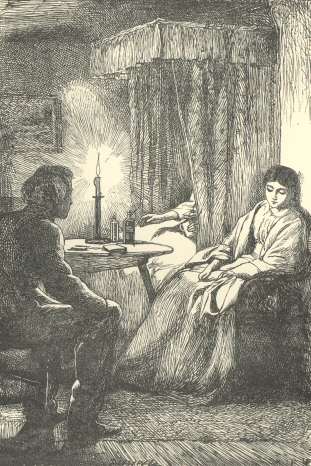
The wounds of which she had spoken, seemed to be about theneck of the self-made outcast. She dressed them now, stillwithout showing her. She steeped a piece of linen in abasin, into which she poured some liquid from a bottle, and laidit with a gentle hand upon the sore. The three-legged tablehad been drawn close to the bedside, and on it there were twobottles. This was one.
It was not so far off, but that Stephen, following her handswith his eyes, could read what was printed on it in largeletters. He turned of a deadly hue, and a sudden horrorseemed to fall upon him.
‘I will stay here, Stephen,’ said Rachael, quietlyresuming her seat, ‘till the bells go Three. ’Tis to be done again at three, and then she may be lefttill morning.’
‘But thy rest agen to-morrow’s work, mydear.’
‘I slept sound last night. I can wake many nights,when I am put to it. ’Tis thou who art in need ofrest—so white and tired. Try to sleep in the chairthere, while I watch. Thou hadst no sleep last night, I canwell believe. To-morrow’s work is far harder for theethan for me.’
He heard the thundering and surging out of doors, and itseemed to him as if his late angry mood were going about tryingto get at him. She had cast it out; she would keep it out;he trusted to her to defend him from himself.
‘She don’t know me, Stephen; she just drowsilymutters and stares. I have spoken to her times and again,but she don’t notice! ’Tis as well so. When she comes to her right mind once more, I shall have donewhat I can, and she never the wiser.’
‘How long, Rachael, is ’t looked for, thatshe’ll be so?’
‘Doctor said she would haply come to her mindto-morrow.’
His eyes fell again on the bottle, and a tremble passed overhim, causing him to shiver in every limb. She thought hewas chilled with the wet. ‘No,’ he said,‘it was not that. He had had a fright.’
‘A fright?’
‘Ay, ay! coming in. When I were walking. When I were thinking. When I—’ It seizedhim again; and he stood up, holding by the mantel-shelf, as hepressed his dank cold hair down with a hand that shook as if itwere palsied.
‘Stephen!’
She was coming to him, but he stretched out his arm to stopher.
‘No! Don’t, please; don’t. Letme see thee setten by the bed. Let me see thee, a’ sogood, and so forgiving. Let me see thee as I see thee whenI coom in. I can never see thee better than so. Never, never, never!’
He had a violent fit of trembling, and then sunk into hischair. After a time he controlled himself, and, restingwith an elbow on one knee, and his head upon that hand, couldlook towards Rachael. Seen across the dim candle with hismoistened eyes, she looked as if she had a glory shining roundher head. He could have believed she had. He didbelieve it, as the noise without shook the window, rattled at thedoor below, and went about the house clamouring andlamenting.
‘When she gets better, Stephen, ’tis to be hopedshe’ll leave thee to thyself again, and do thee no morehurt. Anyways we will hope so now. And now I shallkeep silence, for I want thee to sleep.’
He closed his eyes, more to please her than to rest his wearyhead; but, by slow degrees as he listened to the great noise ofthe wind, he ceased to hear it, or it changed into the working ofhis loom, or even into the voices of the day (his own included)saying what had been really said. Even this imperfectconsciousness faded away at last, and he dreamed a long, troubleddream.
He thought that he, and some one on whom his heart had longbeen set—but she was not Rachael, and that surprised him,even in the midst of his imaginary happiness—stood in thechurch being married. While the ceremony was performing,and while he recognized among the witnesses some whom he knew tobe living, and many whom he knew to be dead, darkness came on,succeeded by the shining of a tremendous light. It brokefrom one line in the table of commandments at the altar, andilluminated the building with the words. They were soundedthrough the church, too, as if there were voices in the fieryletters. Upon this, the whole appearance before him andaround him changed, and nothing was left as it had been, buthimself and the clergyman. They stood in the daylightbefore a crowd so vast, that if all the people in the world couldhave been brought together into one space, they could not havelooked, he thought, more numerous; and they all abhorred him, andthere was not one pitying or friendly eye among the millions thatwere fastened on his face. He stood on a raised stage,under his own loom; and, looking up at the shape the loom took,and hearing the burial service distinctly read, he knew that hewas there to suffer death. In an instant what he stood onfell below him, and he was gone.
—Out of what mystery he came back to his usual life, andto places that he knew, he was unable to consider; but he wasback in those places by some means, and with this condemnationupon him, that he was never, in this world or the next, throughall the unimaginable ages of eternity, to look on Rachael’sface or hear her voice. Wandering to and fro, unceasingly,without hope, and in search of he knew not what (he only knewthat he was doomed to seek it), he was the subject of a nameless,horrible dread, a mortal fear of one particular shape whicheverything took. Whatsoever he looked at, grew into thatform sooner or later. The object of his miserable existencewas to prevent its recognition by any one among the variouspeople he encountered. Hopeless labour! If he ledthem out of rooms where it was, if he shut up drawers and closetswhere it stood, if he drew the curious from places where he knewit to be secreted, and got them out into the streets, the verychimneys of the mills assumed that shape, and round them was theprinted word.
The wind was blowing again, the rain was beating on thehouse-tops, and the larger spaces through which he had strayedcontracted to the four walls of his room. Saving that thefire had died out, it was as his eyes had closed upon it. Rachael seemed to have fallen into a doze, in the chair by thebed. She sat wrapped in her shawl, perfectly still. The table stood in the same place, close by the bedside, and onit, in its real proportions and appearance, was the shape sooften repeated.
He thought he saw the curtain move. He looked again, andhe was sure it moved. He saw a hand come forth and gropeabout a little. Then the curtain moved more perceptibly,and the woman in the bed put it back, and sat up.
With her woful eyes, so haggard and wild, so heavy and large,she looked all round the room, and passed the corner where heslept in his chair. Her eyes returned to that corner, andshe put her hand over them as a shade, while she looked intoit. Again they went all round the room, scarcely heedingRachael if at all, and returned to that corner. He thought,as she once more shaded them—not so much looking at him, aslooking for him with a brutish instinct that he wasthere—that no single trace was left in those debauchedfeatures, or in the mind that went along with them, of the womanhe had married eighteen years before. But that he had seenher come to this by inches, he never could have believed her tobe the same.
All this time, as if a spell were on him, he was motionlessand powerless, except to watch her.
Stupidly dozing, or communing with her incapable self aboutnothing, she sat for a little while with her hands at her ears,and her head resting on them. Presently, she resumed herstaring round the room. And now, for the first time, hereyes stopped at the table with the bottles on it.
Straightway she turned her eyes back to his corner, with thedefiance of last night, and moving very cautiously and softly,stretched out her greedy hand. She drew a mug into the bed,and sat for a while considering which of the two bottles sheshould choose. Finally, she laid her insensate grasp uponthe bottle that had swift and certain death in it, and, beforehis eyes, pulled out the cork with her teeth.
Dream or reality, he had no voice, nor had he power tostir. If this be real, and her allotted time be not yetcome, wake, Rachael, wake!
She thought of that, too. She looked at Rachael, andvery slowly, very cautiously, poured out the contents. Thedraught was at her lips. A moment and she would be past allhelp, let the whole world wake and come about her with its utmostpower. But in that moment Rachael started up with asuppressed cry. The creature struggled, struck her, seizedher by the hair; but Rachael had the cup.
Stephen broke out of his chair. ‘Rachael, am Iwakin’ or dreamin’ this dreadfo’night?’
‘’Tis all well, Stephen. I have been asleep,myself. ’Tis near three. Hush! I hear thebells.’
The wind brought the sounds of the church clock to thewindow. They listened, and it struck three. Stephenlooked at her, saw how pale she was, noted the disorder of herhair, and the red marks of fingers on her forehead, and feltassured that his senses of sight and hearing had beenawake. She held the cup in her hand even now.
‘I thought it must be near three,’ she said,calmly pouring from the cup into the basin, and steeping thelinen as before. ‘I am thankful I stayed! ’Tis done now, when I have put this on. There! And now she’s quiet again. The few drops in the basinI’ll pour away, for ’tis bad stuff to leave about,though ever so little of it.’ As she spoke, shedrained the basin into the ashes of the fire, and broke thebottle on the hearth.
She had nothing to do, then, but to cover herself with hershawl before going out into the wind and rain.
‘Thou’lt let me walk wi’ thee at this hour,Rachael?’
‘No, Stephen. ’Tis but a minute, andI’m home.’
‘Thou’rt not fearfo’;’ he said it in alow voice, as they went out at the door; ‘to leave me alonewi’ her!’
As she looked at him, saying, ‘Stephen?’ he wentdown on his knee before her, on the poor mean stairs, and put anend of her shawl to his lips.
‘Thou art an Angel. Bless thee, blessthee!’
‘I am, as I have told thee, Stephen, thy poorfriend. Angels are not like me. Between them, and aworking woman fu’ of faults, there is a deep gulfset. My little sister is among them, but she ischanged.’
She raised her eyes for a moment as she said the words; andthen they fell again, in all their gentleness and mildness, onhis face.
‘Thou changest me from bad to good. Thoumak’st me humbly wishfo’ to be more like thee, andfearfo’ to lose thee when this life is ower, and a’the muddle cleared awa’. Thou’rt an Angel; itmay be, thou hast saved my soul alive!’
She looked at him, on his knee at her feet, with her shawlstill in p.69his hand, and the reproof on her lips died away when shesaw the working of his face.
‘I coom home desp’rate. I coom homewi’out a hope, and mad wi’ thinking that when I saida word o’ complaint I was reckoned a unreasonableHand. I told thee I had had a fright. It were thePoison-bottle on table. I never hurt a livin’creetur; but happenin’ so suddenly upon ’t, I thowt,“How can Isay what I might ha’ done tomyseln, or her, or both!”’
She put her two hands on his mouth, with a face of terror, tostop him from saying more. He caught them in his unoccupiedhand, and holding them, and still clasping the border of hershawl, said hurriedly:
‘But I see thee, Rachael, setten by the bed. Iha’ seen thee, aw this night. In my troublous sleep Iha’ known thee still to be there. Evermore I will seethee there. I nevermore will see her or think o’ her,but thou shalt be beside her. I nevermore will see or thinko’ anything that angers me, but thou, so much better thanme, shalt be by th’ side on’t. And so I willtry t’ look t’ th’ time, and so I will tryt’ trust t’ th’ time, when thou and me at lastshall walk together far awa’, beyond the deep gulf, inth’ country where thy little sister is.’
He kissed the border of her shawl again, and let her go. She bade him good night in a broken voice, and went out into thestreet.
The wind blew from the quarter where the day would soonappear, and still blew strongly. It had cleared the skybefore it, and the rain had spent itself or travelled elsewhere,and the stars were bright. He stood bare-headed in theroad, watching her quick disappearance. As the shiningstars were to the heavy candle in the window, so was Rachael, inthe rugged fancy of this man, to the common experiences of hislife.
CHAPTER XIV
THE GREAT MANUFACTURER
Time went on in Coketown like itsown machinery: so much material wrought up, so much fuelconsumed, so many powers worn out, so much money made. But,less inexorable than iron, steel, and brass, it brought itsvarying seasons even into that wilderness of smoke and brick, andmade the only stand that ever wasmade in the placeagainst its direful uniformity.
‘Louisa is becoming,’ said Mr. Gradgrind,‘almost a young woman.’
Time, with his innumerable horse-power, worked away, notminding what anybody said, and presently turned out young Thomasa foot taller than when his father had last taken particularnotice of him.
‘Thomas is becoming,’ said Mr. Gradgrind,‘almost a young man.’
Time passed Thomas on in the mill, while his father wasthinking about it, and there he stood in a long-tailed coat and astiff shirt-collar.
‘Really,’ said Mr. Gradgrind, ‘the periodhas arrived when Thomas ought to go to Bounderby.’
Time, sticking to him, passed him on into Bounderby’sBank, made him an inmate of Bounderby’s house, necessitatedthe purchase of his first razor, and exercised him diligently inhis calculations relative to number one.
The same great manufacturer, always with an immense variety ofwork on hand, in every stage of development, passed Sissy onwardin his mill, and worked her up into a very pretty articleindeed.
‘I fear, Jupe,’ said Mr. Gradgrind, ‘thatyour continuance at the school any longer would beuseless.’
‘I am afraid it would, sir,’ Sissy answered with acurtsey.
‘I cannot disguise from you, Jupe,’ said Mr.Gradgrind, knitting his brow, ‘that the result of yourprobation there has disappointed me; has greatly disappointedme. You have not acquired, under Mr. and Mrs.M’Choakumchild, anything like that amount of exactknowledge which I looked for. You are extremely deficientin your facts. Your acquaintance with figures is verylimited. You are altogether backward, and below themark.’
‘I am sorry, sir,’ she returned; ‘but I knowit is quite true. Yet I have tried hard, sir.’
‘Yes,’ said Mr. Gradgrind, ‘yes, I believeyou have tried hard; I have observed you, and I can find no faultin that respect.’
‘Thank you, sir. I have thought sometimes;’Sissy very timid here; ‘that perhaps I tried to learn toomuch, and that if I had asked to be allowed to try a little less,I might have—’
‘No, Jupe, no,’ said Mr. Gradgrind, shaking hishead in his profoundest and most eminently practical way. ‘No. The course you pursued, you pursued according tothe system—the system—and there is no more to be saidabout it. I can only suppose that the circumstances of yourearly life were too unfavourable to the development of yourreasoning powers, and that we began too late. Still, as Ihave said already, I am disappointed.’
‘I wish I could have made a better acknowledgment, sir,of your kindness to a poor forlorn girl who had no claim uponyou, and of your protection of her.’
‘Don’t shed tears,’ said Mr.Gradgrind. ‘Don’t shed tears. Idon’t complain of you. You are an affectionate,earnest, good young woman—and—and we must make thatdo.’
‘Thank you, sir, very much,’ said Sissy, with agrateful curtsey.
‘You are useful to Mrs. Gradgrind, and (in a generallypervading way) you are serviceable in the family also; so Iunderstand from Miss Louisa, and, indeed, so I have observedmyself. I therefore hope,’ said Mr. Gradgrind,‘that you can make yourself happy in thoserelations.’
‘I should have nothing to wish, sir,if—’
‘I understand you,’ said Mr. Gradgrind; ‘youstill refer to your father. I have heard from Miss Louisathat you still preserve that bottle. Well! If yourtraining in the science of arriving at exact results had beenmore successful, you would have been wiser on these points. I will say no more.’
He really liked Sissy too well to have a contempt for her;otherwise he held her calculating powers in such very slightestimation that he must have fallen upon that conclusion. Somehow or other, he had become possessed by an idea that therewas something in this girl which could hardly be set forth in atabular form. Her capacity of definition might be easilystated at a very low figure, her mathematical knowledge atnothing; yet he was not sure that if he had been required, forexample, to tick her off into columns in a parliamentary return,he would have quite known how to divide her.
In some stages of his manufacture of the human fabric, theprocesses of Time are very rapid. Young Thomas and Sissybeing both at such a stage of their working up, these changeswere effected in a year or two; while Mr. Gradgrind himselfseemed stationary in his course, and underwent no alteration.
Except one, which was apart from his necessary progressthrough the mill. Time hustled him into a little noisy andrather dirty machinery, in a by-comer, and made him Member ofParliament for Coketown: one of the respected members for ounceweights and measures, one of the representatives of themultiplication table, one of the deaf honourable gentlemen, dumbhonourable gentlemen, blind honourable gentlemen, lame honourablegentlemen, dead honourable gentlemen, to every otherconsideration. Else wherefore live we in a Christian land,eighteen hundred and odd years after our Master?
All this while, Louisa had been passing on, so quiet andreserved, and so much given to watching the bright ashes attwilight as they fell into the grate, and became extinct, thatfrom the period when her father had said she was almost a youngwoman—which seemed but yesterday—she had scarcelyattracted his notice again, when he found her quite a youngwoman.
‘Quite a young woman,’ said Mr. Gradgrind,musing. ‘Dear me!’
Soon after this discovery, he became more thoughtful thanusual for several days, and seemed much engrossed by onesubject. On a certain night, when he was going out, andLouisa came to bid him good-bye before his departure—as hewas not to be home until late and she would not see him againuntil the morning—he held her in his arms, looking at herin his kindest manner, and said:
‘My dear Louisa, you are a woman!’
She answered with the old, quick, searching look of the nightwhen she was found at the Circus; then cast down her eyes. ‘Yes, father.’
‘My dear,’ said Mr. Gradgrind, ‘I must speakwith you alone and seriously. Come to me in my room afterbreakfast to-morrow, will you?’
‘Yes, father.’
‘Your hands are rather cold, Louisa. Are you notwell?’
‘Quite well, father.’
‘And cheerful?’
She looked at him again, and smiled in her peculiarmanner. ‘I am as cheerful, father, as I usually am,or usually have been.’
‘That’s well,’ said Mr. Gradgrind. So,he kissed her and went away; and Louisa returned to the sereneapartment of the hair-cutting character, and leaning her elbow onher hand, looked again at the short-lived sparks that so soonsubsided into ashes.
‘Are you there, Loo?’ said her brother, looking inat the door. He was quite a young gentleman of pleasurenow, and not quite a prepossessing one.
‘Dear Tom,’ she answered, rising and embracinghim, ‘how long it is since you have been to seeme!’
‘Why, I have been otherwise engaged, Loo, in theevenings; and in the daytime old Bounderby has been keeping me atit rather. But I touch him up with you when he comes it toostrong, and so we preserve an understanding. I say! Has father said anything particular to you to-day or yesterday,Loo?’
‘No, Tom. But he told me to-night that he wishedto do so in the morning.’
‘Ah! That’s what I mean,’ saidTom. ‘Do you know where he isto-night?’—with a very deep expression.
‘No.’
‘Then I’ll tell you. He’s with oldBounderby. They are having a regular confab together up atthe Bank. Why at the Bank, do you think? Well,I’ll tell you again. To keep Mrs. Sparsit’sears as far off as possible, I expect.’
With her hand upon her brother’s shoulder, Louisa stillstood looking at the fire. Her brother glanced at her facewith greater interest than usual, and, encircling her waist withhis arm, drew her coaxingly to him.
p.73‘You are very fond of me, an’t you,Loo?’
‘Indeed I am, Tom, though you do let such long intervalsgo by without coming to see me.’
‘Well, sister of mine,’ said Tom, ‘when yousay that, you are near my thoughts. We might be so muchoftener together—mightn’t we? Always together,almost—mightn’t we? It would do me a great dealof good if you were to make up your mind to I know what,Loo. It would be a splendid thing for me. It would beuncommonly jolly!’
Her thoughtfulness baffled his cunning scrutiny. Hecould make nothing of her face. He pressed her in his arm,and kissed her cheek. She returned the kiss, but stilllooked at the fire.
‘I say, Loo! I thought I’d come, and justhint to you what was going on: though I supposed you’d mostlikely guess, even if you didn’t know. I can’tstay, because I’m engaged to some fellows to-night. You won’t forget how fond you are of me?’
‘No, dear Tom, I won’t forget.’
‘That’s a capital girl,’ said Tom. ‘Good-bye, Loo.’
She gave him an affectionate good-night, and went out with himto the door, whence the fires of Coketown could be seen, makingthe distance lurid. She stood there, looking steadfastlytowards them, and listening to his departing steps. Theyretreated quickly, as glad to get away from Stone Lodge; and shestood there yet, when he was gone and all was quiet. Itseemed as if, first in her own fire within the house, and then inthe fiery haze without, she tried to discover what kind of woofOld Time, that greatest and longest-established Spinner of all,would weave from the threads he had already spun into awoman. But his factory is a secret place, his work isnoiseless, and his Hands are mutes.
CHAPTER XV
FATHER AND DAUGHTER
Although Mr. Gradgrind did not takeafter Blue Beard, his room was quite a blue chamber in itsabundance of blue books. Whatever they could prove (whichis usually anything you like), they proved there, in an armyconstantly strengthening by the arrival of new recruits. Inthat charmed apartment, the most complicated social questionswere cast up, got into exact totals, and finally settled—ifthose concerned could only have been brought to know it. Asif an astronomical observatory should be made without anywindows, and the astronomer within should arrange the starryuniverse solely by pen, ink, and paper, so Mr. Gradgrind, inhisObservatory (and there are many like it), had no needto cast an eye upon the teeming myriads of human beings aroundhim, but could settle all their destinies on a slate, and wipeout all their tears with one dirty little bit of sponge.
To this Observatory, then: a stern room, with a deadlystatistical clock in it, which measured every second with a beatlike a rap upon a coffin-lid; Louisa repaired on the appointedmorning. A window looked towards Coketown; and when she satdown near her father’s table, she saw the high chimneys andthe long tracts of smoke looming in the heavy distancegloomily.
‘My dear Louisa,’ said her father, ‘Iprepared you last night to give me your serious attention in theconversation we are now going to have together. You havebeen so well trained, and you do, I am happy to say, so muchjustice to the education you have received, that I have perfectconfidence in your good sense. You are not impulsive, youare not romantic, you are accustomed to view everything from thestrong dispassionate ground of reason and calculation. Fromthat ground alone, I know you will view and consider what I amgoing to communicate.’
He waited, as if he would have been glad that she saidsomething. But she said never a word.
‘Louisa, my dear, you are the subject of a proposal ofmarriage that has been made to me.’
Again he waited, and again she answered not one word. This so far surprised him, as to induce him gently to repeat,‘a proposal of marriage, my dear.’ To which shereturned, without any visible emotion whatever:
‘I hear you, father. I am attending, I assureyou.’
‘Well!’ said Mr. Gradgrind, breaking into a smile,after being for the moment at a loss, ‘you are even moredispassionate than I expected, Louisa. Or, perhaps, you arenot unprepared for the announcement I have it in charge tomake?’
‘I cannot say that, father, until I hear it. Prepared or unprepared, I wish to hear it all from you. Iwish to hear you state it to me, father.’
Strange to relate, Mr. Gradgrind was not so collected at thismoment as his daughter was. He took a paper-knife in hishand, turned it over, laid it down, took it up again, and eventhen had to look along the blade of it, considering how to goon.
‘What you say, my dear Louisa, is perfectlyreasonable. I have undertaken then to let you knowthat—in short, that Mr. Bounderby has informed me that hehas long watched your progress with particular interest andpleasure, and has long hoped that the time might ultimatelyarrive when he should offer you his hand in marriage. Thattime, to which he has so long, and certainly with greatconstancy, looked forward, is now come. Mr. Bounderby hasmade his proposal of marriage to me, and has entreated me to makeit known to you, and to express his hope that you will take itinto your favourable consideration.’
Silence between them. The deadly statistical clock veryhollow. The distant smoke very black and heavy.
‘Father,’ said Louisa, ‘do you think I loveMr. Bounderby?’
Mr. Gradgrind was extremely discomfited by this unexpectedquestion. ‘Well, my child,’ he returned,‘I—really—cannot take upon myself tosay.’
‘Father,’ pursued Louisa in exactly the same voiceas before, ‘do you ask me to love Mr. Bounderby?’
‘My dear Louisa, no. No. I asknothing.’
‘Father,’ she still pursued, ‘does Mr.Bounderby ask me to love him?’
‘Really, my dear,’ said Mr. Gradgrind, ‘itis difficult to answer your question—’
‘Difficult to answer it, Yes or No, father?
‘Certainly, my dear. Because;’ here wassomething to demonstrate, and it set him up again; ‘becausethe reply depends so materially, Louisa, on the sense in which weuse the expression. Now, Mr. Bounderby does not do you theinjustice, and does not do himself the injustice, of pretendingto anything fanciful, fantastic, or (I am using synonymous terms)sentimental. Mr. Bounderby would have seen you grow upunder his eyes, to very little purpose, if he could so far forgetwhat is due to your good sense, not to say to his, as to addressyou from any such ground. Therefore, perhaps the expressionitself—I merely suggest this to you, my dear—may be alittle misplaced.’
‘What would you advise me to use in its stead,father?’
‘Why, my dear Louisa,’ said Mr. Gradgrind,completely recovered by this time, ‘I would advise you(since you ask me) to consider this question, as you have beenaccustomed to consider every other question, simply as one oftangible Fact. The ignorant and the giddy may embarrasssuch subjects with irrelevant fancies, and other absurdities thathave no existence, properly viewed—really noexistence—but it is no compliment to you to say, that youknow better. Now, what are the Facts of this case? You are, we will say in round numbers, twenty years of age; Mr.Bounderby is, we will say in round numbers, fifty. There issome disparity in your respective years, but in your means andpositions there is none; on the contrary, there is a greatsuitability. Then the question arises, Is this onedisparity sufficient to operate as a bar to such amarriage? In considering this question, it is notunimportant to take into account the statistics of marriage, sofar as they have yet been obtained, in England and Wales. Ifind, on reference to the figures, that a large proportion ofthese marriages are contracted between parties of very unequalages, and that the elder of these contracting parties is, inrather more than three-fourths of these instances, thebridegroom. It is remarkable as showing the wide prevalenceof this law, that among the natives of the British possessions inIndia, also in a considerable part of China, and among theCalmucks of Tartary, the best means of computation yet furnishedus by travellers, yield similar results. The disparity Ihave mentioned, therefore, almost ceases to be disparity, and(virtually) all but disappears.’
‘What do you recommend, father,’ asked Louisa, herreserved composure not in the least affected by these gratifyingresults, ‘that I should substitute for the term I used justnow? For the misplaced expression?’
‘Louisa,’ returned her father, ‘it appearsto me that nothing can be plainer. Confining yourselfrigidly to Fact, the question of Fact you state to yourself is:Does Mr. Bounderby ask me to marry him? Yes, he does. The sole remaining question then is: Shall I marry him? Ithink nothing can be plainer than that?’
‘Shall I marry him?’ repeated Louisa, with greatdeliberation.
‘Precisely. And it is satisfactory to me, as yourfather, my dear Louisa, to know that you do not come to theconsideration of that question with the previous habits of mind,and habits of life, that belong to many young women.’
‘No, father,’ she returned, ‘I donot.’
‘I now leave you to judge for yourself,’ said Mr.Gradgrind. ‘I have stated the case, as such cases areusually stated among practical minds; I have stated it, as thecase of your mother and myself was stated in its time. Therest, my dear Louisa, is for you to decide.’
From the beginning, she had sat looking at him fixedly. As he now leaned back in his chair, and bent his deep-set eyesupon her in his turn, perhaps he might have seen one waveringmoment in her, when she was impelled to throw herself upon hisbreast, and give him the pent-up confidences of her heart. But, to see it, he must have overleaped at a bound the artificialbarriers he had for many years been erecting, between himself andall those subtle essences of humanity which will elude the utmostcunning of algebra until the last trumpet ever to be soundedshall blow even algebra to wreck. The barriers were toomany and too high for such a leap. With his unbending,utilitarian, matter-of-fact face, he hardened her again; and themoment shot away into the plumbless depths of the past, to minglewith all the lost opportunities that are drowned there.
Removing her eyes from him, she sat so long looking silentlytowards the town, that he said, at length: ‘Are youconsulting the chimneys of the Coketown works, Louisa?’
‘There seems to be nothing there but languid andmonotonous smoke. Yet when the night comes, Fire burstsout, father!’ she answered, turning quickly.
‘Of course I know that, Louisa. I do not see theapplication of the remark.’ To do him justice he didnot, at all.
She passed it away with a slight motion of her hand, andconcentrating her attention upon him again, said, ‘Father,I have often thought that life is very short.’—Thiswas so distinctly one of his subjects that he interposed.
‘It is short, no doubt, my dear. Still, theaverage duration of human life is proved to have increased oflate years. The calculations of various life assurance andannuity offices, among other figures which cannot go wrong, haveestablished the fact.’
‘I speak of my own life, father.’
‘O indeed? Still,’ said Mr. Gradgrind,‘I need not point out to you, Louisa, that it is governedby the laws which govern lives in the aggregate.’
‘While it lasts, I would wish to do the little I can,and the little I am fit for. What does itmatter?’
Mr. Gradgrind seemed rather at a loss to understand the lastfour words; replying, ‘How, matter? What matter, mydear?’
‘Mr. Bounderby,’ she went on in a steady, straightway, without regarding this, ‘asks me to marry him. The question I have to ask myself is, shall I marry him? That is so, father, is it not? You have told me so,father. Have you not?’
‘Certainly, my dear.’
‘Let it be so. Since Mr. Bounderby likes to takeme thus, I am satisfied to accept his proposal. Tell him,father, as soon as you please, that this was my answer. Repeat it, word for word, if you can, because I should wish himto know what I said.’
‘It is quite right, my dear,’ retorted her fatherapprovingly, ‘to be exact. I will observe your veryproper request. Have you any wish in reference to theperiod of your marriage, my child?’
‘None, father. What does it matter!’
Mr. Gradgrind had drawn his chair a little nearer to her, andtaken her hand. But, her repetition of these words seemedto strike with some little discord on his ear. He paused tolook at her, and, still holding her hand, said:
‘Louisa, I have not considered it essential to ask youone question, because the possibility implied in it appeared tome to be too remote. But perhaps I ought to do so. You have never entertained in secret any otherproposal?’
‘Father,’ she returned, almost scornfully,‘what other proposal can have been made to me? Whom have I seen? Where have I been? What are myheart’s experiences?’
‘My dear Louisa,’ returned Mr. Gradgrind,reassured and satisfied. ‘You correct mejustly. I merely wished to discharge my duty.’
‘What do Iknow, father,’ said Louisa inher quiet manner, ‘of tastes and fancies; of aspirationsand affections; of all that part of my nature in which such lightthings might have been nourished? What escape have I hadfrom problems that could be demonstrated, and realities thatcould be grasped?’ As she said it, she unconsciouslyclosed her hand, as if upon a solid object, and slowly opened itas though she were releasing dust or ash.
‘My dear,’ assented her eminently practicalparent, ‘quite true, quite true.’
‘Why, father,’ she pursued, ‘what a strangequestion to ask me! The baby-preference that even Ihave heard of as common among children, has never had itsinnocent resting-place in my breast. You have been socareful of me, that I never had a child’s heart. Youhave trained me so well, that I never dreamed a child’sdream. You have dealt so wisely with me, father, from mycradle to this hour, that I never had a child’s belief or achild’s fear.’
Mr. Gradgrind was quite moved by his success, and by thistestimony to it. ‘My dear Louisa,’ said he,‘you abundantly repay my care. Kiss me, my deargirl.’
So, his daughter kissed him. Detaining her in hisembrace, he said, ‘I may assure you now, my favouritechild, that I am made happy by the sound decision at which youhave arrived. Mr. Bounderby is a very remarkable man; andwhat little disparity can be said to exist between you—ifany—is more than counterbalanced by the tone your mind hasacquired. It has always been my object so to educate you,as that you might, while still in your early youth, be (if I mayso express myself) almost any age. Kiss me once more,Louisa. Now, let us go and find your mother.’
Accordingly, they went down to the drawing-room, where theesteemed lady with no nonsense about her, was recumbent as usual,while Sissy worked beside her. She gave some feeble signsof returning animation when they entered, and presently the fainttransparency was presented in a sitting attitude.
‘Mrs. Gradgrind,’ said her husband, who had waitedfor the achievement of this feat with some impatience,‘allow me to present to you Mrs. Bounderby.’
‘Oh!’ said Mrs. Gradgrind, ‘so you havesettled it! Well, I’m sure I hope your health may begood, Louisa; for if your head begins to split as soon as you aremarried, which was the case with mine, I cannot consider that youare to be envied, though I have no doubt you think you are, asall girls do. However, I give you p. 79joy, mydear—and I hope you may now turn all your ological studiesto good account, I am sure I do! I must give you a kiss ofcongratulation, Louisa; but don’t touch my right shoulder,for there’s something running down it all day long. And now you see,’ whimpered Mrs. Gradgrind, adjusting hershawls after the affectionate ceremony, ‘I shall beworrying myself, morning, noon, and night, to know what I am tocall him!’
‘Mrs. Gradgrind,’ said her husband, solemnly,‘what do you mean?’
‘Whatever I am to call him, Mr. Gradgrind, when he ismarried to Louisa! I must call him something. It’s impossible,’ said Mrs. Gradgrind, with a mingledsense of politeness and injury, ‘to be constantlyaddressing him and never giving him a name. I cannot callhim Josiah, for the name is insupportable to me. Youyourself wouldn’t hear of Joe, you very well know. AmI to call my own son-in-law, Mister! Not, I believe, unlessthe time has arrived when, as an invalid, I am to be trampledupon by my relations. Then, what am I to callhim!’
Nobody present having any suggestion to offer in theremarkable emergency, Mrs. Gradgrind departed this life for thetime being, after delivering the following codicil to her remarksalready executed:
‘As to the wedding, all I ask, Louisa, is,—and Iask it with a fluttering in my chest, which actually extends tothe soles of my feet,—that it may take place soon. Otherwise, I know it is one of those subjects I shall never hearthe last of.’
When Mr. Gradgrind had presented Mrs. Bounderby, Sissy hadsuddenly turned her head, and looked, in wonder, in pity, insorrow, in doubt, in a multitude of emotions, towardsLouisa. Louisa had known it, and seen it, without lookingat her. From that moment she was impassive, proud andcold—held Sissy at a distance—changed to heraltogether.
CHAPTER XVI
HUSBAND AND WIFE
Mr. Bounderby’s firstdisquietude on hearing of his happiness, was occasioned by thenecessity of imparting it to Mrs. Sparsit. He could notmake up his mind how to do that, or what the consequences of thestep might be. Whether she would instantly depart, bag andbaggage, to Lady Scadgers, or would positively refuse to budgefrom the premises; whether she would be plaintive or abusive,tearful or tearing; whether she would break her heart, or breakthe looking-glass; Mr. Bounderby could not all foresee. However, as it must be done, he had no choice but to do it; so,after attempting several letters, and failing in them all, heresolved to do it by word of mouth.
On his way home, on the evening he set aside for thismomentous purpose, he took the precaution of stepping into achemist’s shop and buying a bottle of the very strongestsmelling-salts. ‘By George!’ said Mr.Bounderby, ‘if she takes it in the fainting way, I’llhave the skin off her nose, at all events!’ But, inspite of being thus forearmed, he entered his own house withanything but a courageous air; and appeared before the object ofhis misgivings, like a dog who was conscious of coming directfrom the pantry.
‘Good evening, Mr. Bounderby!’
‘Good evening, ma’am, good evening.’ He drew up his chair, and Mrs. Sparsit drew back hers, as whoshould say, ‘Your fireside, sir. I freely admitit. It is for you to occupy it all, if you thinkproper.’
‘Don’t go to the North Pole, ma’am!’said Mr. Bounderby.
‘Thank you, sir,’ said Mrs. Sparsit, and returned,though short of her former position.
Mr. Bounderby sat looking at her, as, with the points of astiff, sharp pair of scissors, she picked out holes for someinscrutable ornamental purpose, in a piece of cambric. Anoperation which, taken in connexion with the bushy eyebrows andthe Roman nose, suggested with some liveliness the idea of a hawkengaged upon the eyes of a tough little bird. She was sosteadfastly occupied, that many minutes elapsed before she lookedup from her work; when she did so Mr. Bounderby bespoke herattention with a hitch of his head.
‘Mrs. Sparsit, ma’am,’ said Mr. Bounderby,putting his hands in his pockets, and assuring himself with hisright hand that the cork of the little bottle was ready for use,‘I have no occasion to say to you, that you are not only alady born and bred, but a devilish sensible woman.’
‘Sir,’ returned the lady, ‘this is indeednot the first time that you have honoured me with similarexpressions of your good opinion.’
‘Mrs. Sparsit, ma’am,’ said Mr. Bounderby,‘I am going to astonish you.’
‘Yes, sir?’ returned Mrs. Sparsit,interrogatively, and in the most tranquil manner possible. She generally wore mittens, and she now laid down her work, andsmoothed those mittens.
‘I am going, ma’am,’ said Bounderby,‘to marry Tom Gradgrind’s daughter.’
‘Yes, sir,’ returned Mrs. Sparsit. ‘Ihope you may be happy, Mr. Bounderby. Oh, indeed I hope youmay be happy, sir!’ And she said it with such greatcondescension as well as with such great compassion for him, thatBounderby,—far more disconcerted than if she had thrown herworkbox at the mirror, or swooned on the hearthrug,—corkedup the smelling-salts tight in his pocket, and thought,‘Now confound this woman, who could have even guessed thatshe would take it in this way!’
‘I wish with all my heart, sir,’ said Mrs.Sparsit, in a highly superior manner; somehow she seemed, in amoment, to have established a right to pity him ever afterwards;‘that you may be in all respects very happy.’
‘Well, ma’am,’ returned Bounderby, with someresentment in his tone: which was clearly lowered, though inspite of himself, ‘I am obliged to you. I hope Ishall be.’
‘Doyou, sir!’ said Mrs. Sparsit, withgreat affability. ‘But naturally you do; of courseyou do.’
A very awkward pause on Mr. Bounderby’s part,succeeded. Mrs. Sparsit sedately resumed her work andoccasionally gave a small cough, which sounded like the cough ofconscious strength and forbearance.
‘Well, ma’am,’ resumed Bounderby,‘under these circumstances, I imagine it would not beagreeable to a character like yours to remain here, though youwould be very welcome here.’
‘Oh, dear no, sir, I could on no account think ofthat!’ Mrs. Sparsit shook her head, still in her highlysuperior manner, and a little changed the smallcough—coughing now, as if the spirit of prophecy rosewithin her, but had better be coughed down.
‘However, ma’am,’ said Bounderby,‘there are apartments at the Bank, where a born and bredlady, as keeper of the place, would be rather a catch thanotherwise; and if the same terms—’
‘I beg your pardon, sir. You were so good as topromise that you would always substitute the phrase, annualcompliment.’
‘Well, ma’am, annual compliment. If the sameannual compliment would be acceptable there, why, I see nothingto part us, unless you do.’
‘Sir,’ returned Mrs. Sparsit. ‘Theproposal is like yourself, and if the position I shall assume atthe Bank is one that I could occupy without descending lower inthe social scale—’
‘Why, of course it is,’ said Bounderby. ‘If it was not, ma’am, you don’t suppose that Ishould offer it to a lady who has moved in the society you havemoved in. Not that Icare for such society, youknow! But youdo.’
‘Mr. Bounderby, you are very considerate.’
‘You’ll have your own private apartments, andyou’ll have your coals and your candles, and all the restof it, and you’ll have your maid to attend upon you, andyou’ll have your light porter to protect you, andyou’ll be what I take the liberty of considering preciouscomfortable,’ said Bounderby.
‘Sir,’ rejoined Mrs. Sparsit, ‘say nomore. In yielding up my trust here, I shall not be freedfrom the necessity of eating the bread of dependence:’ shemight have said the sweetbread, for that delicate article in asavoury brown sauce was her favourite supper: ‘and I wouldrather receive it from your hand, than from any other. Therefore, sir, I accept your offer gratefully, and with manysincere acknowledgments for past favours. And I hope,sir,’ said Mrs. Sparsit, concluding in an impressivelycompassionate manner, ‘I fondly hope that Miss Gradgrindmay be all you desire, and deserve!’
Nothing moved Mrs. Sparsit from that position any more. It was in vain for Bounderby to bluster or to assert himself inany of his explosive ways; Mrs. Sparsit was resolved to havecompassion on him, as a Victim. She was polite, obliging,cheerful, hopeful; but, the more polite, the more obliging, themore cheerful, the more hopeful, the more exemplary altogether,she; the forlorner Sacrifice and Victim, he. She had thattenderness for his melancholy fate, that his great redcountenance used to break out into cold perspirations when shelooked at him.
Meanwhile the marriage was appointed to be solemnized in eightweeks’ time, and Mr. Bounderby went every evening to StoneLodge as an accepted wooer. Love was made on theseoccasions in the form of bracelets; and, on all occasions duringthe period of betrothal, took a manufacturing aspect. Dresses were made, jewellery was made, cakes and gloves weremade, settlements were made, and an extensive assortment of Factsdid appropriate honour to the contract. The business wasall Fact, from first to last. The Hours did not go throughany of those rosy performances, which foolish poets have ascribedto them at such times; neither did the clocks go any faster, orany slower, than at other seasons. The deadly statisticalrecorder in the Gradgrind observatory knocked every second on thehead as it was born, and buried it with his accustomedregularity.
So the day came, as all other days come to people who willonly stick to reason; and when it came, there were married in thechurch of the florid wooden legs—that popular order ofarchitecture—Josiah Bounderby Esquire of Coketown, toLouisa eldest daughter of Thomas Gradgrind Esquire of StoneLodge, M.P. for that borough. And when they were united inholy matrimony, they went home to breakfast at Stone Lodgeaforesaid.
There was an improving party assembled on the auspiciousoccasion, who knew what everything they had to eat and drink wasmade of, and how it was imported or exported, and in whatquantities, and in what bottoms, whether native or foreign, andall about it. The bridesmaids, down to little JaneGradgrind, were, in an intellectual point of view, fit helpmatesfor the calculating boy; and there was no nonsense about any ofthe company.
After breakfast, the bridegroom addressed them in thefollowing terms:
‘Ladies and gentlemen, I am Josiah Bounderby ofCoketown. Since you have done my wife and myself the honourof drinking our healths and happiness, I suppose I mustacknowledge the same; though, as you all know me, and know what Iam, and what my extraction was, you won’t expect a speechfrom a man who, when he sees a Post, says “that’s aPost,” and when he sees a Pump, says “that’s aPump,” and is not to be got to call a Post a Pump, or aPump a Post, or either of them a Toothpick. If you want aspeech this morning, my friend and father-in-law, Tom Gradgrind,is a Member of Parliament, and you know where to get it. Iam not your man. However, if I feel a little independentwhen I look around this table to-day, and reflect how little Ithought of marrying Tom Gradgrind’s daughter when I was aragged street-boy, who never washed his face unless it was at apump, and that not oftener than once a fortnight, I hope I may beexcused. So, I hope you like my feeling independent; if youdon’t, I can’t help it. I dofeelindependent. Now I have mentioned, and you have mentioned,that I am this day married to Tom Gradgrind’sdaughter. I am very glad to be so. It has long beenmy wish to be so. I have watched her bringing-up, and Ibelieve she is worthy of me. At the same time—not todeceive you—I believe I am worthy of her. So, I thankyou, on both our parts, for the good-will you have shown towardsus; and the best wish I can give the unmarried part of thepresent company, is this: I hope every bachelor may find as gooda wife as I have found. And I hope every spinster may findas good a husband as my wife has found.’
Shortly after which oration, as they were going on a nuptialtrip to Lyons, in order that Mr. Bounderby might take theopportunity of seeing how the Hands got on in those parts, andwhether they, too, required to be fed with gold spoons; the happypair departed for the railroad. The bride, in passingdown-stairs, dressed for her journey, found Tom waiting forher—flushed, either with his feelings, or the vinous partof the breakfast.
‘What a game girl you are, to be such a first-ratesister, Loo!’ whispered Tom.
She clung to him as she should have clung to some far betternature that day, and was a little shaken in her reservedcomposure for the first time.
‘Old Bounderby’s quite ready,’ saidTom. ‘Time’s up. Good-bye! I shallbe on the look-out for you, when you come back. I say, mydear Loo! An’t ituncommonly jolly now!’
END OF THEFIRST BOOK
p. 84BOOKTHE SECOND
REAPING
CHAPTER I
EFFECTS IN THE BANK
A sunny midsummer day. Therewas such a thing sometimes, even in Coketown.
Seen from a distance in such weather, Coketown lay shrouded ina haze of its own, which appeared impervious to the sun’srays. You only knew the town was there, because you knewthere could have been no such sulky blotch upon the prospectwithout a town. A blur of soot and smoke, now confusedlytending this way, now that way, now aspiring to the vault ofHeaven, now murkily creeping along the earth, as the wind roseand fell, or changed its quarter: a dense formless jumble, withsheets of cross light in it, that showed nothing but masses ofdarkness:—Coketown in the distance was suggestive ofitself, though not a brick of it could be seen.
The wonder was, it was there at all. It had been ruinedso often, that it was amazing how it had borne so manyshocks. Surely there never was such fragile china-ware asthat of which the millers of Coketown were made. Handlethem never so lightly, and they fell to pieces with such easethat you might suspect them of having been flawed before. They were ruined, when they were required to send labouringchildren to school; they were ruined when inspectors wereappointed to look into their works; they were ruined, when suchinspectors considered it doubtful whether they were quitejustified in chopping people up with their machinery; they wereutterly undone, when it was hinted that perhaps they need notalways make quite so much smoke. Besides Mr.Bounderby’s gold spoon which was generally received inCoketown, another prevalent fiction was very popular there. It took the form of a threat. Whenever a Coketowner felt hewas ill-used—that is to say, whenever he was not leftentirely alone, and it was proposed to hold him accountable forthe consequences of any of his acts—he was sure to come outwith the awful menace, that he would ‘sooner pitch hisproperty into the Atlantic.’ This had terrified theHome Secretary within an inch of his life, on severaloccasions.
However, the Coketowners were so patriotic after all, thatthey never had pitched their property into the Atlantic yet, but,on the contrary, had been kind enough to take mighty good care ofit. So there it was, in the haze yonder; and it increasedand multiplied.
The streets were hot and dusty on the summer day, and the sunwas so bright that it even shone through the heavy vapourdrooping over Coketown, and could not be looked atsteadily. Stokers emerged from low underground doorwaysinto factory yards, and sat on steps, and posts, and palings,wiping their swarthy visages, and contemplating coals. Thewhole town seemed to be frying in oil. There was a stiflingsmell of hot oil everywhere. The steam-engines shone withit, the dresses of the Hands were soiled with it, the millsthroughout their many stories oozed and trickled it. Theatmosphere of those Fairy palaces was like the breath of thesimoom: and their inhabitants, wasting with heat, toiledlanguidly in the desert. But no temperature made themelancholy mad elephants more mad or more sane. Theirwearisome heads went up and down at the same rate, in hot weatherand cold, wet weather and dry, fair weather and foul. Themeasured motion of their shadows on the walls, was the substituteCoketown had to show for the shadows of rustling woods; while,for the summer hum of insects, it could offer, all the yearround, from the dawn of Monday to the night of Saturday, thewhirr of shafts and wheels.
Drowsily they whirred all through this sunny day, making thepassenger more sleepy and more hot as he passed the humming wallsof the mills. Sun-blinds, and sprinklings of water, alittle cooled the main streets and the shops; but the mills, andthe courts and alleys, baked at a fierce heat. Down uponthe river that was black and thick with dye, some Coketown boyswho were at large—a rare sight there—rowed a crazyboat, which made a spumous track upon the water as it joggedalong, while every dip of an oar stirred up vile smells. But the sun itself, however beneficent, generally, was less kindto Coketown than hard frost, and rarely looked intently into anyof its closer regions without engendering more death thanlife. So does the eye of Heaven itself become an evil eye,when incapable or sordid hands are interposed between it and thethings it looks upon to bless.
Mrs. Sparsit sat in her afternoon apartment at the Bank, onthe shadier side of the frying street. Office-hours wereover: and at that period of the day, in warm weather, she usuallyembellished with her genteel presence, a managerial board-roomover the public office. Her own private sitting-room was astory higher, at the window of which post of observation she wasready, every morning, to greet Mr. Bounderby, as he came acrossthe road, with the sympathizing recognition appropriate to aVictim. He had been married now a year; and Mrs. Sparsithad never released him from her determined pity a moment.
The Bank offered no violence to the wholesome monotony of thetown. It was another red brick house, with black outsideshutters, green inside blinds, a black street-door up two whitesteps, a brazen door-plate, and a brazen door-handle fullstop. It was a size larger than Mr. Bounderby’shouse, as other houses were from a size to half-a-dozen sizessmaller; in all other particulars, it was strictly according topattern.
Mrs. Sparsit was conscious that by coming in the evening-tideamong the desks and writing implements, she shed a feminine, notto say also aristocratic, grace upon the office. Seated,with her needlework or netting apparatus, at the window, she hada self-laudatory sense of correcting, by her ladylike deportment,the rude business aspect of the place. With this impressionof her interesting character upon her, Mrs. Sparsit consideredherself, in some sort, the Bank Fairy. The townspeople who,in their passing and repassing, saw her there, regarded her asthe Bank Dragon keeping watch over the treasures of the mine.
What those treasures were, Mrs. Sparsit knew as little as theydid. Gold and silver coin, precious paper, secrets that ifdivulged would bring vague destruction upon vague persons(generally, however, people whom she disliked), were the chiefitems in her ideal catalogue thereof. For the rest, sheknew that after office-hours, she reigned supreme over all theoffice furniture, and over a locked-up iron room with threelocks, against the door of which strong chamber the light porterlaid his head every night, on a truckle bed, that disappeared atcockcrow. Further, she was lady paramount over certainvaults in the basement, sharply spiked off from communicationwith the predatory world; and over the relics of the currentday’s work, consisting of blots of ink, worn-out pens,fragments of wafers, and scraps of paper torn so small, thatnothing interesting could ever be deciphered on them when Mrs.Sparsit tried. Lastly, she was guardian over a littlearmoury of cutlasses and carbines, arrayed in vengeful orderabove one of the official chimney-pieces; and over thatrespectable tradition never to be separated from a place ofbusiness claiming to be wealthy—a row offire-buckets—vessels calculated to be of no physicalutility on any occasion, but observed to exercise a fine moralinfluence, almost equal to bullion, on most beholders.
A deaf serving-woman and the light porter completed Mrs.Sparsit’s empire. The deaf serving-woman was rumouredto be wealthy; and a saying had for years gone about among thelower orders of Coketown, that she would be murdered some nightwhen the Bank was shut, for the sake of her money. It wasgenerally considered, indeed, that she had been due some time,and ought to have fallen long ago; but she had kept her life, andher situation, with an ill-conditioned tenacity that occasionedmuch offence and disappointment.
Mrs. Sparsit’s tea was just set for her on a pert littletable, with its tripod of legs in an attitude, which sheinsinuated after office-hours, into the company of the stern,leathern-topped, long board-table that bestrode the middle of theroom. The light porter placed the tea-tray on it, knucklinghis forehead as a form of homage.
‘Thank you, Bitzer,’ said Mrs. Sparsit.
‘Thank you, ma’am,’ returned thelight porter. He was a very light porter indeed; as lightas in the days when he blinkingly defined a horse, for girlnumber twenty.
‘All is shut up, Bitzer?’ said Mrs. Sparsit.
‘All is shut up, ma’am.’
‘And what,’ said Mrs. Sparsit, pouring out hertea, ‘is the news of the day? Anything?’
‘Well, ma’am, I can’t say that I have heardanything particular. Our people are a bad lot, ma’am;but that is no news, unfortunately.’
‘What are the restless wretches doing now?’ askedMrs. Sparsit.
‘Merely going on in the old way, ma’am. Uniting, and leaguing, and engaging to stand by oneanother.’
‘It is much to be regretted,’ said Mrs. Sparsit,making her nose more Roman and her eyebrows more Coriolanian inthe strength of her severity, ‘that the united mastersallow of any such class-combinations.’
‘Yes, ma’am,’ said Bitzer.
‘Being united themselves, they ought one and all to settheir faces against employing any man who is united with anyother man,’ said Mrs. Sparsit.
‘They have done that, ma’am,’ returnedBitzer; ‘but it rather fell through,ma’am.’
‘I do not pretend to understand these things,’said Mrs. Sparsit, with dignity, ‘my lot having beensignally cast in a widely different sphere; and Mr. Sparsit, as aPowler, being also quite out of the pale of any suchdissensions. I only know that these people must beconquered, and that it’s high time it was done, once forall.’
‘Yes, ma’am,’ returned Bitzer, with ademonstration of great respect for Mrs. Sparsit’s oracularauthority. ‘You couldn’t put it clearer, I amsure, ma’am.’
As this was his usual hour for having a little confidentialchat with Mrs. Sparsit, and as he had already caught her eye andseen that she was going to ask him something, he made a pretenceof arranging the rulers, inkstands, and so forth, while that ladywent on with her tea, glancing through the open window, down intothe street.
‘Has it been a busy day, Bitzer?’ asked Mrs.Sparsit.
‘Not a very busy day, my lady. About an averageday.’ He now and then slided into my lady, instead ofma’am, as an involuntary acknowledgment of Mrs.Sparsit’s personal dignity and claims to reverence.
‘The clerks,’ said Mrs. Sparsit, carefullybrushing an imperceptible crumb of bread and butter from herleft-hand mitten, ‘are trustworthy, punctual, andindustrious, of course?’
‘Yes, ma’am, pretty fair, ma’am. Withthe usual exception.’
He held the respectable office of general spy and informer inthe establishment, for which volunteer service he received apresent at Christmas, over and above his weekly wage. Hehad grown into an extremely clear-headed, cautious, prudent youngman, who was safe to rise in the world. His mind was soexactly regulated, that he had no affections or passions. All his proceedings were the result of the nicest and coldestcalculation; and it was not without cause that Mrs. Sparsithabitually observed of him, that he was a young man of thesteadiest principle she had ever known. Having satisfiedhimself, on his father’s death, that his mother had a rightof settlement in Coketown, this excellent young economist hadasserted that right for her with such a steadfast adherence tothe principle of the case, that she had been shut up in theworkhouse ever since. It must be admitted that he allowedher half a pound of tea a year, which was weak in him: first,because all gifts have an inevitable tendency to pauperise therecipient, and secondly, because his only reasonable transactionin that commodity would have been to buy it for as little as hecould possibly give, and sell it for as much as he could possiblyget; it having been clearly ascertained by philosophers that inthis is comprised the whole duty of man—not a part ofman’s duty, but the whole.
‘Pretty fair, ma’am. With the usualexception, ma’am,’ repeated Bitzer.
‘Ah—h!’ said Mrs. Sparsit, shaking her headover her tea-cup, and taking a long gulp.
‘Mr. Thomas, ma’am, I doubt Mr. Thomas very much,ma’am, I don’t like his ways at all.’
‘Bitzer,’ said Mrs. Sparsit, in a very impressivemanner, ‘do you recollect my having said anything to yourespecting names?’
‘I beg your pardon, ma’am. It’s quitetrue that you did object to names being used, and they’realways best avoided.’
‘Please to remember that I have a charge here,’said Mrs. Sparsit, with her air of state. ‘I hold atrust here, Bitzer, under Mr. Bounderby. However improbableboth Mr. Bounderby and myself might have deemed it years ago,that he would ever become my patron, making me an annualcompliment, I cannot but regard him in that light. From Mr.Bounderby I have received every acknowledgment of my socialstation, and every recognition of my family descent, that I couldpossibly expect. More, far more. Therefore, to mypatron I will be scrupulously true. And I do not consider,I will not consider, I cannot consider,’ said Mrs. Sparsit,with a most extensive stock on hand of honour and morality,‘that I shouldbe scrupulously true, if I allowednames to be mentioned under this roof, that areunfortunately—most unfortunately—no doubt ofthat—connected with his.’
Bitzer knuckled his forehead again, and again beggedpardon.
‘No, Bitzer,’ continued Mrs. Sparsit, ‘sayan individual, and I will hear you; say Mr. Thomas, and you mustexcuse me.’
‘With the usual exception, ma’am,’ saidBitzer, trying back, ‘of an individual.’
‘Ah—h!’ Mrs. Sparsit repeated theejaculation, the shake of the head over her tea-cup, and the longgulp, as taking up the conversation again at the point where ithad been interrupted.
‘An individual, ma’am,’ said Bitzer,‘has never been what he ought to have been, since he firstcame into the place. He is a dissipated, extravagantidler. He is not worth his salt, ma’am. Hewouldn’t get it either, if he hadn’t a friend andrelation at court, ma’am!’
‘Ah—h!’ said Mrs. Sparsit, with anothermelancholy shake of her head.
‘I only hope, ma’am,’ pursued Bitzer,‘that his friend and relation may not supply him with themeans of carrying on. Otherwise, ma’am, we know outof whose pocket thatmoney comes.’
‘Ah—h!’ sighed Mrs. Sparsit again, withanother melancholy shake of her head.
‘He is to be pitied, ma’am. The last party Ihave alluded to, is to be pitied, ma’am,’ saidBitzer.
‘Yes, Bitzer,’ said Mrs. Sparsit. ‘Ihave always pitied the delusion, always.’
‘As to an individual, ma’am,’ said Bitzer,dropping his voice and drawing nearer, ‘he is asimprovident as any of the people in this town. And you knowwhat theirimprovidence is, ma’am. No onecould wish to know it better than a lady of your eminencedoes.’
‘They would do well,’ returned Mrs. Sparsit,‘to take example by you, Bitzer.’
‘Thank you, ma’am. But, since you do referto me, now look at me, ma’am. I have put by a little,ma’am, already. That gratuity which I receive atChristmas, ma’am: I never touch it. I don’teven go the length of my wages, though they’re not high,ma’am. Why can’t they do as I have done,ma’am? What one person can do, another cando.’
This, again, was among the fictions of Coketown. Anycapitalist there, who had made sixty thousand pounds out ofsixpence, always professed to wonder why the sixty thousandnearest Hands didn’t each make sixty thousand pounds out ofsixpence, and more or less reproached them every one for notaccomplishing the little feat. What I did you can do. Why don’t you go and do it?
‘As to their wanting recreations, ma’am,’said Bitzer, ‘it’s stuff and nonsense. Idon’t want recreations. I never did, and I nevershall; I don’t like ’em. As to their combiningtogether; there are many of them, I have no doubt, that bywatching and informing upon one another could earn a trifle nowand then, whether in money or good will, and improve theirlivelihood. Then, why don’t they improve it,ma’am! It’s the first consideration of arational creature, and it’s what they pretend towant.’
‘Pretend indeed!’ said Mrs. Sparsit.
‘I am sure we are constantly hearing, ma’am, tillit becomes quite nauseous, concerning their wives andfamilies,’ said Bitzer. ‘Why look at me,ma’am! I don’t want a wife and family. Why should they?’
‘Because they are improvident,’ said Mrs.Sparsit.
‘Yes, ma’am,’ returned Bitzer,‘that’s where it is. If they were moreprovident and less perverse, ma’am, what would theydo? They would say, “While my hat covers myfamily,” or “while my bonnet covers myfamily,”—as the case might be,ma’am—“I have only one to feed, andthat’s the person I most like to feed.”’
‘To be sure,’ assented Mrs. Sparsit, eatingmuffin.
‘Thank you, ma’am,’ said Bitzer, knucklinghis forehead again, in return for the favour of Mrs.Sparsit’s improving conversation. ‘Would youwish a little more hot water, ma’am, or is there anythingelse that I could fetch you?’
‘Nothing just now, Bitzer.’
‘Thank you, ma’am. I shouldn’t wish todisturb you at your meals, ma’am, particularly tea, knowingyour partiality for it,’ said Bitzer, craning a little tolook over into the street from where he stood; ‘butthere’s a gentleman been looking up here for a minute orso, ma’am, and he has come across as if he was going toknock. That ishis knock, ma’am, nodoubt.’
He stepped to the window; and looking out, and drawing in hishead again, confirmed himself with, ‘Yes,ma’am. Would you wish the gentleman to be shown in,ma’am?’
‘I don’t know who it can be,’ said Mrs.Sparsit, wiping her mouth and arranging her mittens.
‘A stranger, ma’am, evidently.’
‘What a stranger can want at the Bank at this time ofthe evening, unless he comes upon some business for which he istoo late, I don’t know,’ said Mrs. Sparsit,‘but I hold a charge in this establishment from Mr.Bounderby, and I will never shrink from it. If to see himis any part of the duty I have accepted, I will see him. Use your own discretion, Bitzer.’
Here the visitor, all unconscious of Mrs. Sparsit’smagnanimous words, repeated his knock so loudly that the lightporter hastened down to open the door; while Mrs. Sparsit tookthe precaution of concealing her little table, with all itsappliances upon it, in a cupboard, and then decamped up-stairs,that she might appear, if needful, with the greater dignity.
‘If you please, ma’am, the gentleman would wish tosee you,’ said Bitzer, with his light eye at Mrs.Sparsit’s keyhole. So, Mrs. Sparsit, who had improvedthe interval by touching up her cap, took her classical featuresdown-stairs again, and entered the board-room in the manner of aRoman matron going outside the city walls to treat with aninvading general.
The visitor having strolled to the window, and being thenengaged in looking carelessly out, was as unmoved by thisimpressive entry as man could possibly be. He stoodwhistling to himself with all imaginable coolness, with his hatstill on, and a certain air of exhaustion upon him, in partarising from excessive summer, and in part from excessivegentility. For it was to be seen with half an eye that hewas a thorough gentleman, made to the model of the time; weary ofeverything, and putting no more faith in anything thanLucifer.
‘I believe, sir,’ quoth Mrs. Sparsit, ‘youwished to see me.’
‘I beg your pardon,’ he said, turning and removinghis hat; ‘pray excuse me.’
‘Humph!’ thought Mrs. Sparsit, as she made astately bend. ‘Five and thirty, good-looking, goodfigure, good teeth, good voice, good breeding, well-dressed, darkhair, bold eyes.’ All which Mrs. Sparsit observed inher womanly way—like the Sultan who put his head in thepail of water—merely in dipping down and coming upagain.
‘Please to be seated, sir,’ said Mrs. Sparsit.
‘Thank you. Allow me.’ He placed achair for her, but remained himself carelessly lounging againstthe table. ‘I left my servant at the railway lookingafter the luggage—very heavy train and vast quantity of itin the van—and strolled on, looking about me. Exceedingly odd place. Will you allow me to ask you ifit’s alwaysas black as this?’
‘In general much blacker,’ returned Mrs. Sparsit,in her uncompromising way.
‘Is it possible! Excuse me: you are not a native,I think?’
‘No, sir,’ returned Mrs. Sparsit. ‘Itwas once my good or ill fortune, as it may be—before Ibecame a widow—to move in a very different sphere. Myhusband was a Powler.’
‘Beg your pardon, really!’ said thestranger. ‘Was—?’
Mrs. Sparsit repeated, ‘A Powler.’
‘Powler Family,’ said the stranger, afterreflecting a few moments. Mrs. Sparsit signifiedassent. The stranger seemed a little more fatigued thanbefore.
‘You must be very much bored here?’ was theinference he drew from the communication.
‘I am the servant of circumstances, sir,’ saidMrs. Sparsit, ‘and I have long adapted myself to thegoverning power of my life.’
‘Very philosophical,’ returned the stranger,‘and very exemplary and laudable, and—’ It seemed to be scarcely worth his while to finish the sentence,so he played with his watch-chain wearily.
‘May I be permitted to ask, sir,’ said Mrs.Sparsit, ‘to what I am indebted for the favourof—’
‘Assuredly,’ said the stranger. ‘Muchobliged to you for reminding me. I am the bearer of aletter of introduction to Mr. Bounderby, the banker. Walking through this extraordinarily black town, while they weregetting dinner ready at the hotel, I asked a fellow whom I met;one of the working people; who appeared to have been taking ashower-bath of something fluffy, which I assume to be the rawmaterial—’
Mrs. Sparsit inclined her head.
‘—Raw material—where Mr. Bounderby, thebanker, might reside. Upon which, misled no doubt by theword Banker, he directed me to the Bank. Fact being, Ipresume, that Mr. Bounderby the Banker does notreside inthe edifice in which I have the honour of offering thisexplanation?’
‘No, sir,’ returned Mrs. Sparsit, ‘he doesnot.’
‘Thank you. I had no intention of delivering myletter at the present moment, nor have I. But strolling on to theBank to kill time, and having the good fortune to observe at thewindow,’ towards which he languidly waved his hand, thenslightly bowed, ‘a lady of a very superior and agreeableappearance, I considered that I could not do better than take theliberty of asking that lady where Mr. Bounderby the Bankerdoeslive. Which I accordingly venture, with allsuitable apologies, to do.’
The inattention and indolence of his manner were sufficientlyrelieved, to Mrs. Sparsit’s thinking, by a certaingallantry at ease, which offered her homage too. Here hewas, for instance, at this moment, all but sitting on the table,and yet lazily bending over her, as if he acknowledged anattraction in her that made her charming—in her way.
‘Banks, I know, are always suspicious, and officiallymust be,’ said the stranger, whose lightness and smoothnessof speech were pleasant likewise; suggesting matter far moresensible and humorous than it ever contained—which wasperhaps a shrewd device of the founder of this numerous sect,whosoever may have been that great man: ‘therefore I mayobserve that my letter—here it is—is from the memberfor this place—Gradgrind—whom I have had the pleasureof knowing in London.’
Mrs. Sparsit recognized the hand, intimated that suchconfirmation was quite unnecessary, and gave Mr.Bounderby’s address, with all needful clues and directionsin aid.
‘Thousand thanks,’ said the stranger. ‘Of course you know the Banker well?’
‘Yes, sir,’ rejoined Mrs. Sparsit. ‘Inmy dependent relation towards him, I have known him tenyears.’
‘Quite an eternity! I think he marriedGradgrind’s daughter?’
‘Yes,’ said Mrs. Sparsit, suddenly compressing hermouth, ‘he had that—honour.’
‘The lady is quite a philosopher, I am told?’
‘Indeed, sir,’ said Mrs. Sparsit. ‘Isshe?’
‘Excuse my impertinent curiosity,’ pursued thestranger, fluttering over Mrs. Sparsit’s eyebrows, with apropitiatory air, ‘but you know the family, and know theworld. I am about to know the family, and may have much todo with them. Is the lady so very alarming? Herfather gives her such a portentously hard-headed reputation, thatI have a burning desire to know. Is she absolutelyunapproachable? Repellently and stunningly clever? Isee, by your meaning smile, you think not. You have pouredbalm into my anxious soul. As to age, now. Forty? Five and thirty?’
Mrs. Sparsit laughed outright. ‘A chit,’said she. ‘Not twenty when she wasmarried.’
‘I give you my honour, Mrs. Powler,’ returned thestranger, detaching himself from the table, ‘that I neverwas so astonished in my life!’
It really did seem to impress him, to the utmost extent of hiscapacity of being impressed. He looked at his informant forfull a quarter of a minute, and appeared to have the surprise inhis mind all the time. ‘I assure you, Mrs.Powler,’ he then said, much exhausted, ‘that thefather’s manner prepared me for a grim and stonymaturity. I am obliged to you, of all things, forcorrecting so absurd a mistake. Pray excuse myintrusion. Many thanks. Good day!’
He bowed himself out; and Mrs. Sparsit, hiding in the windowcurtain, saw him languishing down the street on the shady side ofthe way, observed of all the town.
p.94‘What do you think of the gentleman,Bitzer?’ she asked the light porter, when he came to takeaway.
‘Spends a deal of money on his dress,ma’am.’
‘It must be admitted,’ said Mrs. Sparsit,‘that it’s very tasteful.’
‘Yes, ma’am,’ returned Bitzer, ‘ifthat’s worth the money.’
‘Besides which, ma’am,’ resumed Bitzer,while he was polishing the table, ‘he looks to me as if hegamed.’
‘It’s immoral to game,’ said Mrs.Sparsit.
‘It’s ridiculous, ma’am,’ said Bitzer,‘because the chances are against the players.’
Whether it was that the heat prevented Mrs. Sparsit fromworking, or whether it was that her hand was out, she did no workthat night. She sat at the window, when the sun began tosink behind the smoke; she sat there, when the smoke was burningred, when the colour faded from it, when darkness seemed to riseslowly out of the ground, and creep upward, upward, up to thehouse-tops, up the church steeple, up to the summits of thefactory chimneys, up to the sky. Without a candle in theroom, Mrs. Sparsit sat at the window, with her hands before her,not thinking much of the sounds of evening; the whooping of boys,the barking of dogs, the rumbling of wheels, the steps and voicesof passengers, the shrill street cries, the clogs upon thepavement when it was their hour for going by, the shutting-up ofshop-shutters. Not until the light porter announced thather nocturnal sweetbread was ready, did Mrs. Sparsit arouseherself from her reverie, and convey her dense blackeyebrows—by that time creased with meditation, as if theyneeded ironing out-up-stairs.
‘O, you Fool!’ said Mrs. Sparsit, when she wasalone at her supper. Whom she meant, she did not say; butshe could scarcely have meant the sweetbread.
CHAPTER II
MR. JAMES HARTHOUSE
The Gradgrind party wantedassistance in cutting the throats of the Graces. They wentabout recruiting; and where could they enlist recruits morehopefully, than among the fine gentlemen who, having found outeverything to be worth nothing, were equally ready foranything?
Moreover, the healthy spirits who had mounted to this sublimeheight were attractive to many of the Gradgrind school. They liked fine gentlemen; they pretended that they did not, butthey did. They became exhausted in imitation of them; andthey yaw-yawed in their speech like them; and they served out,with an enervated air, the little mouldy rations of politicaleconomy, on which they regaled their disciples. There neverbefore was seen on earth such a wonderful hybrid race as was thusproduced.
Among the fine gentlemen not regularly belonging to theGradgrind school, there was one of a good family and a betterappearance, with a happy turn of humour which had told immenselywith the House of Commons on the occasion of his entertaining itwith his (and the Board of Directors) view of a railway accident,in which the most careful officers ever known, employed by themost liberal managers ever heard of, assisted by the finestmechanical contrivances ever devised, the whole in action on thebest line ever constructed, had killed five people and woundedthirty-two, by a casualty without which the excellence of thewhole system would have been positively incomplete. Amongthe slain was a cow, and among the scattered articles unowned, awidow’s cap. And the honourable member had so tickledthe House (which has a delicate sense of humour) by putting thecap on the cow, that it became impatient of any serious referenceto the Coroner’s Inquest, and brought the railway off withCheers and Laughter.
Now, this gentleman had a younger brother of still betterappearance than himself, who had tried life as a Cornet ofDragoons, and found it a bore; and had afterwards tried it in thetrain of an English minister abroad, and found it a bore; and hadthen strolled to Jerusalem, and got bored there; and had thengone yachting about the world, and got bored everywhere. Towhom this honourable and jocular, member fraternally said oneday, ‘Jem, there’s a good opening among the hard Factfellows, and they want men. I wonder you don’t go infor statistics.’ Jem, rather taken by the novelty ofthe idea, and very hard up for a change, was as ready to‘go in’ for statistics as for anything else. So, he went in. He coached himself up with a blue-book ortwo; and his brother put it about among the hard Fact fellows,and said, ‘If you want to bring in, for any place, ahandsome dog who can make you a devilish good speech, look aftermy brother Jem, for he’s your man.’ After a fewdashes in the public meeting way, Mr. Gradgrind and a council ofpolitical sages approved of Jem, and it was resolved to send himdown to Coketown, to become known there and in theneighbourhood. Hence the letter Jem had last night shown toMrs. Sparsit, which Mr. Bounderby now held in his hand;superscribed, ‘Josiah Bounderby, Esquire, Banker,Coketown. Specially to introduce James Harthouse,Esquire. Thomas Gradgrind.’
Within an hour of the receipt of this dispatch and Mr. JamesHarthouse’s card, Mr. Bounderby put on his hat and wentdown to the Hotel. There he found Mr. James Harthouselooking out of window, in a state of mind so disconsolate, thathe was already half-disposed to ‘go in’ for somethingelse.
‘My name, sir,’ said his visitor, ‘is JosiahBounderby, of Coketown.’
Mr. James Harthouse was very happy indeed (though he scarcelylooked so) to have a pleasure he had long expected.
‘Coketown, sir,’ said Bounderby, obstinatelytaking a chair, ‘is not the kind of place you have beenaccustomed to. Therefore, if you will allow me—orwhether you will or not, for I am a plain man—I’lltell you something about it before we go any further.’
Mr. Harthouse would be charmed.
‘Don’t be too sure of that,’ saidBounderby. ‘I don’t promise it. First ofall, you see our smoke. That’s meat and drink tous. It’s the healthiest thing in the world in allrespects, and particularly for the lungs. If you are one ofthose who want us to consume it, I differ from you. We arenot going to wear the bottoms of our boilers out any faster thanwe wear ’em out now, for all the humbugging sentiment inGreat Britain and Ireland.’
By way of ‘going in’ to the fullest extent, Mr.Harthouse rejoined, ‘Mr. Bounderby, I assure you I amentirely and completely of your way of thinking. Onconviction.’
‘I am glad to hear it,’ said Bounderby. ‘Now, you have heard a lot of talk about the work in ourmills, no doubt. You have? Very good. I’ll state the fact of it to you. It’s thepleasantest work there is, and it’s the lightest work thereis, and it’s the best-paid work there is. More thanthat, we couldn’t improve the mills themselves, unless welaid down Turkey carpets on the floors. Which we’renot a-going to do.’
‘Mr. Bounderby, perfectly right.’
‘Lastly,’ said Bounderby, ‘as to ourHands. There’s not a Hand in this town, sir, man,woman, or child, but has one ultimate object in life. Thatobject is, to be fed on turtle soup and venison with a goldspoon. Now, they’re not a-going—none of’em—ever to be fed on turtle soup and venison with agold spoon. And now you know the place.’
Mr. Harthouse professed himself in the highest degreeinstructed and refreshed, by this condensed epitome of the wholeCoketown question.
‘Why, you see,’ replied Mr. Bounderby, ‘itsuits my disposition to have a full understanding with a man,particularly with a public man, when I make hisacquaintance. I have only one thing more to say to you, Mr.Harthouse, before assuring you of the pleasure with which I shallrespond, to the utmost of my poor ability, to my friend TomGradgrind’s letter of introduction. You are a man offamily. Don’t you deceive yourself by supposing for amoment that I am a man of family. I am a bit of dirtyriff-raff, and a genuine scrap of tag, rag, andbobtail.’
If anything could have exalted Jem’s interest in Mr.Bounderby, it would have been this very circumstance. Or,so he told him.
‘So now,’ said Bounderby, ‘we may shakehands on equal terms. I say, equal terms, because althoughI know what I am, and the exact depth of the gutter I have liftedmyself out of, better than any man does, I am as proud as youare. I am just as proud as you are. Having nowasserted my independence in a proper manner, I may come to how doyou find yourself, and I hope you’re prettywell.’
The better, Mr. Harthouse gave him to understand as they shookhands, for the salubrious air of Coketown. Mr. Bounderbyreceived the answer with favour.
‘Perhaps you know,’ said he, ‘or perhaps youdon’t know, I married Tom Gradgrind’s daughter. If you have nothing better to do than to walk up town with me, Ishall be glad to introduce you to Tom Gradgrind’sdaughter.’
‘Mr. Bounderby,’ said Jem, ‘you anticipatemy dearest wishes.’
They went out without further discourse; and Mr. Bounderbypiloted the new acquaintance who so strongly contrasted with him,to the private red brick dwelling, with the black outsideshutters, the green inside blinds, and the black street door upthe two white steps. In the drawing-room of which mansion,there presently entered to them the most remarkable girl Mr.James Harthouse had ever seen. She was so constrained, andyet so careless; so reserved, and yet so watchful; so cold andproud, and yet so sensitively ashamed of her husband’sbraggart humility—from which she shrunk as if every exampleof it were a cut or a blow; that it was quite a new sensation toobserve her. In face she was no less remarkable than inmanner. Her features were handsome; but their natural playwas so locked up, that it seemed impossible to guess at theirgenuine expression. Utterly indifferent, perfectlyself-reliant, never at a loss, and yet never at her ease, withher figure in company with them there, and her mind apparentlyquite alone—it was of no use ‘going in’ yetawhile to comprehend this girl, for she baffled allpenetration.
From the mistress of the house, the visitor glanced to thehouse itself. There was no mute sign of a woman in theroom. No graceful little adornment, no fanciful littledevice, however trivial, anywhere expressed her influence. Cheerless and comfortless, boastfully and doggedly rich, therethe room stared at its present occupants, unsoftened andunrelieved by the least trace of any womanly occupation. AsMr. Bounderby stood in the midst of his household gods, so thoseunrelenting divinities occupied their places around Mr.Bounderby, and they were worthy of one another, and wellmatched.
‘This, sir,’ said Bounderby, ‘is my wife,Mrs. Bounderby: Tom Gradgrind’s eldest daughter. Loo,Mr. James Harthouse. Mr. Harthouse has joined yourfather’s muster-roll. If he is not TomGradgrind’s colleague before long, I believe we shall atleast hear of him in connexion with one of our neighbouringtowns. You observe, Mr. Harthouse, that my wife is myjunior. I don’t know what she saw in me to marry me,but she saw something in me, I suppose, or she wouldn’thave married me. She has lots of expensive knowledge, sir,political and otherwise. If you want to cram for anything,I should be troubled to recommend you to a better adviser thanLoo Bounderby.’
To a more agreeable adviser, or one from whom he would be morelikely to learn, Mr. Harthouse could never be recommended.
‘Come!’ said his host. ‘Ifyou’re in the complimentary line, you’ll get on here,for you’ll meet with no competition. I have neverbeen in the way of learning compliments myself, and I don’tprofess to understand the art of paying ’em. In fact,despise ’em. But, your bringing-up was different frommine; mine was a real thing, by George! You’re agentleman, and I don’t pretend to be one. I am JosiahBounderby of Coketown, and that’s enough for me. However, though I am not influenced by manners and station, LooBounderby may be. She hadn’t myadvantages—disadvantages you would call ’em, but Icall ’em advantages—so you’ll not waste yourpower, I dare say.’
‘Mr. Bounderby,’ said Jem, turning with a smile toLouisa, ‘is a noble animal in a comparatively naturalstate, quite free from the harness in which a conventional hacklike myself works.’
‘You respect Mr. Bounderby very much,’ she quietlyreturned. ‘It is natural that you should.’
He was disgracefully thrown out, for a gentleman who had seenso much of the world, and thought, ‘Now, how am I to takethis?’
‘You are going to devote yourself, as I gather from whatMr. Bounderby has said, to the service of your country. Youhave made up your mind,’ said Louisa, still standing beforehim where she had first stopped—in all the singularcontrariety of her self-possession, and her being obviously veryill at ease—‘to show the nation the way out of allits difficulties.’
‘Mrs. Bounderby,’ he returned, laughing,‘upon my honour, no. I will make no such pretence toyou. I have seen a little, here and there, up and down; Ihave found it all to be very worthless, as everybody has, and assome confess they have, and some do not; and I am going in foryour respected father’s opinions—really because Ihave no choice of opinions, and may as well back them as anythingelse.’
‘Have you none of your own?’ asked Louisa.
‘I have not so much as the slightest predilectionleft. I assure you I attach not the least importance to anyopinions. The result of the varieties of boredom I haveundergone, is a conviction (unless conviction is too industriousa word for the lazy sentiment I entertain on the subject), thatany set of ideas will do just as much good as any other set, andjust as much harm as any other set. There’s anEnglish family with a charming Italian motto. What will be,will be. It’s the only truth going!’
This vicious assumption of honesty in dishonesty—a viceso dangerous, so deadly, and so common—seemed, he observed,a little to impress her in his favour. He followed up theadvantage, by saying in his pleasantest manner: a manner to whichshe might attach as much or as little meaning as she pleased:‘The side that can prove anything in a line of units, tens,hundreds, and thousands, Mrs. Bounderby, seems to me to affordthe most fun, and to give a man the best chance. I am quiteas much attached to it as if I believed it. I am quiteready to go in for it, to the same extent as if I believedit. And what more could I possibly do, if I did believeit!’
‘You are a singular politician,’ said Louisa.
‘Pardon me; I have not even that merit. We are thelargest party in the state, I assure you, Mrs. Bounderby, if weall fell out of our adopted ranks and were reviewedtogether.’
Mr. Bounderby, who had been in danger of bursting in silence,interposed here with a project for postponing the family dinnertill half-past six, and taking Mr. James Harthouse in themeantime on a round of visits to the voting and interestingnotabilities of Coketown and its vicinity. The round ofvisits was made; and Mr. James Harthouse, with a discreet use ofhis blue coaching, came off triumphantly, though with aconsiderable accession of boredom.
In the evening, he found the dinner-table laid for four, butthey sat down only three. It was an appropriate occasionfor Mr. Bounderby to discuss the flavour of the hap’orth ofstewed eels he had purchased in the streets at eight years old;and also of the inferior water, specially used for laying thedust, with which he had washed down that repast. Helikewise entertained his guest over the soup and fish, with thecalculation that he (Bounderby) had eaten in his youth at leastthree horses under the guise of polonies and saveloys. These recitals, Jem, in a languid manner, received with‘charming!’ every now and then; and they probablywould have decided him to ‘go in’ for Jerusalem againto-morrow morning, had he been less curious respectingLouisa.
‘Is there nothing,’ he thought, glancing at her asshe sat at the head of the table, where her youthful figure,small and slight, but p. 100very graceful, looked as pretty asit looked misplaced; ‘is there nothing that will move thatface?’
Yes! By Jupiter, there was something, and here it was,in an unexpected shape. Tom appeared. She changed asthe door opened, and broke into a beaming smile.
A beautiful smile. Mr. James Harthouse might not havethought so much of it, but that he had wondered so long at herimpassive face. She put out her hand—a pretty littlesoft hand; and her fingers closed upon her brother’s, as ifshe would have carried them to her lips.
‘Ay, ay?’ thought the visitor. ‘Thiswhelp is the only creature she cares for. So,so!’
The whelp was presented, and took his chair. Theappellation was not flattering, but not unmerited.
‘When I was your age, young Tom,’ said Bounderby,‘I was punctual, or I got no dinner!’
‘When you were my age,’ resumed Tom, ‘youhadn’t a wrong balance to get right, and hadn’t todress afterwards.’
‘Never mind that now,’ said Bounderby.
‘Well, then,’ grumbled Tom. ‘Don’t begin with me.’
‘Mrs. Bounderby,’ said Harthouse, perfectlyhearing this under-strain as it went on; ‘yourbrother’s face is quite familiar to me. Can I haveseen him abroad? Or at some public school,perhaps?’
‘No,’ she resumed, quite interested, ‘he hasnever been abroad yet, and was educated here, at home. Tom,love, I am telling Mr. Harthouse that he never saw youabroad.’
‘No such luck, sir,’ said Tom.
There was little enough in him to brighten her face, for hewas a sullen young fellow, and ungracious in his manner even toher. So much the greater must have been the solitude of herheart, and her need of some one on whom to bestow it. ‘So much the more is this whelp the only creature she hasever cared for,’ thought Mr. James Harthouse, turning itover and over. ‘So much the more. So much themore.’
Both in his sister’s presence, and after she had leftthe room, the whelp took no pains to hide his contempt for Mr.Bounderby, whenever he could indulge it without the observationof that independent man, by making wry faces, or shutting oneeye. Without responding to these telegraphiccommunications, Mr. Harthouse encouraged him much in the courseof the evening, and showed an unusual liking for him. Atlast, when he rose to return to his hotel, and was a littledoubtful whether he knew the way by night, the whelp immediatelyproffered his services as guide, and turned out with him toescort him thither.
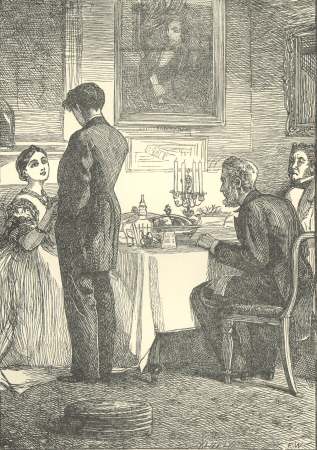
p.101CHAPTER III
THE WHELP
It was very remarkable that a younggentleman who had been brought up under one continuous system ofunnatural restraint, should be a hypocrite; but it was certainlythe case with Tom. It was very strange that a younggentleman who had never been left to his own guidance for fiveconsecutive minutes, should be incapable at last of governinghimself; but so it was with Tom. It was altogetherunaccountable that a young gentleman whose imagination had beenstrangled in his cradle, should be still inconvenienced by itsghost in the form of grovelling sensualities; but such a monster,beyond all doubt, was Tom.
‘Do you smoke?’ asked Mr. James Harthouse, whenthey came to the hotel.
‘I believe you!’ said Tom.
He could do no less than ask Tom up; and Tom could do no lessthan go up. What with a cooling drink adapted to theweather, but not so weak as cool; and what with a rarer tobaccothan was to be bought in those parts; Tom was soon in a highlyfree and easy state at his end of the sofa, and more than everdisposed to admire his new friend at the other end.
Tom blew his smoke aside, after he had been smoking a littlewhile, and took an observation of his friend. ‘Hedon’t seem to care about his dress,’ thought Tom,‘and yet how capitally he does it. What an easy swellhe is!’
Mr. James Harthouse, happening to catch Tom’s eye,remarked that he drank nothing, and filled his glass with his ownnegligent hand.
‘Thank’ee,’ said Tom. ‘Thank’ee. Well, Mr. Harthouse, I hope you havehad about a dose of old Bounderby to-night.’ Tom saidthis with one eye shut up again, and looking over his glassknowingly, at his entertainer.
‘A very good fellow indeed!’ returned Mr. JamesHarthouse.
‘You think so, don’t you?’ said Tom. And shut up his eye again.
Mr. James Harthouse smiled; and rising from his end of thesofa, and lounging with his back against the chimney-piece, sothat he stood before the empty fire-grate as he smoked, in frontof Tom and looking down at him, observed:
‘What a comical brother-in-law you are!’
‘What a comical brother-in-law old Bounderby is, I thinkyou mean,’ said Tom.
‘You are a piece of caustic, Tom,’ retorted Mr.James Harthouse.
There was something so very agreeable in being so intimatewith such a waistcoat; in being called Tom, in such an intimateway, by such a voice; in being on such off-hand terms so soon,with such a pair of whiskers; that Tom was uncommonly pleasedwith himself.
‘Oh! I don’t care for old Bounderby,’said he, ‘if you mean that. I have always called oldBounderby by the same name when I have talked about him, and Ihave always thought of him in the same way. I am not goingto begin to be polite now, about old Bounderby. It would berather late in the day.’
‘Don’t mind me,’ returned James; ‘buttake care when his wife is by, you know.’
‘His wife?’ said Tom. ‘My sisterLoo? O yes!’ And he laughed, and took a littlemore of the cooling drink.
James Harthouse continued to lounge in the same place andattitude, smoking his cigar in his own easy way, and lookingpleasantly at the whelp, as if he knew himself to be a kind ofagreeable demon who had only to hover over him, and he must giveup his whole soul if required. It certainly did seem thatthe whelp yielded to this influence. He looked at hiscompanion sneakingly, he looked at him admiringly, he looked athim boldly, and put up one leg on the sofa.
‘My sister Loo?’ said Tom. ‘Shenever cared for old Bounderby.’
‘That’s the past tense, Tom,’ returned Mr.James Harthouse, striking the ash from his cigar with his littlefinger. ‘We are in the present tense, now.’
‘Verb neuter, not to care. Indicative mood,present tense. First person singular, I do not care; secondperson singular, thou dost not care; third person singular, shedoes not care,’ returned Tom.
‘Good! Very quaint!’ said his friend. ‘Though you don’t mean it.’
‘But I domean it,’ cried Tom. ‘Upon my honour! Why, you won’t tell me, Mr.Harthouse, that you really suppose my sister Loo does care forold Bounderby.’
‘My dear fellow,’ returned the other, ‘whatam I bound to suppose, when I find two married people living inharmony and happiness?’
Tom had by this time got both his legs on the sofa. Ifhis second leg had not been already there when he was called adear fellow, he would have put it up at that great stage of theconversation. Feeling it necessary to do something then, hestretched himself out at greater length, and, reclining with theback of his head on the end of the sofa, and smoking with aninfinite assumption of negligence, turned his common face, andnot too sober eyes, towards the face looking down upon him socarelessly yet so potently.
‘You know our governor, Mr. Harthouse,’ said Tom,‘and therefore, you needn’t be surprised that Loomarried old Bounderby. She never had a lover, and thegovernor proposed old Bounderby, and she took him.’
‘Very dutiful in your interesting sister,’ saidMr. James Harthouse.
‘Yes, but she wouldn’t have been as dutiful, andit would not have come off as easily,’ returned the whelp,‘if it hadn’t been for me.’
The tempter merely lifted his eyebrows; but the whelp wasobliged to go on.
‘Ipersuaded her,’ he said, with anedifying air of superiority. ‘I was stuck into oldBounderby’s bank (where I never wanted to be), and I knew Ishould get into scrapes there, if she put old Bounderby’spipe out; so I told her my wishes, and she came into them. She would do anything for me. It was very game of her,wasn’t it?’
‘It was charming, Tom!’
‘Not that it was altogether so important to her as itwas to me,’ continued Tom coolly, ‘because my libertyand comfort, and perhaps my getting on, depended on it; and shehad no other lover, and staying at home was like staying injail—especially when I was gone. It wasn’t asif she gave up another lover for old Bounderby; but still it wasa good thing in her.’
‘Perfectly delightful. And she gets on soplacidly.’
‘Oh,’ returned Tom, with contemptuous patronage,‘she’s a regular girl. A girl can get onanywhere. She has settled down to the life, and shedon’t mind. It does just as well as another. Besides, though Loo is a girl, she’s not a common sort ofgirl. She can shut herself up within herself, andthink—as I have often known her sit and watch thefire—for an hour at a stretch.’
‘Ay, ay? Has resources of her own,’ saidHarthouse, smoking quietly.
‘Not so much of that as you may suppose,’ returnedTom; ‘for our governor had her crammed with all sorts ofdry bones and sawdust. It’s his system.’
‘Formed his daughter on his own model?’ suggestedHarthouse.
‘His daughter? Ah! and everybody else. Why,he formed Me that way!’ said Tom.
‘Impossible!’
‘He did, though,’ said Tom, shaking hishead. ‘I mean to say, Mr. Harthouse, that when Ifirst left home and went to old Bounderby’s, I was as flatas a warming-pan, and knew no more about life, than any oysterdoes.’
‘Come, Tom! I can hardly believe that. Ajoke’s a joke.’
‘Upon my soul!’ said the whelp. ‘I amserious; I am indeed!’ He smoked with great gravityand dignity for a little while, and then added, in a highlycomplacent tone, ‘Oh! I have picked up a littlesince. I don’t deny that. But I have done itmyself; no thanks to the governor.’
‘And your intelligent sister?’
‘My intelligent sister is about where she was. Sheused to complain to me that she had nothing to fall back upon,that girls usually fall back upon; and I don’t see how sheis to have got over that since. But shedon’tmind,’ he sagaciously added, puffing at his cigaragain. ‘Girls can always get on, somehow.’
‘Calling at the Bank yesterday evening, for Mr.Bounderby’s address, I found an ancient lady there, whoseems to entertain great admiration for your sister,’observed Mr. James Harthouse, throwing away the last smallremnant of the cigar he had now smoked out.
‘Mother Sparsit!’ said Tom. ‘What! youhave seen her already, have you?’
His friend nodded. Tom took his cigar out of his mouth,to shut up his eye (which had grown rather unmanageable) with thegreater expression, and to tap his nose several times with hisfinger.
‘Mother Sparsit’s feeling for Loo is more thanadmiration, I should think,’ said Tom. ‘Sayaffection and devotion. Mother Sparsit never set her cap atBounderby when he was a bachelor. Oh no!’
These were the last words spoken by the whelp, before a giddydrowsiness came upon him, followed by complete oblivion. Hewas roused from the latter state by an uneasy dream of beingstirred up with a boot, and also of a voice saying: ‘Come,it’s late. Be off!’
‘Well!’ he said, scrambling from the sofa. ‘I must take my leave of you though. I say. Yours is very good tobacco. But it’s toomild.’
‘Yes, it’s too mild,’ returned hisentertainer.
‘It’s—it’s ridiculously mild,’said Tom. ‘Where’s the door! Goodnight!’
He had another odd dream of being taken by a waiterthrough a mist, which, after giving him some trouble anddifficulty, resolved itself into the main street, in which hestood alone. He then walked home pretty easily, though notyet free from an impression of the presence and influence of hisnew friend—as if he were lounging somewhere in the air, inthe same negligent attitude, regarding him with the samelook.
p. 105Thewhelp went home, and went to bed. If he had had any senseof what he had done that night, and had been less of a whelp andmore of a brother, he might have turned short on the road, mighthave gone down to the ill-smelling river that was dyed black,might have gone to bed in it for good and all, and have curtainedhis head for ever with its filthy waters.
CHAPTER IV
MEN AND BROTHERS
‘Oh, my friends, thedown-trodden operatives of Coketown! Oh, my friends andfellow-countrymen, the slaves of an iron-handed and a grindingdespotism! Oh, my friends and fellow-sufferers, andfellow-workmen, and fellow-men! I tell you that the hour iscome, when we must rally round one another as One united power,and crumble into dust the oppressors that too long have battenedupon the plunder of our families, upon the sweat of our brows,upon the labour of our hands, upon the strength of our sinews,upon the God-created glorious rights of Humanity, and upon theholy and eternal privileges of Brotherhood!’
‘Good!’ ‘Hear, hear,hear!’ ‘Hurrah!’ and other cries, arosein many voices from various parts of the densely crowded andsuffocatingly close Hall, in which the orator, perched on astage, delivered himself of this and what other froth and fume hehad in him. He had declaimed himself into a violent heat,and was as hoarse as he was hot. By dint of roaring at thetop of his voice under a flaring gaslight, clenching his fists,knitting his brows, setting his teeth, and pounding with hisarms, he had taken so much out of himself by this time, that hewas brought to a stop, and called for a glass of water.
As he stood there, trying to quench his fiery face with hisdrink of water, the comparison between the orator and the crowdof attentive faces turned towards him, was extremely to hisdisadvantage. Judging him by Nature’s evidence, hewas above the mass in very little but the stage on which hestood. In many great respects he was essentially belowthem. He was not so honest, he was not so manly, he was notso good-humoured; he substituted cunning for their simplicity,and passion for their safe solid sense. An ill-made,high-shouldered man, with lowering brows, and his featurescrushed into an habitually sour expression, he contrasted mostunfavourably, even in his mongrel dress, with the great body ofhis hearers in their plain working clothes. Strange as italways is to consider any assembly in the act of submissivelyresigning itself to the dreariness of some complacent person,lord or commoner, whom three-fourths of it could, by no humanmeans, raise out of the slough of inanity to their ownintellectual level, it was particularly strange, and it was evenparticularly affecting, to see this crowd of earnest faces, whosehonesty in the main no competent observer free from bias coulddoubt, so agitated by such a leader.
Good! Hear, hear! Hurrah! The eagerness bothof attention and intention, exhibited in all the countenances,made them a most impressive sight. There was nocarelessness, no languor, no idle curiosity; none of the manyshades of indifference to be seen in all other assemblies,visible for one moment there. That every man felt hiscondition to be, somehow or other, worse than it might be; thatevery man considered it incumbent on him to join the rest,towards the making of it better; that every man felt his onlyhope to be in his allying himself to the comrades by whom he wassurrounded; and that in this belief, right or wrong (unhappilywrong then), the whole of that crowd were gravely, deeply,faithfully in earnest; must have been as plain to any one whochose to see what was there, as the bare beams of the roof andthe whitened brick walls. Nor could any such spectator failto know in his own breast, that these men, through their verydelusions, showed great qualities, susceptible of being turned tothe happiest and best account; and that to pretend (on thestrength of sweeping axioms, howsoever cut and dried) that theywent astray wholly without cause, and of their own irrationalwills, was to pretend that there could be smoke without fire,death without birth, harvest without seed, anything or everythingproduced from nothing.
The orator having refreshed himself, wiped his corrugatedforehead from left to right several times with his handkerchieffolded into a pad, and concentrated all his revived forces, in asneer of great disdain and bitterness.
‘But oh, my friends and brothers! Oh, men andEnglishmen, the down-trodden operatives of Coketown! Whatshall we say of that man—that working-man, that I shouldfind it necessary so to libel the glorious name—who, beingpractically and well acquainted with the grievances and wrongs ofyou, the injured pith and marrow of this land, and having heardyou, with a noble and majestic unanimity that will make Tyrantstremble, resolve for to subscribe to the funds of the UnitedAggregate Tribunal, and to abide by the injunctions issued bythat body for your benefit, whatever they may be—what, Iask you, will you say of that working-man, since such I mustacknowledge him to be, who, at such a time, deserts his post, andsells his flag; who, at such a time, turns a traitor and a cravenand a recreant, who, at such a time, is not ashamed to make toyou the dastardly and humiliating avowal that he will holdhimself aloof, and will notbe one of those associated inthe gallant stand for Freedom and for Right?’
The assembly was divided at this point. There were somegroans and hisses, but the general sense of honour was much toostrong for the condemnation of a man unheard. ‘Besure you’re right, Slackbridge!’ ‘Put himup!’ ‘Let’s hear him!’ Suchthings were said on many sides. Finally, one strong voicecalled out, ‘Is the man heer? If the man’sheer, Slackbridge, let’s hear the man himseln, ’steado’ yo.’ Which was received with a round ofapplause.
Slackbridge, the orator, looked about him with a witheringsmile; and, holding out his right hand at arm’s length (asthe manner of all Slackbridges is), to still the thundering sea,waited until there was a profound silence.
‘Oh, my friends and fellow-men!’ said Slackbridgethen, shaking his head with violent scorn, ‘I do not wonderthat you, the prostrate sons of labour, are incredulous of theexistence of such a man. But he who sold his birthright fora mess of pottage existed, and Judas Iscariot existed, andCastlereagh existed, and this man exists!’
Here, a brief press and confusion near the stage, ended in theman himself standing at the orator’s side before theconcourse. He was pale and a little moved in theface—his lips especially showed it; but he stood quiet,with his left hand at his chin, waiting to be heard. Therewas a chairman to regulate the proceedings, and this functionarynow took the case into his own hands.
‘My friends,’ said he, ‘by virtue o’my office as your president, I askes o’ our friendSlackbridge, who may be a little over hetter in this business, totake his seat, whiles this man Stephen Blackpool is heern. You all know this man Stephen Blackpool. You know himawlung o’ his misfort’ns, and his goodname.’
With that, the chairman shook him frankly by the hand, and satdown again. Slackbridge likewise sat down, wiping his hotforehead—always from left to right, and never the reverseway.
‘My friends,’ Stephen began, in the midst of adead calm; ‘I ha’ hed what’s been spok’no’ me, and ’tis lickly that I shan’t mendit. But I’d liefer you’d hearn the truthconcernin myseln, fro my lips than fro onny other man’s,though I never cud’n speak afore so monny, wi’outbein moydert and muddled.’
Slackbridge shook his head as if he would shake it off, in hisbitterness.
‘I’m th’ one single Hand inBounderby’s mill, o’ a’ the men theer, asdon’t coom in wi’ th’ proposedreg’lations. I canna coom in wi’’em. My friends, I doubt their doin’ yo onnygood. Licker they’ll do yo hurt.’
Slackbridge laughed, folded his arms, and frownedsarcastically.
‘But ’t an’t sommuch for that as I standsout. If that were aw, I’d coom in wi’ th’rest. But I ha’ my reasons—mine, yosee—for being hindered; not on’y now, butawlus—awlus—life long!’
Slackbridge jumped up and stood beside him, gnashing andtearing. ‘Oh, my friends, what but this did I tellyou? Oh, my fellow-countrymen, what warning but this did Igive you? And how shows this recreant conduct in a man onwhom unequal laws are known to have fallen heavy? Oh, youEnglishmen, I ask you how does this subornation show in one ofyourselves, who is thus consenting to his own undoing and toyours, and to your children’s and your children’schildren’s?’
There was some applause, and some crying of Shame upon theman; but the greater part of the audience were quiet. Theylooked at Stephen’s worn face, rendered more pathetic bythe homely emotions it evinced; and, in the kindness of theirnature, they were more sorry than indignant.
‘’Tis this Delegate’s trade for t’speak,’ said Stephen, ‘an’ he’s paid for’t, an’ he knows his work. Let him keep to’t. Let him give no heed to what I ha had’n tobear. That’s not for him. That’s not fornobbody but me.’
There was a propriety, not to say a dignity in these words,that made the hearers yet more quiet and attentive. Thesame strong voice called out, ‘Slackbridge, let the man beheern, and howd thee tongue!’ Then the place waswonderfully still.
‘My brothers,’ said Stephen, whose low voice wasdistinctly heard, ‘and my fellow-workmen—for that yoare to me, though not, as I knows on, to this delegatehere—I ha but a word to sen, and I could sen nommore if Iwas to speak till Strike o’ day. I know weel, awwhat’s afore me. I know weel that yo aw resolve to hanommore ado wi’ a man who is not wi’ yo in thismatther. I know weel that if I was a lyin parisht i’th’ road, yo’d feel it right to pass me by, as aforrenner and stranger. What I ha getn, I mun mak th’best on.’
‘Stephen Blackpool,’ said the chairman, rising,‘think on ’t agen. Think on ’t once agen,lad, afore thou’rt shunned by aw owd friends.’
There was an universal murmur to the same effect, though noman articulated a word. Every eye was fixed onStephen’s face. To repent of his determination, wouldbe to take a load from all their minds. He looked aroundhim, and knew that it was so. Not a grain of anger withthem was in his heart; he knew them, far below their surfaceweaknesses and misconceptions, as no one but theirfellow-labourer could.
‘I ha thowt on ’t, above a bit, sir. Isimply canna coom in. I mun go th’ way as lays aforeme. I mun tak my leave o’ aw heer.’
He made a sort of reverence to them by holding up his arms,and stood for the moment in that attitude; not speaking untilthey slowly dropped at his sides.
‘Monny’s the pleasant word as soom heer hasspok’n wi’ me; monny’s the face I see heer, asI first seen when I were yoong and lighter heart’n thannow. I ha’ never had no fratch afore, sin ever I wereborn, wi’ any o’ my like; Gonnows I ha’ nonenow that’s o’ my makin’. Yo’llca’ me traitor and that—yo I mean t’say,’ addressing Slackbridge, ‘but ’tis easierto ca’ than mak’ out. So let be.’
He had moved away a pace or two to come down from theplatform, when he remembered something he had not said, andreturned again.
‘Haply,’ he said, turning his furrowed face slowlyabout, that he might as it were individually address the wholeaudience, those both near and distant; ‘haply, when thisquestion has been tak’n up and discoosed, there’ll bea threat to turn out if I’m let to work among yo. Ihope I shall die ere ever such a time cooms, and I shall worksolitary among yo unless it cooms—truly, I mun do ’t,my friends; not to brave yo, but to live. I ha nobbut workto live by; and wheerever can I go, I who ha worked sin I were noheighth at aw, in Coketown heer? I mak’ no complaintso’ bein turned to the wa’, o’ bein outcastenand overlooken fro this time forrard, but hope I shall be let towork. If there is any right for me at aw, my friends, Ithink ’tis that.’
Not a word was spoken. Not a sound was audible in thebuilding, but the slight rustle of men moving a little apart, allalong the centre of the room, to open a means of passing out, tothe man with whom they had all bound themselves to renouncecompanionship. Looking at no one, and going his way with alowly steadiness upon him that asserted nothing and soughtnothing, Old Stephen, with all his troubles on his head, left thescene.
Then Slackbridge, who had kept his oratorical arm extendedduring the going out, as if he were repressing with infinitesolicitude and by a wonderful moral power the vehement passionsof the multitude, applied himself to raising their spirits. Had not the Roman Brutus, oh, my British countrymen, condemnedhis son to death; and had not the Spartan mothers, oh my soon tobe victorious friends, driven their flying children on the pointsof their enemies’ swords? Then was it not the sacredduty of the men of Coketown, with forefathers before them, anadmiring world in company with them, and a posterity to comeafter them, to hurl out traitors from the tents they had pitchedin a sacred and a God-like cause? The winds of heavenanswered Yes; and bore Yes, east, west, north, and south. And consequently three cheers for the United AggregateTribunal!
Slackbridge acted as fugleman, and gave the time. Themultitude of doubtful faces (a little conscience-stricken)brightened at the sound, and took it up. Private feelingmust yield to the common cause. Hurrah! The roof yetvibrated with the cheering, when the assembly dispersed.
Thus easily did Stephen Blackpool fall into the loneliest oflives, the life of solitude among a familiar crowd. Thestranger in the land who looks into ten thousand faces for someanswering look and never finds it, is in cheering society ascompared with him who passes ten averted faces daily, that wereonce the countenances of friends. Such experience was to beStephen’s now, in every waking moment of his life; at hiswork, on his way to it and from it, at his door, at his window,everywhere. By general consent, they even avoided that sideof the street on which he habitually walked; and left it, of allthe working men, to him only.
He had been for many years, a quiet silent man, associatingbut little with other men, and used to companionship with his ownthoughts. He had never known before the strength of thewant in his heart for the frequent recognition of a nod, a look,a word; or the immense amount of relief that had been poured intoit by drops through such small means. It was even harderthan he could have believed possible, to separate in his ownconscience his abandonment by all his fellows from a baselesssense of shame and disgrace.
The first four days of his endurance were days so long andheavy, that he began to be appalled by the prospect beforehim. Not only did he see no Rachael all the time, but heavoided every chance of seeing her; for, although he knew thatthe prohibition did not yet formally extend to the women workingin the factories, he found that some of them with whom he wasacquainted were changed to him, and he feared to try others, anddreaded that Rachael might be even singled out from the rest ifshe were seen in his company. So, he had been quite aloneduring the four days, and had spoken to no one, when, as he wasleaving his work at night, a young man of a very light complexionaccosted him in the street.
‘Your name’s Blackpool, ain’t it?’said the young man.
Stephen coloured to find himself with his hat in his hand, inhis gratitude for being spoken to, or in the suddenness of it, orboth. He made a feint of adjusting the lining, and said,‘Yes.’
‘You are the Hand they have sent to Coventry, Imean?’ said Bitzer, the very light young man inquestion.
Stephen answered ‘Yes,’ again.
‘I supposed so, from their all appearing to keep awayfrom you. Mr. Bounderby wants to speak to you. Youknow his house, don’t you?’
Stephen said ‘Yes,’ again.
p.111‘Then go straight up there, will you?’ saidBitzer. ‘You’re expected, and have only to tellthe servant it’s you. I belong to the Bank; so, ifyou go straight up without me (I was sent to fetch you),you’ll save me a walk.’
Stephen, whose way had been in the contrary direction, turnedabout, and betook himself as in duty bound, to the red brickcastle of the giant Bounderby.
CHAPTER V
MEN AND MASTERS
‘Well, Stephen,’ saidBounderby, in his windy manner, ‘what’s this Ihear? What have these pests of the earth been doing toyou? Come in, and speak up.’
It was into the drawing-room that he was thus bidden. Atea-table was set out; and Mr. Bounderby’s young wife, andher brother, and a great gentleman from London, werepresent. To whom Stephen made his obeisance, closing thedoor and standing near it, with his hat in his hand.
‘This is the man I was telling you about,Harthouse,’ said Mr. Bounderby. The gentleman headdressed, who was talking to Mrs. Bounderby on the sofa, got up,saying in an indolent way, ‘Oh really?’ and dawdledto the hearthrug where Mr. Bounderby stood.
‘Now,’ said Bounderby, ‘speak up!’
After the four days he had passed, this address fell rudelyand discordantly on Stephen’s ear. Besides being arough handling of his wounded mind, it seemed to assume that hereally was the self-interested deserter he had been called.
‘What were it, sir,’ said Stephen, ‘as yowere pleased to want wi’ me?’
‘Why, I have told you,’ returned Bounderby. ‘Speak up like a man, since you are a man, and tell usabout yourself and this Combination.’
‘Wi’ yor pardon, sir,’ said StephenBlackpool, ‘I ha’ nowt to sen about it.’
Mr. Bounderby, who was always more or less like a Wind,finding something in his way here, began to blow at itdirectly.
‘Now, look here, Harthouse,’ said he,‘here’s a specimen of ’em. When this manwas here once before, I warned this man against the mischievousstrangers who are always about—and who ought to be hangedwherever they are found—and I told this man that he wasgoing in the wrong direction. Now, would you believe it,that although they have put this mark upon him, he is such aslave to them still, that he’s afraid to open his lipsabout them?’
‘I sed as I had nowt to sen, sir; not as I wasfearfo’ o’ openin’ my lips.’
‘You said! Ah! Iknow what you said;more than that, I know what you mean, you see. Not alwaysthe same thing, by the Lord Harry! Quite differentthings. You had better tell us at once, that that fellowSlackbridge is not in the town, stirring up the people to mutiny;and that he is not a regular qualified leader of the people: thatis, a most confounded scoundrel. You had better tell us soat once; you can’t deceive me. You want to tell usso. Why don’t you?’
‘I’m as sooary as yo, sir, when the people’sleaders is bad,’ said Stephen, shaking his head. ‘They taks such as offers. Haply ’tis na’the sma’est o’ their misfortuns when they can get nobetter.’
The wind began to get boisterous.
‘Now, you’ll think this pretty well,Harthouse,’ said Mr. Bounderby. ‘You’llthink this tolerably strong. You’ll say, upon my soulthis is a tidy specimen of what my friends have to deal with; butthis is nothing, sir! You shall hear me ask this man aquestion. Pray, Mr. Blackpool’—wind springingup very fast—‘may I take the liberty of asking youhow it happens that you refused to be in thisCombination?’
‘How ’t happens?’
‘Ah!’ said Mr. Bounderby, with his thumbs in thearms of his coat, and jerking his head and shutting his eyes inconfidence with the opposite wall: ‘how ithappens.’
‘I’d leefer not coom to ’t, sir; but sin youput th’ question—an’ not want’n t’be ill-manner’n—I’ll answer. I ha passeda promess.’
‘Not to me, you know,’ said Bounderby. (Gusty weather with deceitful calms. One nowprevailing.)
‘O no, sir. Not to yo.’
‘As for me, any consideration for me has had justnothing at all to do with it,’ said Bounderby, still inconfidence with the wall. ‘If only Josiah Bounderbyof Coketown had been in question, you would have joined and madeno bones about it?’
‘Why yes, sir. ’Tis true.’
‘Though he knows,’ said Mr. Bounderby, now blowinga gale, ‘that there are a set of rascals and rebels whomtransportation is too good for! Now, Mr. Harthouse, youhave been knocking about in the world some time. Did youever meet with anything like that man out of this blessedcountry?’ And Mr. Bounderby pointed him out forinspection, with an angry finger.
‘Nay, ma’am,’ said Stephen Blackpool,staunchly protesting against the words that had been used, andinstinctively addressing himself to Louisa, after glancing at herface. ‘Not rebels, nor yet rascals. Nowto’ th’ kind, ma’am, nowt o’ th’kind. They’ve not doon me a kindness, ma’am, asI know and feel. But there’s not a dozen men amoong’em, ma’am—a dozen? Not six—butwhat believes as he has doon his duty by the rest and byhimseln. God forbid as I, that ha’ known, andhad’n experience o’ these men aw my life—I,that ha’ ett’n an’ droonken wi’’em, an’ seet’n wi’ ’em, andtoil’n wi’ ’em, and lov’n ’em,should fail fur to stan by ’em wi’ the truth, let’em ha’ doon to me what they may!’
He spoke with the rugged earnestness of his place andcharacter—deepened perhaps by a proud consciousness that hewas faithful to his class under all their mistrust; but he fullyremembered where he was, and did not even raise his voice.
‘No, ma’am, no. They’re true to oneanother, faithfo’ to one another, ’fectionate to oneanother, e’en to death. Be poor amoong ’em, besick amoong ’em, grieve amoong ’em for onny o’th’ monny causes that carries grief to the poor man’sdoor, an’ they’ll be tender wi’ yo, gentlewi’ yo, comfortable wi’ yo, Chrisen wi’yo. Be sure o’ that, ma’am. They’dbe riven to bits, ere ever they’d be different.’
‘In short,’ said Mr. Bounderby, ‘it’sbecause they are so full of virtues that they have turned youadrift. Go through with it while you are about it. Out with it.’
‘How ’tis, ma’am,’ resumed Stephen,appearing still to find his natural refuge in Louisa’sface, ‘that what is best in us fok, seems to turn us mostto trouble an’ misfort’n an’ mistake, Idunno. But ’tis so. I know ’tis, as Iknow the heavens is over me ahint the smoke. We’repatient too, an’ wants in general to do right. An’ I canna think the fawt is aw wi’ us.’
‘Now, my friend,’ said Mr. Bounderby, whom hecould not have exasperated more, quite unconscious of it thoughhe was, than by seeming to appeal to any one else, ‘if youwill favour me with your attention for half a minute, I shouldlike to have a word or two with you. You said just now,that you had nothing to tell us about this business. Youare quite sure of that before we go any further.’
‘Sir, I am sure on ’t.’
‘Here’s a gentleman from London present,’Mr. Bounderby made a backhanded point at Mr. James Harthouse withhis thumb, ‘a Parliament gentleman. I should like himto hear a short bit of dialogue between you and me, instead oftaking the substance of it—for I know precious well,beforehand, what it will be; nobody knows better than I do, takenotice!—instead of receiving it on trust from mymouth.’
Stephen bent his head to the gentleman from London, and showeda rather more troubled mind than usual. He turned his eyesinvoluntarily to his former refuge, but at a look from thatquarter (expressive though instantaneous) he settled them on Mr.Bounderby’s face.
‘Now, what do you complain of?’ asked Mr.Bounderby.
‘I ha’ not coom here, sir,’ Stephen remindedhim, ‘to complain. I coom for that I were sentfor.’
‘What,’ repeated Mr. Bounderby, folding his arms,‘do you people, in a general way, complain of?’
Stephen looked at him with some little irresolution for amoment, and then seemed to make up his mind.
‘Sir, I were never good at showin o ’t, though Iha had’n my share in feeling o ’t. ’Deedwe are in a muddle, sir. Look round town—so rich as’tis—and see the numbers o’ people as has beenbroughten into bein heer, fur to weave, an’ to card,an’ to piece out a livin’, aw the same one way,somehows, ’twixt their cradles and their graves. Lookhow we live, an’ wheer we live, an’ in what numbers,an’ by what chances, and wi’ what sameness; and lookhow the mills is awlus a goin, and how they never works us nonigher to ony dis’ant object—ceptin awlus,Death. Look how you considers of us, and writes of us, andtalks of us, and goes up wi’ yor deputations to Secretarieso’ State ’bout us, and how yo are awlus right, andhow we are awlus wrong, and never had’n no reason in us sinever we were born. Look how this ha growen an’growen, sir, bigger an’ bigger, broader an’ broader,harder an’ harder, fro year to year, fro generation untogeneration. Who can look on ’t, sir, and fairly tella man ’tis not a muddle?’
‘Of course,’ said Mr. Bounderby. ‘Nowperhaps you’ll let the gentleman know, how you would setthis muddle (as you’re so fond of calling it) torights.’
‘I donno, sir. I canna be expecten to’t. ’Tis not me as should be looken to forthat, sir. ’Tis them as is put ower me, and ower awthe rest of us. What do they tak upon themseln, sir, if notto do’t?’
‘I’ll tell you something towards it, at anyrate,’ returned Mr. Bounderby. ‘We will make anexample of half a dozen Slackbridges. We’ll indictthe blackguards for felony, and get ’em shipped off topenal settlements.’
Stephen gravely shook his head.
‘Don’t tell me we won’t, man,’ saidMr. Bounderby, by this time blowing a hurricane, ‘becausewe will, I tell you!’
‘Sir,’ returned Stephen, with the quiet confidenceof absolute certainty, ‘if yo was t’ tak a hundredSlackbridges—aw as there is, and aw the number ten timestowd—an’ was t’ sew ’em up in separatesacks, an’ sink ’em in the deepest ocean as were madeere ever dry land coom to be, yo’d leave the muddle justwheer ’tis. Mischeevous strangers!’ saidStephen, with an anxious smile; ‘when ha we not heern, I amsure, sin ever we can call to mind, o’ th’mischeevous strangers! ’Tis not by themthetrouble’s made, sir. ’Tis not wi’them’t commences. I ha no favour for’em—I ha no reason to favour ’em—but’tis hopeless and useless to dream o’ takin them frotheir trade, ’stead o’ takin their trade frothem! Aw that’s now about me in this room were heerafore I coom, an’ will be heer when I am gone. Putthat clock aboard a ship an’ pack it off to Norfolk Island,an’ the time will go on just the same. So ’tiswi’ Slackbridge every bit.’
Reverting for a moment to his former refuge, he observed acautionary movement of her eyes towards the door. Steppingback, he put his hand upon the lock. But he had not spokenout of his own will and desire; and he felt it in his heart anoble return for his late injurious treatment to be faithful tothe last to those who had repudiated him. He stayed tofinish what was in his mind.
‘Sir, I canna, wi’ my little learning an’ mycommon way, tell the genelman what will better awthis—though some working men o’ this town could,above my powers—but I can tell him what I know will neverdo ’t. The strong hand will never do ’t. Vict’ry and triumph will never do ’t. Agreeingfur to mak one side unnat’rally awlus and for ever right,and toother side unnat’rally awlus and for ever wrong, willnever, never do ’t. Nor yet lettin alone will neverdo ’t. Let thousands upon thousands alone, aw leadingthe like lives and aw faw’en into the like muddle, and theywill be as one, and yo will be as anoother, wi’ a blackunpassable world betwixt yo, just as long or short a time assich-like misery can last. Not drawin nigh to fok,wi’ kindness and patience an’ cheery ways, that sodraws nigh to one another in their monny troubles, and socherishes one another in their distresses wi’ what theyneed themseln—like, I humbly believe, as no people thegenelman ha seen in aw his travels can beat—will never do’t till th’ Sun turns t’ ice. Mosto’ aw, rating ’em as so much Power, andreg’latin ’em as if they was figures in a soom, ormachines: wi’out loves and likens, wi’out memoriesand inclinations, wi’out souls to weary and souls tohope—when aw goes quiet, draggin on wi’ ’em asif they’d nowt o’ th’ kind, and when aw goesonquiet, reproachin ’em for their want o’ sitchhumanly feelins in their dealins wi’ yo—this willnever do ’t, sir, till God’s work isonmade.’
Stephen stood with the open door in his hand, waiting to knowif anything more were expected of him.
‘Just stop a moment,’ said Mr. Bounderby,excessively red in the face. ‘I told you, the lasttime you were here with a grievance, that you had better turnabout and come out of that. And I also told you, if youremember, that I was up to the gold spoon look-out.’
p.116‘I were not up to ’t myseln, sir; I doassure yo.’
‘Now it’s clear to me,’ said Mr. Bounderby,‘that you are one of those chaps who have always got agrievance. And you go about, sowing it and raisingcrops. That’s the business of yourlife, myfriend.’
Stephen shook his head, mutely protesting that indeed he hadother business to do for his life.
‘You are such a waspish, raspish, ill-conditioned chap,you see,’ said Mr. Bounderby, ‘that even your ownUnion, the men who know you best, will have nothing to do withyou. I never thought those fellows could be right inanything; but I tell you what! I so far go along with themfor a novelty, that I’ll have nothing to do with youeither.’
Stephen raised his eyes quickly to his face.
‘You can finish off what you’re at,’ saidMr. Bounderby, with a meaning nod, ‘and then goelsewhere.’
‘Sir, yo know weel,’ said Stephen expressively,‘that if I canna get work wi’ yo, I canna get itelsewheer.’
The reply was, ‘What I know, I know; and what you know,you know. I have no more to say about it.’
Stephen glanced at Louisa again, but her eyes were raised tohis no more; therefore, with a sigh, and saying, barely above hisbreath, ‘Heaven help us aw in this world!’ hedeparted.
CHAPTER VI
FADING AWAY
It was falling dark when Stephencame out of Mr. Bounderby’s house. The shadows ofnight had gathered so fast, that he did not look about him whenhe closed the door, but plodded straight along the street. Nothing was further from his thoughts than the curious old womanhe had encountered on his previous visit to the same house, whenhe heard a step behind him that he knew, and turning, saw her inRachael’s company.
He saw Rachael first, as he had heard her only.
‘Ah, Rachael, my dear! Missus, thou wi’her!’
‘Well, and now you are surprised to be sure, and withreason I must say,’ the old woman returned. ‘Here I am again, you see.’
‘But how wi’ Rachael?’ said Stephen, fallinginto their step, walking between them, and looking from the oneto the other.
‘Why, I come to be with this good lass pretty much as Icame to be with you,’ said the old woman, cheerfully,taking the reply upon herself. ‘My visiting time islater this year than usual, for I have been rather troubled withshortness of breath, and so put it off till the weather was fineand warm. For the same reason I don’t make all myjourney in one day, but divide it into two days, and get a bedto-night at the Travellers’ Coffee House down by therailroad (a nice clean house), and go back Parliamentary, at sixin the morning. Well, but what has this to do with thisgood lass, says you? I’m going to tell you. Ihave heard of Mr. Bounderby being married. I read it in thepaper, where it looked grand—oh, it looked fine!’ theold woman dwelt on it with strange enthusiasm: ‘and I wantto see his wife. I have never seen her yet. Now, ifyou’ll believe me, she hasn’t come out of that housesince noon to-day. So not to give her up too easily, I waswaiting about, a little last bit more, when I passed close tothis good lass two or three times; and her face being so friendlyI spoke to her, and she spoke to me. There!’ said theold woman to Stephen, ‘you can make all the rest out foryourself now, a deal shorter than I can, I dare say!’
Once again, Stephen had to conquer an instinctive propensityto dislike this old woman, though her manner was as honest andsimple as a manner possibly could be. With a gentlenessthat was as natural to him as he knew it to be to Rachael, hepursued the subject that interested her in her old age.
‘Well, missus,’ said he, ‘I ha seen thelady, and she were young and hansom. Wi’ fine darkthinkin eyes, and a still way, Rachael, as I ha never seen thelike on.’
‘Young and handsome. Yes!’ cried the oldwoman, quite delighted. ‘As bonny as a rose! And what a happy wife!’
‘Aye, missus, I suppose she be,’ saidStephen. But with a doubtful glance at Rachael.
‘Suppose she be? She must be. She’syour master’s wife,’ returned the old woman.
Stephen nodded assent. ‘Though as tomaster,’ said he, glancing again at Rachael, ‘notmaster onny more. That’s aw enden ’twixt himand me.’
‘Have you left his work, Stephen?’ asked Rachael,anxiously and quickly.
‘Why, Rachael,’ he replied, ‘whether I halef’n his work, or whether his work ha lef’n me,cooms t’ th’ same. His work and me areparted. ’Tis as weel so—better, I were thinkinwhen yo coom up wi’ me. It would ha brought’ntrouble upon trouble if I had stayed theer. Haply’tis a kindness to monny that I go; haply ’tis akindness to myseln; anyways it mun be done. I mun turn myface fro Coketown fur th’ time, and seek a fort’n,dear, by beginnin fresh.’
‘Where will you go, Stephen?’
‘I donno t’night,’ said he, lifting off hishat, and smoothing his thin hair with the flat of his hand. ‘But I’m not goin t’night, Rachael, nor yett’morrow. ’Tan’t easy overmuch t’know wheer t’ turn, but a good heart will coom tome.’
Herein, too, the sense of even thinking unselfishly aidedhim. Before he had so much as closed Mr. Bounderby’sdoor, he had reflected that at least his being obliged to go awaywas good for her, as it would save her from the chance of beingbrought into question for not withdrawing from him. Thoughit would cost him a hard pang to leave her, and though he couldthink of no similar place in which his condemnation would notpursue him, perhaps it was almost a relief to be forced away fromthe endurance of the last four days, even to unknown difficultiesand distresses.
So he said, with truth, ‘I’m more leetsome,Rachael, under ’t, than I could’n habelieved.’ It was not her part to make his burdenheavier. She answered with her comforting smile, and thethree walked on together.
Age, especially when it strives to be self-reliant andcheerful, finds much consideration among the poor. The oldwoman was so decent and contented, and made so light of herinfirmities, though they had increased upon her since her formerinterview with Stephen, that they both took an interest inher. She was too sprightly to allow of their walking at aslow pace on her account, but she was very grateful to be talkedto, and very willing to talk to any extent: so, when they came totheir part of the town, she was more brisk and vivacious thanever.
‘Come to my poor place, missus,’ said Stephen,‘and tak a coop o’ tea. Rachael will coom then;and arterwards I’ll see thee safe t’ thyTravellers’ lodgin. ’T may be long, Rachael,ere ever I ha th’ chance o’ thy coompanyagen.’
They complied, and the three went on to the house where helodged. When they turned into a narrow street, Stephenglanced at his window with a dread that always haunted hisdesolate home; but it was open, as he had left it, and no one wasthere. The evil spirit of his life had flitted away again,months ago, and he had heard no more of her since. The onlyevidence of her last return now, were the scantier moveables inhis room, and the grayer hair upon his head.
He lighted a candle, set out his little tea-board, got hotwater from below, and brought in small portions of tea and sugar,a loaf, and some butter from the nearest shop. The breadwas new and crusty, the butter fresh, and the sugar lump, ofcourse—in fulfilment of the standard testimony of theCoketown magnates, that these people lived like princes,sir. Rachael made the tea (so large a party necessitatedthe borrowing of a cup), and the visitor enjoyed itmightily. It was the first glimpse of sociality the hosthad had for many days. He too, with the world a wide heathbefore him, enjoyed the meal—again in corroboration of themagnates, as exemplifying the utter want of calculation on thepart of these people, sir.
‘I ha never thowt yet, missus,’ said Stephen,‘o’ askin thy name.’
The old lady announced herself as ‘Mrs.Pegler.’
‘A widder, I think?’ said Stephen.
‘Oh, many long years!’ Mrs. Pegler’shusband (one of the best on record) was already dead, by Mrs.Pegler’s calculation, when Stephen was born.
‘’Twere a bad job, too, to lose so good aone,’ said Stephen. ‘Onny children?’
Mrs. Pegler’s cup, rattling against her saucer as sheheld it, denoted some nervousness on her part. ‘No,’ she said. ‘Not now, notnow.’
‘Dead, Stephen,’ Rachael softly hinted.
‘I’m sooary I ha spok’n on ’t,’said Stephen, ‘I ought t’ hadn in my mind as I mighttouch a sore place. I—I blame myseln.’
While he excused himself, the old lady’s cup rattledmore and more. ‘I had a son,’ she said,curiously distressed, and not by any of the usual appearances ofsorrow; ‘and he did well, wonderfully well. But he isnot to be spoken of if you please. Heis—’ Putting down her cup, she moved her handsas if she would have added, by her action,‘dead!’ Then she said aloud, ‘I have losthim.’
Stephen had not yet got the better of his having given the oldlady pain, when his landlady came stumbling up the narrow stairs,and calling him to the door, whispered in his ear. Mrs.Pegler was by no means deaf, for she caught a word as it wasuttered.
‘Bounderby!’ she cried, in a suppressed voice,starting up from the table. ‘Oh hide me! Don’t let me be seen for the world. Don’t lethim come up till I’ve got away. Pray,pray!’ She trembled, and was excessively agitated;getting behind Rachael, when Rachael tried to reassure her; andnot seeming to know what she was about.
‘But hearken, missus, hearken,’ said Stephen,astonished. ‘’Tisn’t Mr. Bounderby;’tis his wife. Yo’r not fearfo’ o’her. Yo was hey-go-mad about her, but an hoursin.’
‘But are you sure it’s the lady, and not thegentleman?’ she asked, still trembling.
‘Certain sure!’
‘Well then, pray don’t speak to me, nor yet takeany notice of me,’ said the old woman. ‘Let mebe quite to myself in this corner.’
Stephen nodded; looking to Rachael for an explanation, whichshe was quite unable to give him; took the candle, wentdownstairs, and in a few moments returned, lighting Louisa intothe room. She was followed by the whelp.
Rachael had risen, and stood apart with her shawl and bonnetin her hand, when Stephen, himself profoundly astonished by thisvisit, put the candle on the table. Then he too stood, withhis doubled hand upon the table near it, waiting to beaddressed.
For the first time in her life Louisa had come into one of thedwellings of the Coketown Hands; for the first time in her lifeshe was face to face with anything like individuality inconnection with them. She knew of their existence byhundreds and by thousands. She knew what results in work agiven number of them would produce in a given space oftime. She knew them in crowds passing to and from theirnests, like ants or beetles. But she knew from her readinginfinitely more of the ways of toiling insects than of thesetoiling men and women.
Something to be worked so much and paid so much, and thereended; something to be infallibly settled by laws of supply anddemand; something that blundered against those laws, andfloundered into difficulty; something that was a little pinchedwhen wheat was dear, and over-ate itself when wheat was cheap;something that increased at such a rate of percentage, andyielded such another percentage of crime, and such anotherpercentage of pauperism; something wholesale, of which vastfortunes were made; something that occasionally rose like a sea,and did some harm and waste (chiefly to itself), and fell again;this she knew the Coketown Hands to be. But, she hadscarcely thought more of separating them into units, than ofseparating the sea itself into its component drops.
She stood for some moments looking round the room. Fromthe few chairs, the few books, the common prints, and the bed,she glanced to the two women, and to Stephen.
‘I have come to speak to you, in consequence of whatpassed just now. I should like to be serviceable to you, ifyou will let me. Is this your wife?’
Rachael raised her eyes, and they sufficiently answered no,and dropped again.
‘I remember,’ said Louisa, reddening at hermistake; ‘I recollect, now, to have heard your domesticmisfortunes spoken of, though I was not attending to theparticulars at the time. It was not my meaning to ask aquestion that would give pain to any one here. If I shouldask any other question that may happen to have that result, giveme credit, if you please, for being in ignorance how to speak toyou as I ought.’
As Stephen had but a little while ago instinctively addressedhimself to her, so she now instinctively addressed herself toRachael. Her manner was short and abrupt, yet faltering andtimid.
‘He has told you what has passed between himself and myhusband? You would be his first resource, Ithink.’
‘I have heard the end of it, young lady,’ saidRachael.
‘Did I understand, that, being rejected by one employer,he would probably be rejected by all? I thought he said asmuch?’
‘The chances are very small, young lady—next tonothing—for a man who gets a bad name amongthem.’
‘What shall I understand that you mean by a badname?’
‘The name of being troublesome.’
‘Then, by the prejudices of his own class, and by theprejudices of the other, he is sacrificed alike? Are thetwo so deeply separated in this town, that there is no placewhatever for an honest workman between them?’
Rachael shook her head in silence.
‘He fell into suspicion,’ said Louisa, ‘withhis fellow-weavers, because—he had made a promise not to beone of them. I think it must have been to you that he madethat promise. Might I ask you why he made it?’
Rachael burst into tears. ‘I didn’t seek itof him, poor lad. I prayed him to avoid trouble for his owngood, little thinking he’d come to it through me. ButI know he’d die a hundred deaths, ere ever he’d breakhis word. I know that of him well.’
Stephen had remained quietly attentive, in his usualthoughtful attitude, with his hand at his chin. He nowspoke in a voice rather less steady than usual.
‘No one, excepting myseln, can ever know what honour,an’ what love, an’ respect, I bear to Rachael, orwi’ what cause. When I passed that promess, I towdher true, she were th’ Angel o’ my life. ’Twere a solemn promess. ’Tis gone fro’me, for ever.’
Louisa turned her head to him, and bent it with a deferencethat was new in her. She looked from him to Rachael, andher features softened. ‘What will you do?’ sheasked him. And her voice had softened too.
‘Weel, ma’am,’ said Stephen, making the bestof it, with a smile; ‘when I ha finished off, I mun quitthis part, and try another. Fortnet or misfortnet, a mancan but try; there’s nowt to be done wi’outtryin’—cept laying down and dying.’
‘How will you travel?’
‘Afoot, my kind ledy, afoot.’
Louisa coloured, and a purse appeared in her hand. Therustling of a bank-note was audible, as she unfolded one and laidit on the table.
‘Rachael, will you tell him—for you know how,without offence—that this is freely his, to help him on hisway? Will you entreat him to take it?’
‘I canna do that, young lady,’ she answered,turning her head aside. ‘Bless you for thinkingo’ the poor lad wi’ such tenderness. But’tis for him to know his heart, and what is right accordingto it.’
Louisa looked, in part incredulous, in part frightened, inpart overcome with quick sympathy, when this man of so muchself-command, who had been so plain and steady through the lateinterview, lost his composure in a moment, and now stood with hishand before his face. She stretched out hers, as if shewould have touched him; then checked herself, and remainedstill.
‘Not e’en Rachael,’ said Stephen, when hestood again with his face uncovered, ‘could mak sitch akind offerin, by onny words, kinder. T’ show thatI’m not a man wi’out reason and gratitude, I’lltak two pound. I’ll borrow ’t for t’ pay’t back. ’Twill be the sweetest work as ever Iha done, that puts it in my power t’ acknowledge once moremy lastin thankfulness for this present action.’
She was fain to take up the note again, and to substitute themuch smaller sum he had named. He was neither courtly, norhandsome, nor picturesque, in any respect; and yet his manner ofaccepting it, and of expressing his thanks without more words,had a grace in it that Lord Chesterfield could not have taughthis son in a century.
Tom had sat upon the bed, swinging one leg and sucking hiswalking-stick with sufficient unconcern, until the visit hadattained this stage. Seeing his sister ready to depart, hegot up, rather hurriedly, and put in a word.
‘Just wait a moment, Loo! Before we go, I shouldlike to speak to him a moment. Something comes into myhead. If you’ll step out on the stairs, Blackpool,I’ll mention it. Never mind a light,man!’ Tom was remarkably impatient of his movingtowards the cupboard, to get one. ‘It don’twant a light.’
Stephen followed him out, and Tom closed the room door, andheld the lock in his hand.
‘I say!’ he whispered. ‘I think I cando you a good turn. Don’t ask me what it is, becauseit may not come to anything. But there’s no harm inmy trying.’
His breath fell like a flame of fire on Stephen’s ear,it was so hot.
‘That was our light porter at the Bank,’ said Tom,‘who brought you the message to-night. I call him ourlight porter, because I belong to the Bank too.’
Stephen thought, ‘What a hurry he is in!’ Hespoke so confusedly.
‘Well!’ said Tom. ‘Now lookhere! When are you off?’
‘T’ day’s Monday,’ replied Stephen,considering. ‘Why, sir, Friday or Saturday, nigh’bout.’
‘Friday or Saturday,’ said Tom. ‘Nowlook here! I am not sure that I can do you the good turn Iwant to do you—that’s my sister, you know, in yourroom—but I may be able to, and if I should not be able to,there’s no harm done. So I tell you what. You’ll know our light porter again?’
‘Yes, sure,’ said Stephen.
‘Very well,’ returned Tom. ‘When youleave work of a night, between this and your going away, justhang about the Bank an hour or so, will you? Don’ttake on, as if you meant anything, if he should see you hangingabout there; because I shan’t put him up to speak to you,unless I find I can do you the service I want to do you. Inthat case he’ll have a note or a message for you, but notelse. Now look here! You are sure youunderstand.’
He had wormed a finger, in the darkness, through a button-holeof Stephen’s coat, and was screwing that corner of thegarment tight up round and round, in an extraordinary manner.
‘I understand, sir,’ said Stephen.
‘Now look here!’ repeated Tom. ‘Besure you don’t make any mistake then, and don’tforget. I shall tell my sister as we go home, what I havein view, and she’ll approve, I know. Now lookhere! You’re all right, are you? You understandall about it? Very well then. Come along,Loo!’
He pushed the door open as he called to her, but did notreturn into the room, or wait to be lighted down the narrowstairs. He was at the bottom when she began to descend, andwas in the street before she could take his arm.
Mrs. Pegler remained in her corner until the brother andsister were gone, and until Stephen came back with the candle inhis hand. She was in a state of inexpressible admiration ofMrs. Bounderby, and, like an unaccountable old woman, wept,‘because she was such a pretty dear.’ Yet Mrs.Pegler was so flurried lest the object of her admiration shouldreturn by chance, or anybody else should come, that hercheerfulness was ended for that night. It was late too, topeople who rose early and worked hard; therefore the party brokeup; and Stephen and Rachael escorted their mysteriousacquaintance to the door of the Travellers’ Coffee House,where they parted from her.
They walked back together to the corner of the street whereRachael lived, and as they drew nearer and nearer to it, silencecrept upon them. When they came to the dark corner wheretheir unfrequent meetings always ended, they stopped, stillsilent, as if both were afraid to speak.
‘I shall strive t’ see thee agen, Rachael, afore Igo, but if not—’
‘Thou wilt not, Stephen, I know. ’Tis betterthat we make up our minds to be open wi’ oneanother.’
‘Thou’rt awlus right. ’Tis bolder andbetter. I ha been thinkin then, Rachael, that as ’tisbut a day or two that remains, ’twere better for thee, mydear, not t’ be seen wi’ me. ’T mightbring thee into trouble, fur no good.’
‘’Tis not for that, Stephen, that I mind. But thou know’st our old agreement. ’Tis forthat.’
‘Well, well,’ said he. ‘’Tisbetter, onnyways.’
‘Thou’lt write to me, and tell me all thathappens, Stephen?’
‘Yes. What can I say now, but Heaven be wi’thee, Heaven bless thee, Heaven thank thee and rewardthee!’
‘May it bless thee, Stephen, too, in all thy wanderings,and send thee peace and rest at last!’
‘I towd thee, my dear,’ said StephenBlackpool—‘that night—that I would never see orthink o’ onnything that angered me, but thou, so muchbetter than me, should’st be beside it. Thou’rtbeside it now. Thou mak’st me see it wi’ abetter eye. Bless thee. Good night. Good-bye!’
It was but a hurried parting in a common street, yet it was asacred remembrance to these two common people. Utilitarianeconomists, skeletons of schoolmasters, Commissioners of Fact,genteel and used-up infidels, gabblers of many littledog’s-eared creeds, the poor you will have always withyou. Cultivate in them, while there is yet time, the utmostgraces of the fancies and affections, to adorn their lives somuch in need of ornament; or, in the day of your triumph, whenromance is utterly driven out of their souls, and they and a bareexistence stand face to face, Reality will take a wolfish turn,and make an end of you.
Stephen worked the next day, and the next, uncheered by a wordfrom any one, and shunned in all his comings and goings asbefore. At the end of the second day, he saw land; at theend of the third, his loom stood empty.
He had overstayed his hour in the street outside the Bank, oneach of the two first evenings; and nothing had happened there,good or bad. That he might not be remiss in his part of theengagement, he resolved to wait full two hours, on this third andlast night.
There was the lady who had once kept Mr. Bounderby’shouse, sitting at the first-floor window as he had seen herbefore; and there was the light porter, sometimes talking withher there, and sometimes looking over the blind below which hadBank upon it, and sometimes coming tothe door and standing on the steps for a breath of air. When he first came out, Stephen thought he might be looking forhim, and passed near; but the light porter only cast his winkingeyes upon him slightly, and said nothing.
Two hours were a long stretch of lounging about, after a longday’s labour. Stephen sat upon the step of a door,leaned against a wall under an archway, strolled up and down,listened for the church clock, stopped and watched childrenplaying in the street. Some purpose or other is so naturalto every one, that a mere loiterer always looks and feelsremarkable. When the first hour was out, Stephen even beganto have an uncomfortable sensation upon him of being for the timea disreputable character.
Then came the lamplighter, and two lengthening lines of lightall down the long perspective of the street, until they wereblended and lost in the distance. Mrs. Sparsit closed thefirst-floor window, drew down the blind, and wentup-stairs. Presently, a light went up-stairs after her,passing first the fanlight of the door, and afterwards the twostaircase windows, on its way up. By and by, one corner ofthe second-floor blind was disturbed, as if Mrs. Sparsit’seye were there; also the other corner, as if the lightporter’s eye were on that side. Still, nocommunication was made to Stephen. Much relieved when thetwo hours were at last accomplished, he went away at a quickpace, as a recompense for so much loitering.
He had only to take leave of his landlady, and lie down on histemporary bed upon the floor; for his bundle was made up forto-morrow, and all was arranged for his departure. He meantto be clear of the town very early; before the Hands were in thestreets.
It was barely daybreak, when, with a parting look round hisroom, mournfully wondering whether he should ever see it again,he went out. The town was as entirely deserted as if theinhabitants had abandoned it, rather than hold communication withhim. Everything looked wan at that hour. Even thecoming sun made but a pale waste in the sky, like a sad sea.
By the place where Rachael lived, though it was not in hisway; by the red brick streets; by the great silent factories, nottrembling yet; by the railway, where the danger-lights werewaning in the strengthening day; by the railway’s crazyneighbourhood, half pulled down and half built up; by scatteredred brick villas, where the besmoked evergreens were sprinkledwith a dirty powder, like untidy snuff-takers; by coal-dust pathsand many varieties of ugliness; Stephen got to the top of thehill, and looked back.
Day was shining radiantly upon the town then, and the bellswere going for the morning work. Domestic fires were notyet lighted, and the high chimneys had the sky tothemselves. Puffing out their poisonous volumes, they wouldnot be long in hiding it; but, for half an hour, some of the manywindows were golden, which showed the Coketown people a suneternally in eclipse, through a medium of smoked glass.
So strange to turn from the chimneys to the birds. Sostrange, p.126to have the road-dust on his feet instead of thecoal-grit. So strange to have lived to his time of life,and yet to be beginning like a boy this summer morning! With these musings in his mind, and his bundle under his arm,Stephen took his attentive face along the high road. Andthe trees arched over him, whispering that he left a true andloving heart behind.
CHAPTER VII
GUNPOWDER
Mr. James Harthouse, ‘goingin’ for his adopted party, soon began to score. Withthe aid of a little more coaching for the political sages, alittle more genteel listlessness for the general society, and atolerable management of the assumed honesty in dishonesty, mosteffective and most patronized of the polite deadly sins, hespeedily came to be considered of much promise. The notbeing troubled with earnestness was a grand point in his favour,enabling him to take to the hard Fact fellows with as good agrace as if he had been born one of the tribe, and to throw allother tribes overboard, as conscious hypocrites.
‘Whom none of us believe, my dear Mrs. Bounderby, andwho do not believe themselves. The only difference betweenus and the professors of virtue or benevolence, orphilanthropy—never mind the name—is, that we know itis all meaningless, and say so; while they know it equally andwill never say so.’
Why should she be shocked or warned by this reiteration? It was not so unlike her father’s principles, and her earlytraining, that it need startle her. Where was the greatdifference between the two schools, when each chained her down tomaterial realities, and inspired her with no faith in anythingelse? What was there in her soul for James Harthouse todestroy, which Thomas Gradgrind had nurtured there in its stateof innocence!
It was even the worse for her at this pass, that in hermind—implanted there before her eminently practical fatherbegan to form it—a struggling disposition to believe in awider and nobler humanity than she had ever heard of, constantlystrove with doubts and resentments. With doubts, becausethe aspiration had been so laid waste in her youth. Withresentments, because of the wrong that had been done her, if itwere indeed a whisper of the truth. Upon a nature longaccustomed to self-suppression, thus torn and divided, theHarthouse philosophy came as a relief and justification. Everything being hollow and worthless, she had missed nothing andsacrificed nothing. What did it matter, she had said to herfather, when he proposed her husband. What did it matter,she said still. With a scornful self-reliance, she askedherself, What did anything matter—and went on.
Towards what? Step by step, onward and downward, towardssome end, yet so gradually, that she believed herself to remainmotionless. As to Mr. Harthouse, whither hetended,he neither considered nor cared. He had no particulardesign or plan before him: no energetic wickedness ruffled hislassitude. He was as much amused and interested, atpresent, as it became so fine a gentleman to be; perhaps evenmore than it would have been consistent with his reputation toconfess. Soon after his arrival he languidly wrote to hisbrother, the honourable and jocular member, that the Bounderbyswere ‘great fun;’ and further, that the femaleBounderby, instead of being the Gorgon he had expected, wasyoung, and remarkably pretty. After that, he wrote no moreabout them, and devoted his leisure chiefly to their house. He was very often in their house, in his flittings and visitingsabout the Coketown district; and was much encouraged by Mr.Bounderby. It was quite in Mr. Bounderby’s gusty wayto boast to all his world that hedidn’t care aboutyour highly connected people, but that if his wife TomGradgrind’s daughter did, she was welcome to theircompany.
Mr. James Harthouse began to think it would be a newsensation, if the face which changed so beautifully for thewhelp, would change for him.
He was quick enough to observe; he had a good memory, and didnot forget a word of the brother’s revelations. Heinterwove them with everything he saw of the sister, and he beganto understand her. To be sure, the better and profounderpart of her character was not within his scope of perception; forin natures, as in seas, depth answers unto depth; but he soonbegan to read the rest with a student’s eye.
Mr. Bounderby had taken possession of a house and grounds,about fifteen miles from the town, and accessible within a mileor two, by a railway striding on many arches over a wild country,undermined by deserted coal-shafts, and spotted at night by firesand black shapes of stationary engines at pits’mouths. This country, gradually softening towards theneighbourhood of Mr. Bounderby’s retreat, there mellowedinto a rustic landscape, golden with heath, and snowy withhawthorn in the spring of the year, and tremulous with leaves andtheir shadows all the summer time. The bank had forecloseda mortgage effected on the property thus pleasantly situated, byone of the Coketown magnates, who, in his determination to make ashorter cut than usual to an enormous fortune, overspeculatedhimself by about two hundred thousand pounds. Theseaccidents did sometimes happen in the best regulated families ofCoketown, but the bankrupts had no connexion whatever with theimprovident classes.
It afforded Mr. Bounderby supreme satisfaction to instalhimself in this snug little estate, and with demonstrativehumility to grow cabbages in the flower-garden. Hedelighted to live, barrack-fashion, among the elegant furniture,and he bullied the very pictures with his origin. ‘Why, sir,’ he would say to a visitor, ‘I amtold that Nickits,’ the late owner, ‘gave sevenhundred pound for that Seabeach. Now, to be plain with you,if I ever, in the whole course of my life, take seven looks atit, at a hundred pound a look, it will be as much as I shalldo. No, by George! I don’t forget that I amJosiah Bounderby of Coketown. For years upon years, theonly pictures in my possession, or that I could have got into mypossession, by any means, unless I stole ’em, were theengravings of a man shaving himself in a boot, on the blackingbottles that I was overjoyed to use in cleaning boots with, andthat I sold when they were empty for a farthing a-piece, and gladto get it!’
Then he would address Mr. Harthouse in the same style.
‘Harthouse, you have a couple of horses down here. Bring half a dozen more if you like, and we’ll find roomfor ’em. There’s stabling in this place for adozen horses; and unless Nickits is belied, he kept the fullnumber. A round dozen of ’em, sir. When thatman was a boy, he went to Westminster School. Went toWestminster School as a King’s Scholar, when I wasprincipally living on garbage, and sleeping in marketbaskets. Why, if I wanted to keep a dozenhorses—which I don’t, for one’s enough forme—I couldn’t bear to see ’em in their stallshere, and think what my own lodging used to be. Icouldn’t look at ’em, sir, and not order ’emout. Yet so things come round. You see this place;you know what sort of a place it is; you are aware thatthere’s not a completer place of its size in this kingdomor elsewhere—I don’t care where—and here, gotinto the middle of it, like a maggot into a nut, is JosiahBounderby. While Nickits (as a man came into my office, andtold me yesterday), Nickits, who used to act in Latin, in theWestminster School plays, with the chief-justices and nobility ofthis country applauding him till they were black in the face, isdrivelling at this minute—drivelling, sir!—in a fifthfloor, up a narrow dark back street in Antwerp.’
It was among the leafy shadows of this retirement, in the longsultry summer days, that Mr. Harthouse began to prove the facewhich had set him wondering when he first saw it, and to try ifit would change for him.
‘Mrs. Bounderby, I esteem it a most fortunate accidentthat I find you alone here. I have for some time had aparticular wish to speak to you.’
It was not by any wonderful accident that he found her, thetime of day being that at which she was always alone, and theplace being her favourite resort. It was an opening in adark wood, where some felled trees lay, and where she would sitwatching the fallen leaves of last year, as she had watched thefalling ashes at home.
He sat down beside her, with a glance at her face.
‘Your brother. My young friendTom—’
Her colour brightened, and she turned to him with a look ofinterest. ‘I never in my life,’ he thought,‘saw anything so remarkable and so captivating as thelighting of those features!’ His face betrayed histhoughts—perhaps without betraying him, for it might havebeen according to its instructions so to do.
‘Pardon me. The expression of your sisterlyinterest is so beautiful—Tom should be so proud ofit—I know this is inexcusable, but I am so compelled toadmire.’
‘Being so impulsive,’ she said composedly.
‘Mrs. Bounderby, no: you know I make no pretence withyou. You know I am a sordid piece of human nature, ready tosell myself at any time for any reasonable sum, and altogetherincapable of any Arcadian proceeding whatever.’
‘I am waiting,’ she returned, ‘for yourfurther reference to my brother.’
‘You are rigid with me, and I deserve it. I am asworthless a dog as you will find, except that I am notfalse—not false. But you surprised and started mefrom my subject, which was your brother. I have an interestin him.’
‘Have you an interest in anything, Mr. Harthouse?’she asked, half incredulously and half gratefully.
‘If you had asked me when I first came here, I shouldhave said no. I must say now—even at the hazard ofappearing to make a pretence, and of justly awakening yourincredulity—yes.’
She made a slight movement, as if she were trying to speak,but could not find voice; at length she said, ‘Mr.Harthouse, I give you credit for being interested in mybrother.’
‘Thank you. I claim to deserve it. You knowhow little I do claim, but I will go that length. You havedone so much for him, you are so fond of him; your whole life,Mrs. Bounderby, expresses such charming self-forgetfulness on hisaccount—pardon me again—I am running wide of thesubject. I am interested in him for his ownsake.’
She had made the slightest action possible, as if she wouldhave risen in a hurry and gone away. He had turned thecourse of what he said at that instant, and she remained.
‘Mrs. Bounderby,’ he resumed, in a lighter manner,and yet with a show of effort in assuming it, which was even moreexpressive than the manner he dismissed; ‘it is noirrevocable offence in a young fellow of your brother’syears, if he is heedless, inconsiderate, and expensive—alittle dissipated, in the common phrase. Is he?’
‘Yes.’
‘Allow me to be frank. Do you think he games atall?’
‘I think he makes bets.’ Mr. Harthousewaiting, as if that were not her whole answer, she added,‘I know he does.’
‘Of course he loses?’
‘Yes.’
‘Everybody does lose who bets. May I hint at theprobability of your sometimes supplying him with money for thesepurposes?’
She sat, looking down; but, at this question, raised her eyessearchingly and a little resentfully.
‘Acquit me of impertinent curiosity, my dear Mrs.Bounderby. I think Tom may be gradually falling intotrouble, and I wish to stretch out a helping hand to him from thedepths of my wicked experience.—Shall I say again, for hissake? Is that necessary?’
She seemed to try to answer, but nothing came of it.
‘Candidly to confess everything that has occurred tome,’ said James Harthouse, again gliding with the sameappearance of effort into his more airy manner; ‘I willconfide to you my doubt whether he has had many advantages. Whether—forgive my plainness—whether any great amountof confidence is likely to have been established between himselfand his most worthy father.’
‘I do not,’ said Louisa, flushing with her owngreat remembrance in that wise, ‘think itlikely.’
‘Or, between himself, and—I may trust to yourperfect understanding of my meaning, I am sure—and hishighly esteemed brother-in-law.’
She flushed deeper and deeper, and was burning red when shereplied in a fainter voice, ‘I do not think that likely,either.’
‘Mrs. Bounderby,’ said Harthouse, after a shortsilence, ‘may there be a better confidence between yourselfand me? Tom has borrowed a considerable sum ofyou?’
‘You will understand, Mr. Harthouse,’ shereturned, after some indecision: she had been more or lessuncertain, and troubled throughout the conversation, and yet hadin the main preserved her self-contained manner; ‘you willunderstand that if I tell you what you press to know, it is notby way of complaint or regret. I would never complain ofanything, and what I have done I do not in the leastregret.’
‘So spirited, too!’ thought James Harthouse.
‘When I married, I found that my brother was even atthat time heavily in debt. Heavily for him, I mean. Heavily enough to oblige me to sell some trinkets. Theywere no sacrifice. I sold them very willingly. Iattached no value to them. They were quite worthless tome.’
Either she saw in his face that he knew, or she only feared inher conscience that he knew, that she spoke of some of herhusband’s gifts. She stopped, and reddenedagain. If he had not known it before, he would have knownit then, though he had been a much duller man than he was.
‘Since then, I have given my brother, at various times,what money I could spare: in short, what money I have had. Confiding in you at all, on the faith of the interest you professfor him, I will not do so by halves. Since you have been inthe habit of visiting here, he has wanted in one sum as much as ahundred pounds. I have not been able to give it tohim. I have felt uneasy for the consequences of his beingso involved, but I have kept these secrets until now, when Itrust them to your honour. I have held no confidence withany one, because—you anticipated my reason justnow.’ She abruptly broke off.
He was a ready man, and he saw, and seized, an opportunityhere of presenting her own image to her, slightly disguised asher brother.
‘Mrs. Bounderby, though a graceless person, of the worldworldly, I feel the utmost interest, I assure you, in what youtell me. I cannot possibly be hard upon your brother. I understand and share the wise consideration with which youregard his errors. With all possible respect both for Mr.Gradgrind and for Mr. Bounderby, I think I perceive that he hasnot been fortunate in his training. Bred at a disadvantagetowards the society in which he has his part to play, he rushesinto these extremes for himself, from opposite extremes that havelong been forced—with the very best intentions we have nodoubt—upon him. Mr. Bounderby’s fine bluffEnglish independence, though a most charming characteristic, doesnot—as we have agreed—invite confidence. If Imight venture to remark that it is the least in the worlddeficient in that delicacy to which a youth mistaken, a charactermisconceived, and abilities misdirected, would turn for reliefand guidance, I should express what it presents to my ownview.’
As she sat looking straight before her, across the changinglights upon the grass into the darkness of the wood beyond, hesaw in her face her application of his very distinctly utteredwords.
‘All allowance,’ he continued, ‘must bemade. I have one great fault to find with Tom, however,which I cannot forgive, and for which I take him heavily toaccount.’
Louisa turned her eyes to his face, and asked him what faultwas that?
‘Perhaps,’ he returned, ‘I have saidenough. Perhaps it would have been better, on the whole, ifno allusion to it had escaped me.’
‘You alarm me, Mr. Harthouse. Pray let me knowit.’
p.132‘To relieve you from needlessapprehension—and as this confidence regarding your brother,which I prize I am sure above all possible things, has beenestablished between us—I obey. I cannot forgive himfor not being more sensible in every word, look, and act of hislife, of the affection of his best friend; of the devotion of hisbest friend; of her unselfishness; of her sacrifice. Thereturn he makes her, within my observation, is a very poorone. What she has done for him demands his constant loveand gratitude, not his ill-humour and caprice. Carelessfellow as I am, I am not so indifferent, Mrs. Bounderby, as to beregardless of this vice in your brother, or inclined to considerit a venial offence.’
The wood floated before her, for her eyes were suffused withtears. They rose from a deep well, long concealed, and herheart was filled with acute pain that found no relief inthem.
‘In a word, it is to correct your brother in this, Mrs.Bounderby, that I must aspire. My better knowledge of hiscircumstances, and my direction and advice in extricatingthem—rather valuable, I hope, as coming from a scapegraceon a much larger scale—will give me some influence overhim, and all I gain I shall certainly use towards this end. I have said enough, and more than enough. I seem to beprotesting that I am a sort of good fellow, when, upon my honour,I have not the least intention to make any protestation to thateffect, and openly announce that I am nothing of the sort. Yonder, among the trees,’ he added, having lifted up hiseyes and looked about; for he had watched her closely until now;‘is your brother himself; no doubt, just come down. As he seems to be loitering in this direction, it may be as well,perhaps, to walk towards him, and throw ourselves in hisway. He has been very silent and doleful of late. Perhaps, his brotherly conscience is touched—if there aresuch things as consciences. Though, upon my honour, I hearof them much too often to believe in them.’
He assisted her to rise, and she took his arm, and theyadvanced to meet the whelp. He was idly beating thebranches as he lounged along: or he stooped viciously to rip themoss from the trees with his stick. He was startled whenthey came upon him while he was engaged in this latter pastime,and his colour changed.
‘Halloa!’ he stammered; ‘I didn’t knowyou were here.’
‘Whose name, Tom,’ said Mr. Harthouse, putting hishand upon his shoulder and turning him, so that they all threewalked towards the house together, ‘have you been carvingon the trees?’
‘Whose name?’ returned Tom. ‘Oh! You mean what girl’s name?’
‘You have a suspicious appearance of inscribing somefair creature’s on the bark, Tom.’
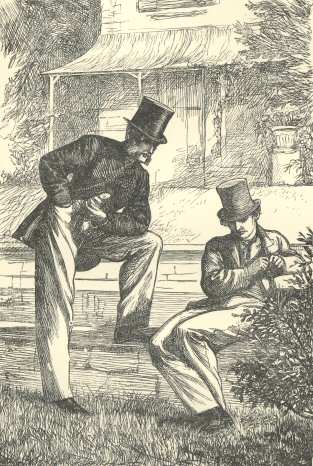
‘Not much of that, Mr. Harthouse, unless some faircreature with a slashing fortune at her own disposal would take afancy to me. Or she might be as ugly as she was rich,without any fear of losing me. I’d carve her name asoften as she liked.’
‘I am afraid you are mercenary, Tom.’
‘Mercenary,’ repeated Tom. ‘Who is notmercenary? Ask my sister.’
‘Have you so proved it to be a failing of mine,Tom?’ said Louisa, showing no other sense of his discontentand ill-nature.
‘You know whether the cap fits you, Loo,’ returnedher brother sulkily. ‘If it does, you can wearit.’
‘Tom is misanthropical to-day, as all bored people arenow and then,’ said Mr. Harthouse. ‘Don’tbelieve him, Mrs. Bounderby. He knows much better. Ishall disclose some of his opinions of you, privately expressedto me, unless he relents a little.’
‘At all events, Mr. Harthouse,’ said Tom,softening in his admiration of his patron, but shaking his headsullenly too, ‘you can’t tell her that I ever praisedher for being mercenary. I may have praised her for beingthe contrary, and I should do it again, if I had as goodreason. However, never mind this now; it’s not veryinteresting to you, and I am sick of the subject.’
They walked on to the house, where Louisa quitted hervisitor’s arm and went in. He stood looking afterher, as she ascended the steps, and passed into the shadow of thedoor; then put his hand upon her brother’s shoulder again,and invited him with a confidential nod to a walk in thegarden.
‘Tom, my fine fellow, I want to have a word withyou.’
They had stopped among a disorder of roses—it was partof Mr. Bounderby’s humility to keep Nickits’s roseson a reduced scale—and Tom sat down on a terrace-parapet,plucking buds and picking them to pieces; while his powerfulFamiliar stood over him, with a foot upon the parapet, and hisfigure easily resting on the arm supported by that knee. They were just visible from her window. Perhaps she sawthem.
‘Tom, what’s the matter?’
‘Oh! Mr. Harthouse,’ said Tom with a groan,‘I am hard up, and bothered out of my life.’
‘My good fellow, so am I.’
‘You!’ returned Tom. ‘You are thepicture of independence. Mr. Harthouse, I am in a horriblemess. You have no idea what a state I have got myselfinto—what a state my sister might have got me out of, ifshe would only have done it.’
He took to biting the rosebuds now, and tearing them away fromhis teeth with a hand that trembled like an infirm oldman’s. After one exceedingly observant look at him,his companion relapsed into his lightest air.
‘Tom, you are inconsiderate: you expect too much of yoursister. You have had money of her, you dog, you know youhave.’
‘Well, Mr. Harthouse, I know I have. How else wasI to get it? Here’s old Bounderby always boastingthat at my age he lived upon twopence a month, or something ofthat sort. Here’s my father drawing what he calls aline, and tying me down to it from a baby, neck and heels. Here’s my mother who never has anything of her own, excepther complaints. What isa fellow to do for money,and where amI to look for it, if not to mysister?’
He was almost crying, and scattered the buds about bydozens. Mr. Harthouse took him persuasively by thecoat.
‘But, my dear Tom, if your sister has not gotit—’
‘Not got it, Mr. Harthouse? I don’t say shehas got it. I may have wanted more than she was likely tohave got. But then she ought to get it. She could getit. It’s of no use pretending to make a secret ofmatters now, after what I have told you already; you know shedidn’t marry old Bounderby for her own sake, or for hissake, but for my sake. Then why doesn’t she get whatI want, out of him, for my sake? She is not obliged to saywhat she is going to do with it; she is sharp enough; she couldmanage to coax it out of him, if she chose. Then whydoesn’t she choose, when I tell her of what consequence itis? But no. There she sits in his company like astone, instead of making herself agreeable and getting iteasily. I don’t know what you may call this, but Icall it unnatural conduct.’
There was a piece of ornamental water immediately below theparapet, on the other side, into which Mr. James Harthouse had avery strong inclination to pitch Mr. Thomas Gradgrind junior, asthe injured men of Coketown threatened to pitch their propertyinto the Atlantic. But he preserved his easy attitude; andnothing more solid went over the stone balustrades than theaccumulated rosebuds now floating about, a littlesurface-island.
‘My dear Tom,’ said Harthouse, ‘let me tryto be your banker.’
‘For God’s sake,’ replied Tom, suddenly,‘don’t talk about bankers!’ And verywhite he looked, in contrast with the roses. Verywhite.
Mr. Harthouse, as a thoroughly well-bred man, accustomed tothe best society, was not to be surprised—he could as soonhave been affected—but he raised his eyelids a little more,as if they were lifted by a feeble touch of wonder. Albeitit was as much against the precepts of his school to wonder, asit was against the doctrines of the Gradgrind College.
‘What is the present need, Tom? Threefigures? Out with them. Say what they are.’
‘Mr. Harthouse,’ returned Tom, now actuallycrying; and his tears were better than his injuries, howeverpitiful a figure he made: ‘it’s too late; the moneyis of no use to me at present. I should have had it beforeto be of use to me. But I am very much obliged to you;you’re a true friend.’
A true friend! ‘Whelp, whelp!’ thought Mr.Harthouse, lazily; ‘what an Ass you are!’
‘And I take your offer as a great kindness,’ saidTom, grasping his hand. ‘As a great kindness, Mr.Harthouse.’
‘Well,’ returned the other, ‘it may be ofmore use by and by. And, my good fellow, if you will openyour bedevilments to me when they come thick upon you, I may showyou better ways out of them than you can find foryourself.’
‘Thank you,’ said Tom, shaking his head dismally,and chewing rosebuds. ‘I wish I had known you sooner,Mr. Harthouse.’
‘Now, you see, Tom,’ said Mr. Harthouse inconclusion, himself tossing over a rose or two, as a contributionto the island, which was always drifting to the wall as if itwanted to become a part of the mainland: ‘every man isselfish in everything he does, and I am exactly like the rest ofmy fellow-creatures. I am desperately intent;’ thelanguor of his desperation being quite tropical; ‘on yoursoftening towards your sister—which you ought to do; and onyour being a more loving and agreeable sort ofbrother—which you ought to be.’
‘I will be, Mr. Harthouse.’
‘No time like the present, Tom. Begin atonce.’
‘Certainly I will. And my sister Loo shall sayso.’
‘Having made which bargain, Tom,’ said Harthouse,clapping him on the shoulder again, with an air which left him atliberty to infer—as he did, poor fool—that thiscondition was imposed upon him in mere careless good nature tolessen his sense of obligation, ‘we will tear ourselvesasunder until dinner-time.’
When Tom appeared before dinner, though his mind seemed heavyenough, his body was on the alert; and he appeared before Mr.Bounderby came in. ‘I didn’t mean to be cross,Loo,’ he said, giving her his hand, and kissing her. ‘I know you are fond of me, and you know I am fond ofyou.’
After this, there was a smile upon Louisa’s face thatday, for some one else. Alas, for some one else!
‘So much the less is the whelp the only creature thatshe cares for,’ thought James Harthouse, reversing thereflection of his first day’s knowledge of her prettyface. ‘So much the less, so much the less.’
p.136CHAPTER VIII
EXPLOSION
The next morning was too bright amorning for sleep, and James Harthouse rose early, and sat in thepleasant bay window of his dressing-room, smoking the raretobacco that had had so wholesome an influence on his youngfriend. Reposing in the sunlight, with the fragrance of hiseastern pipe about him, and the dreamy smoke vanishing into theair, so rich and soft with summer odours, he reckoned up hisadvantages as an idle winner might count his gains. He wasnot at all bored for the time, and could give his mind to it.
He had established a confidence with her, from which herhusband was excluded. He had established a confidence withher, that absolutely turned upon her indifference towards herhusband, and the absence, now and at all times, of anycongeniality between them. He had artfully, but plainly,assured her that he knew her heart in its last most delicaterecesses; he had come so near to her through its tenderestsentiment; he had associated himself with that feeling; and thebarrier behind which she lived, had melted away. All veryodd, and very satisfactory!
And yet he had not, even now, any earnest wickedness ofpurpose in him. Publicly and privately, it were much betterfor the age in which he lived, that he and the legion of whom hewas one were designedly bad, than indifferent andpurposeless. It is the drifting icebergs setting with anycurrent anywhere, that wreck the ships.
When the Devil goeth about like a roaring lion, he goeth aboutin a shape by which few but savages and hunters areattracted. But, when he is trimmed, smoothed, andvarnished, according to the mode; when he is aweary of vice, andaweary of virtue, used up as to brimstone, and used up as tobliss; then, whether he take to the serving out of red tape, orto the kindling of red fire, he is the very Devil.
So James Harthouse reclined in the window, indolently smoking,and reckoning up the steps he had taken on the road by which hehappened to be travelling. The end to which it led wasbefore him, pretty plainly; but he troubled himself with nocalculations about it. What will be, will be.
As he had rather a long ride to take that day—for therewas a public occasion ‘to do’ at some distance, whichafforded a tolerable opportunity of going in for the Gradgrindmen—he dressed early and went down to breakfast. Hewas anxious to see if she had relapsed since the previousevening. No. He resumed where he had left off. There was a look of interest for him again.
He got through the day as much (or as little) to his ownsatisfaction, as was to be expected under the fatiguingcircumstances; and came riding back at six o’clock. There was a sweep of some half-mile between the lodge and thehouse, and he was riding along at a foot pace over the smoothgravel, once Nickits’s, when Mr. Bounderby burst out of theshrubbery, with such violence as to make his horse shy across theroad.
‘Harthouse!’ cried Mr. Bounderby. ‘Have you heard?’
‘Heard what?’ said Harthouse, soothing his horse,and inwardly favouring Mr. Bounderby with no good wishes.
‘Then you haven’theard!’
‘I have heard you, and so has this brute. I haveheard nothing else.’
Mr. Bounderby, red and hot, planted himself in the centre ofthe path before the horse’s head, to explode his bombshellwith more effect.
‘The Bank’s robbed!’
‘You don’t mean it!’
‘Robbed last night, sir. Robbed in anextraordinary manner. Robbed with a false key.’
‘Of much?’
Mr. Bounderby, in his desire to make the most of it, reallyseemed mortified by being obliged to reply, ‘Why, no; notof very much. But it might have been.’
‘Of how much?’
‘Oh! as a sum—if you stick to a sum—of notmore than a hundred and fifty pound,’ said Bounderby, withimpatience. ‘But it’s not the sum; it’sthe fact. It’s the fact of the Bank being robbed,that’s the important circumstance. I am surprised youdon’t see it.’
‘My dear Bounderby,’ said James, dismounting, andgiving his bridle to his servant, ‘I dosee it; andam as overcome as you can possibly desire me to be, by thespectacle afforded to my mental view. Nevertheless, I maybe allowed, I hope, to congratulate you—which I do with allmy soul, I assure you—on your not having sustained agreater loss.’
‘Thank’ee,’ replied Bounderby, in a short,ungracious manner. ‘But I tell you what. Itmight have been twenty thousand pound.’
‘I suppose it might.’
‘Suppose it might! By the Lord, you maysuppose so. By George!’ said Mr. Bounderby, withsundry menacing nods and shakes of his head. ‘Itmight have been twice twenty. There’s no knowing whatit would have been, or wouldn’t have been, as it was, butfor the fellows’ being disturbed.’
Louisa had come up now, and Mrs. Sparsit, and Bitzer.
‘Here’s Tom Gradgrind’s daughter knowspretty well what it might have been, if you don’t,’blustered Bounderby. ‘Dropped, sir, as if she wasshot when I told her! Never knew her do such a thingbefore. Does her credit, under the circumstances, in myopinion!’
She still looked faint and pale. James Harthouse beggedher to take his arm; and as they moved on very slowly, asked herhow the robbery had been committed.
‘Why, I am going to tell you,’ said Bounderby,irritably giving his arm to Mrs. Sparsit. ‘If youhadn’t been so mighty particular about the sum, I shouldhave begun to tell you before. You know this lady (for sheisa lady), Mrs. Sparsit?’
‘I have already had the honour—’
‘Very well. And this young man, Bitzer, you sawhim too on the same occasion?’ Mr. Harthouse inclinedhis head in assent, and Bitzer knuckled his forehead.
‘Very well. They live at the Bank. You knowthey live at the Bank, perhaps? Very well. Yesterdayafternoon, at the close of business hours, everything was putaway as usual. In the iron room that this young fellowsleeps outside of, there was never mind how much. In thelittle safe in young Tom’s closet, the safe used for pettypurposes, there was a hundred and fifty odd pound.’
‘A hundred and fifty-four, seven, one,’ saidBitzer.
‘Come!’ retorted Bounderby, stopping to wheelround upon him, ‘let’s have none of yourinterruptions. It’s enough to be robbed whileyou’re snoring because you’re too comfortable,without being put right with yourfour seven ones. Ididn’t snore, myself, when I was your age, let me tellyou. I hadn’t victuals enough to snore. And Ididn’t four seven one. Not if I knew it.’
Bitzer knuckled his forehead again, in a sneaking manner, andseemed at once particularly impressed and depressed by theinstance last given of Mr. Bounderby’s moralabstinence.
‘A hundred and fifty odd pound,’ resumed Mr.Bounderby. ‘That sum of money, young Tom locked inhis safe, not a very strong safe, but that’s no matternow. Everything was left, all right. Some time in thenight, while this young fellow snored—Mrs. Sparsit,ma’am, you say you have heard him snore?’
‘Sir,’ returned Mrs. Sparsit, ‘I cannot saythat I have heard him precisely snore, and therefore must notmake that statement. But on winter evenings, when he hasfallen asleep at his table, I have heard him, what I shouldprefer to describe as partially choke. I have heard him onsuch occasions produce sounds of a nature similar to what may besometimes heard in Dutch clocks. Not,’ said Mrs.Sparsit, with a lofty sense of giving strict evidence,‘that I would convey any imputation on his moralcharacter. Far from it. I have always consideredBitzer a young man of the most upright principle; and to that Ibeg to bear my testimony.’
‘Well!’ said the exasperated Bounderby,‘while he was snoring, orchoking, orDutch-clocking, orsomething orother—beingasleep—some fellows, somehow, whether previously concealedin the house or not remains to be seen, got to young Tom’ssafe, forced it, and abstracted the contents. Being thendisturbed, they made off; letting themselves out at the maindoor, and double-locking it again (it was double-locked, and thekey under Mrs. Sparsit’s pillow) with a false key, whichwas picked up in the street near the Bank, about twelveo’clock to-day. No alarm takes place, till this chap,Bitzer, turns out this morning, and begins to open and preparethe offices for business. Then, looking at Tom’ssafe, he sees the door ajar, and finds the lock forced, and themoney gone.’
‘Where is Tom, by the by?’ asked Harthouse,glancing round.
‘He has been helping the police,’ said Bounderby,‘and stays behind at the Bank. I wish these fellowshad tried to rob me when I was at his time of life. Theywould have been out of pocket if they had invested eighteenpencein the job; I can tell ’em that.’
‘Is anybody suspected?’
‘Suspected? I should think there was somebodysuspected. Egod!’ said Bounderby, relinquishing Mrs.Sparsit’s arm to wipe his heated head. ‘JosiahBounderby of Coketown is not to be plundered and nobodysuspected. No, thank you!’
Might Mr. Harthouse inquire Who was suspected?
‘Well,’ said Bounderby, stopping and facing aboutto confront them all, ‘I’ll tell you. It’s not to be mentioned everywhere; it’s not to bementioned anywhere: in order that the scoundrels concerned(there’s a gang of ’em) may be thrown off theirguard. So take this in confidence. Now wait abit.’ Mr. Bounderby wiped his head again. ‘What should you say to;’ here he violently exploded:‘to a Hand being in it?’
‘I hope,’ said Harthouse, lazily, ‘not ourfriend Blackpot?’
‘Say Pool instead of Pot, sir,’ returnedBounderby, ‘and that’s the man.’
Louisa faintly uttered some word of incredulity andsurprise.
‘O yes! I know!’ said Bounderby, immediatelycatching at the sound. ‘I know! I am used tothat. I know all about it. They are the finest peoplein the world, these fellows are. They have got the gift ofthe gab, they have. They only want to have their rightsexplained to them, they do. But I tell you what. Showme a dissatisfied Hand, and I’ll show you a manthat’s fit for anything bad, I don’t care what itis.’
Another of the popular fictions of Coketown, which some painshad been taken to disseminate—and which some people reallybelieved.
‘But I am acquainted with these chaps,’ saidBounderby. ‘I can read ’em off, likebooks. Mrs. Sparsit, ma’am, I appeal to you. What warning did I give that fellow, the first time he set footin the house, when the express object of his visit was to knowhow he could knock Religion over, and floor the EstablishedChurch? Mrs. Sparsit, in point of high connexions, you areon a level with the aristocracy,—did I say, or did I notsay, to that fellow, “you can’t hide the truth fromme: you are not the kind of fellow I like; you’ll come tono good”?’
‘Assuredly, sir,’ returned Mrs. Sparsit,‘you did, in a highly impressive manner, give him such anadmonition.’
‘When he shocked you, ma’am,’ saidBounderby; ‘when he shocked your feelings?’
‘Yes, sir,’ returned Mrs. Sparsit, with a meekshake of her head, ‘he certainly did so. Though I donot mean to say but that my feelings may be weaker on suchpoints—more foolish if the term is preferred—thanthey might have been, if I had always occupied my presentposition.’
Mr. Bounderby stared with a bursting pride at Mr. Harthouse,as much as to say, ‘I am the proprietor of this female, andshe’s worth your attention, I think.’ Then,resumed his discourse.
‘You can recall for yourself, Harthouse, what I said tohim when you saw him. I didn’t mince the matter withhim. I am never mealy with ’em. I KNOW ’em. Very well,sir. Three days after that, he bolted. Went off,nobody knows where: as my mother did in my infancy—onlywith this difference, that he is a worse subject than my mother,if possible. What did he do before he went? What doyou say;’ Mr. Bounderby, with his hat in his hand, gave abeat upon the crown at every little division of his sentences, asif it were a tambourine; ‘to his being seen—nightafter night—watching the Bank?—to his lurking aboutthere—after dark?—To its striking Mrs.Sparsit—that he could be lurking for no good—To hercalling Bitzer’s attention to him, and their both takingnotice of him—And to its appearing on inquiryto-day—that he was also noticed by theneighbours?’ Having come to the climax, Mr.Bounderby, like an oriental dancer, put his tambourine on hishead.
‘Suspicious,’ said James Harthouse,‘certainly.’
‘I think so, sir,’ said Bounderby, with a defiantnod. ‘I think so. But there are more of’em in it. There’s an old woman. Onenever hears of these things till the mischief’s done; allsorts of defects are found out in the stable door after the horseis stolen; there’s an old woman turns up now. An oldwoman who seems to have been flying into town on a broomstick,every now and then. Shewatches the place a wholeday before this fellow begins, and on the night when you saw him,she steals away with him and holds a council with him—Isuppose, to make her report on going off duty, and be damned toher.’
There was such a person in the room that night, and she shrunkfrom observation, thought Louisa.
‘This is not all of ’em, even as we already know’em,’ said Bounderby, with many nods of hiddenmeaning. ‘But I have said enough for thepresent. You’ll have the goodness to keep it quiet,and mention it to no one. It may take time, but we shallhave ’em. It’s policy to give ’em lineenough, and there’s no objection to that.’
‘Of course, they will be punished with the utmost rigourof the law, as notice-boards observe,’ replied JamesHarthouse, ‘and serve them right. Fellows who go infor Banks must take the consequences. If there were noconsequences, we should all go in for Banks.’ He hadgently taken Louisa’s parasol from her hand, and had put itup for her; and she walked under its shade, though the sun didnot shine there.
‘For the present, Loo Bounderby,’ said herhusband, ‘here’s Mrs. Sparsit to look after. Mrs. Sparsit’s nerves have been acted upon by thisbusiness, and she’ll stay here a day or two. So makeher comfortable.’
‘Thank you very much, sir,’ that discreet ladyobserved, ‘but pray do not let My comfort be aconsideration. Anything will do for Me.’
It soon appeared that if Mrs. Sparsit had a failing in herassociation with that domestic establishment, it was that she wasso excessively regardless of herself and regardful of others, asto be a nuisance. On being shown her chamber, she was sodreadfully sensible of its comforts as to suggest the inferencethat she would have preferred to pass the night on the mangle inthe laundry. True, the Powlers and the Scadgerses wereaccustomed to splendour, ‘but it is my duty toremember,’ Mrs. Sparsit was fond of observing with a loftygrace: particularly when any of the domestics were present,‘that what I was, I am no longer. Indeed,’ saidshe, ‘if I could altogether cancel the remembrance that Mr.Sparsit was a Powler, or that I myself am related to the Scadgersfamily; or if I could even revoke the fact, and make myself aperson of common descent and ordinary connexions; I would gladlydo so. I should think it, under existing circumstances,right to do so.’ The same Hermitical state of mindled to her renunciation of made dishes and wines at dinner, untilfairly commanded by Mr. Bounderby to take them; when she said,‘Indeed you are very good, sir;’ and departed from aresolution of which she had made rather formal and publicannouncement, to ‘wait for the simple mutton.’ She was likewise deeply apologetic for wanting the salt; and,feeling amiably bound to bear out Mr. Bounderby to the fullestextent in the testimony he had borne to her nerves, occasionallysat back in her chair and silently wept; at which periods a tearof large dimensions, like a crystal ear-ring, might be observed(or rather, must be, for it insisted on public notice) slidingdown her Roman nose.
But Mrs. Sparsit’s greatest point, first and last, washer determination to pity Mr. Bounderby. There wereoccasions when in looking at him she was involuntarily moved toshake her head, as who would say, ‘Alas, poorYorick!’ After allowing herself to be betrayed intothese evidences of emotion, she would force a lambent brightness,and would be fitfully cheerful, and would say, ‘You havestill good spirits, sir, I am thankful to find;’ and wouldappear to hail it as a blessed dispensation that Mr. Bounderbybore up as he did. One idiosyncrasy for which she oftenapologized, she found it excessively difficult to conquer. She had a curious propensity to call Mrs. Bounderby ‘MissGradgrind,’ and yielded to it some three or four scoretimes in the course of the evening. Her repetition of thismistake covered Mrs. Sparsit with modest confusion; but indeed,she said, it seemed so natural to say Miss Gradgrind: whereas, topersuade herself that the young lady whom she had had thehappiness of knowing from a child could be really and truly Mrs.Bounderby, she found almost impossible. It was a furthersingularity of this remarkable case, that the more she thoughtabout it, the more impossible it appeared; ‘thedifferences,’ she observed, ‘being such.’
In the drawing-room after dinner, Mr. Bounderby tried the caseof the robbery, examined the witnesses, made notes of theevidence, found the suspected persons guilty, and sentenced themto the extreme punishment of the law. That done, Bitzer wasdismissed to town with instructions to recommend Tom to come homeby the mail-train.
When candles were brought, Mrs. Sparsit murmured,‘Don’t be low, sir. Pray let me see youcheerful, sir, as I used to do.’ Mr. Bounderby, uponwhom these consolations had begun to produce the effect of makinghim, in a bull-headed blundering way, sentimental, sighed likesome large sea-animal. ‘I cannot bear to see you so,sir,’ said Mrs. Sparsit. ‘Try a hand atbackgammon, sir, as you used to do when I had the honour ofliving under your roof.’ ‘I haven’tplayed backgammon, ma’am,’ said Mr. Bounderby,‘since that time.’ ‘No, sir,’ saidMrs. Sparsit, soothingly, ‘I am aware that you havenot. I remember that Miss Gradgrind takes no interest inthe game. But I shall be happy, sir, if you willcondescend.’
They played near a window, opening on the garden. It wasa fine night: not moonlight, but sultry and fragrant. Louisa and Mr. Harthouse strolled out into the garden, wheretheir voices could be heard in the stillness, though not whatthey said. Mrs. Sparsit, from her place at the backgammonboard, was constantly straining her eyes to pierce the shadowswithout. ‘What’s the matter,ma’am?’ said Mr. Bounderby; ‘you don’tsee a Fire, do you?’ ‘Oh dear no, sir,’returned Mrs. Sparsit, ‘I was thinking of thedew.’ ‘What have you got to do with the dew,ma’am?’ said Mr. Bounderby. ‘It’snot myself, sir,’ returned Mrs. Sparsit, ‘I amfearful of Miss Gradgrind’s taking cold.’ ‘She never takes cold,’ said Mr. Bounderby. ‘Really, sir?’ said Mrs. Sparsit. And wasaffected with a cough in her throat.
When the time drew near for retiring, Mr. Bounderby took aglass of water. ‘Oh, sir?’ said Mrs.Sparsit. ‘Not your sherry warm, with lemon-peel andnutmeg?’ ‘Why, I have got out of the habit oftaking it now, ma’am,’ said Mr. Bounderby. ‘The more’s the pity, sir,’ returned Mrs.Sparsit; ‘you are losing all your good old habits. Cheer up, sir! If Miss Gradgrind will permit me, I willoffer to make it for you, as I have often done.’
Miss Gradgrind readily permitting Mrs. Sparsit to do anythingshe pleased, that considerate lady made the beverage, and handedit to Mr. Bounderby. ‘It will do you good, sir. It will warm your heart. It is the sort of thing you want,and ought to take, sir.’ And when Mr. Bounderby said,‘Your health, ma’am!’ she answered with greatfeeling, ‘Thank you, sir. The same to you, andhappiness also.’ Finally, she wished him good night,with great pathos; and Mr. Bounderby went to bed, with a maudlinpersuasion that he had been crossed in something tender, thoughhe could not, for his life, have mentioned what it was.
Long after Louisa had undressed and lain down, she watched andwaited for her brother’s coming home. That couldhardly be, she knew, until an hour past midnight; but in thecountry silence, which did anything but calm the trouble of herthoughts, time lagged wearily. At last, when the darknessand stillness had seemed for hours to thicken one another, sheheard the bell at the gate. She felt as though she wouldhave been glad that it rang on until daylight; but it ceased, andthe circles of its last sound spread out fainter and wider in theair, and all was dead again.
She waited yet some quarter of an hour, as she judged. Then she arose, put on a loose robe, and went out of her room inthe dark, and up the staircase to her brother’s room. His door being shut, she softly opened it and spoke to him,approaching his bed with a noiseless step.
She kneeled down beside it, passed her arm over his neck, anddrew his face to hers. She knew that he only feigned to beasleep, but she said nothing to him.
He started by and by as if he were just then awakened, andasked who that was, and what was the matter?
‘Tom, have you anything to tell me? If ever youloved me in your life, and have anything concealed from every onebesides, tell it to me.’
‘I don’t know what you mean, Loo. You havebeen dreaming.’
‘My dear brother:’ she laid her head down on hispillow, and her hair flowed over him as if she would hide himfrom every one but herself: ‘is there nothing that you haveto tell me? Is there nothing you can tell me if youwill? You can tell me nothing that will change me. OTom, tell me the truth!’
‘I don’t know what you mean, Loo!’
‘As you lie here alone, my dear, in the melancholynight, so you must lie somewhere one night, when even I, if I amliving then, shall have left you. As I am here beside you,barefoot, unclothed, undistinguishable in darkness, so must I liethrough all the night of my decay, until I am dust. In thename of that time, Tom, tell me the truth now!’
‘What is it you want to know?’
‘You may be certain;’ in the energy of her loveshe took him to her bosom as if he were a child; ‘that Iwill not reproach you. You may be certain that I will becompassionate and true to you. You may be certain that Iwill save you at whatever cost. O Tom, have you nothing totell me? Whisper very softly. Say only“yes,” and I shall understand you!’
She turned her ear to his lips, but he remained doggedlysilent.
‘Not a word, Tom?’
‘How can I say Yes, or how can I say No, when Idon’t know what you mean? Loo, you are a brave, kindgirl, worthy I begin to think of a better brother than Iam. But I have nothing more to say. Go to bed, go tobed.’
‘You are tired,’ she whispered presently, more inher usual way.
‘Yes, I am quite tired out.’
‘You have been so hurried and disturbed to-day. Have any fresh discoveries been made?’
‘Only those you have heard of,from—him.’
‘Tom, have you said to any one that we made a visit tothose people, and that we saw those three together?’
‘No. Didn’t you yourself particularly ask meto keep it quiet when you asked me to go there withyou?’
‘Yes. But I did not know then what was going tohappen.’
‘Nor I neither. How could I?’
He was very quick upon her with this retort.
‘Ought I to say, after what has happened,’ saidhis sister, standing by the bed—she had gradually withdrawnherself and risen, ‘that I made that visit? Should Isay so? Must I say so?’
‘Good Heavens, Loo,’ returned her brother,‘you are not in the habit of asking my advice. Saywhat you like. If you keep it to yourself, I shall keep itto myself. If you disclose it, there’s an endof it.’
It was too dark for either to see the other’s face; buteach seemed very attentive, and to consider before speaking.
‘Tom, do you believe the man I gave the money to, isreally implicated in this crime?’
‘I don’t know. I don’t see why heshouldn’t be.’
‘He seemed to me an honest man.’
‘Another person may seem to you dishonest, and yet notbe so.’ There was a pause, for he had hesitated andstopped.
‘In short,’ resumed Tom, as if he had made up hismind, ‘if you come to that, perhaps I was so far from beingaltogether in his favour, that I took him outside the door totell him quietly, that I thought he might consider himself verywell off to get such a windfall as he had got from my sister, andthat I hoped he would make good use of it. You rememberwhether I took him out or not. I say nothing against theman; he may be a very good fellow, for anything I know; I hope heis.’
‘Was he offended by what you said?’
‘No, he took it pretty well; he was civil enough. Where are you, Loo?’ He sat up in bed and kissedher. ‘Good night, my dear, good night.’
‘You have nothing more to tell me?’
‘No. What should I have? You wouldn’thave me tell you a lie!’
‘I wouldn’t have you do that to-night, Tom, of allthe nights in your life; many and much happier as I hope theywill be.’
‘Thank you, my dear Loo. I am so tired, that I amsure I wonder I don’t say anything to get to sleep. Go to bed, go to bed.’
Kissing her again, he turned round, drew the coverlet over hishead, and lay as still as if that time had come by which she hadadjured him. She stood for some time at the bedside beforeshe slowly moved away. She stopped at the door, looked backwhen she had opened it, and asked him if he had called her? But he lay still, and she softly closed the door and returned toher room.
Then the wretched boy looked cautiously up and found her gone,crept out of bed, fastened his door, and threw himself upon hispillow again: tearing his hair, morosely crying, grudginglyloving her, hatefully but impenitently spurning himself, and noless hatefully and unprofitably spurning all the good in theworld.
p.146CHAPTER IX
HEARING THE LAST OF IT
Mrs. Sparsit, lying by to recoverthe tone of her nerves in Mr. Bounderby’s retreat, keptsuch a sharp look-out, night and day, under her Coriolanianeyebrows, that her eyes, like a couple of lighthouses on aniron-bound coast, might have warned all prudent mariners fromthat bold rock her Roman nose and the dark and craggy region inits neighbourhood, but for the placidity of her manner. Although it was hard to believe that her retiring for the nightcould be anything but a form, so severely wide awake were thoseclassical eyes of hers, and so impossible did it seem that herrigid nose could yield to any relaxing influence, yet her mannerof sitting, smoothing her uncomfortable, not to say, grittymittens (they were constructed of a cool fabric like ameat-safe), or of ambling to unknown places of destination withher foot in her cotton stirrup, was so perfectly serene, thatmost observers would have been constrained to suppose her a dove,embodied by some freak of nature, in the earthly tabernacle of abird of the hook-beaked order.
She was a most wonderful woman for prowling about thehouse. How she got from story to story was a mystery beyondsolution. A lady so decorous in herself, and so highlyconnected, was not to be suspected of dropping over the banistersor sliding down them, yet her extraordinary facility oflocomotion suggested the wild idea. Another noticeablecircumstance in Mrs. Sparsit was, that she was neverhurried. She would shoot with consummate velocity from theroof to the hall, yet would be in full possession of her breathand dignity on the moment of her arrival there. Neither wasshe ever seen by human vision to go at a great pace.
She took very kindly to Mr. Harthouse, and had some pleasantconversation with him soon after her arrival. She made himher stately curtsey in the garden, one morning beforebreakfast.
‘It appears but yesterday, sir,’ said Mrs.Sparsit, ‘that I had the honour of receiving you at theBank, when you were so good as to wish to be made acquainted withMr. Bounderby’s address.’
‘An occasion, I am sure, not to be forgotten by myselfin the course of Ages,’ said Mr. Harthouse, inclining hishead to Mrs. Sparsit with the most indolent of all possibleairs.
‘We live in a singular world, sir,’ said Mrs.Sparsit.
‘I have had the honour, by a coincidence of which I amproud, to have made a remark, similar in effect, though not soepigrammatically expressed.’
‘A singular world, I would say, sir,’ pursued Mrs.Sparsit; after acknowledging the compliment with a drooping ofher dark eyebrows, not altogether so mild in its expression asher voice was in its dulcet tones; ‘as regards theintimacies we form at one time, with individuals we were quiteignorant of, at another. I recall, sir, that on thatoccasion you went so far as to say you were actually apprehensiveof Miss Gradgrind.’
‘Your memory does me more honour than my insignificancedeserves. I availed myself of your obliging hints tocorrect my timidity, and it is unnecessary to add that they wereperfectly accurate. Mrs. Sparsit’s talentfor—in fact for anything requiring accuracy—with acombination of strength of mind—and Family—is toohabitually developed to admit of any question.’ Hewas almost falling asleep over this compliment; it took him solong to get through, and his mind wandered so much in the courseof its execution.
‘You found Miss Gradgrind—I really cannot call herMrs. Bounderby; it’s very absurd of me—as youthful asI described her?’ asked Mrs. Sparsit, sweetly.
‘You drew her portrait perfectly,’ said Mr.Harthouse. ‘Presented her dead image.’
‘Very engaging, sir,’ said Mrs. Sparsit, causingher mittens slowly to revolve over one another.
‘Highly so.’
‘It used to be considered,’ said Mrs. Sparsit,‘that Miss Gradgrind was wanting in animation, but Iconfess she appears to me considerably and strikingly improved inthat respect. Ay, and indeed here isMr.Bounderby!’ cried Mrs. Sparsit, nodding her head a greatmany times, as if she had been talking and thinking of no oneelse. ‘How do you find yourself this morning,sir? Pray let us see you cheerful, sir.’
Now, these persistent assuagements of his misery, andlightenings of his load, had by this time begun to have theeffect of making Mr. Bounderby softer than usual towards Mrs.Sparsit, and harder than usual to most other people from his wifedownward. So, when Mrs. Sparsit said with forced lightnessof heart, ‘You want your breakfast, sir, but I dare sayMiss Gradgrind will soon be here to preside at the table,’Mr. Bounderby replied, ‘If I waited to be taken care of bymy wife, ma’am, I believe you know pretty well I shouldwait till Doomsday, so I’ll trouble youto takecharge of the teapot.’ Mrs. Sparsit complied, andassumed her old position at table.
This again made the excellent woman vastly sentimental. She was so humble withal, that when Louisa appeared, she rose,protesting she never could think of sitting in that place underexisting circumstances, often as she had had the honour of makingMr. Bounderby’s breakfast, before Mrs. Gradgrind—shebegged pardon, she meant to say Miss Bounderby—she hoped tobe excused, but she really could not get it right yet, though shetrusted to become familiar with it by and by—had assumedher present position. It was only (she observed) becauseMiss Gradgrind happened to be a little late, and Mr.Bounderby’s time was so very precious, and she knew it ofold to be so essential that he should breakfast to the moment,that she had taken the liberty of complying with his request;long as his will had been a law to her.
‘There! Stop where you are, ma’am,’said Mr. Bounderby, ‘stop where you are! Mrs.Bounderby will be very glad to be relieved of the trouble, Ibelieve.’
‘Don’t say that, sir,’ returned Mrs.Sparsit, almost with severity, ‘because that is very unkindto Mrs. Bounderby. And to be unkind is not to be you,sir.’
‘You may set your mind at rest, ma’am.—Youcan take it very quietly, can’t you, Loo?’ said Mr.Bounderby, in a blustering way to his wife.
‘Of course. It is of no moment. Why shouldit be of any importance to me?’
‘Why should it be of any importance to any one, Mrs.Sparsit, ma’am?’ said Mr. Bounderby, swelling with asense of slight. ‘You attach too much importance tothese things, ma’am. By George, you’ll becorrupted in some of your notions here. You areold-fashioned, ma’am. You are behind TomGradgrind’s children’s time.’
‘What is the matter with you?’ asked Louisa,coldly surprised. ‘What has given youoffence?’
‘Offence!’ repeated Bounderby. ‘Do yousuppose if there was any offence given me, I shouldn’t nameit, and request to have it corrected? I am astraightforward man, I believe. I don’t go beatingabout for side-winds.’
‘I suppose no one ever had occasion to think you toodiffident, or too delicate,’ Louisa answered himcomposedly: ‘I have never made that objection to you,either as a child or as a woman. I don’t understandwhat you would have.’
‘Have?’ returned Mr. Bounderby. ‘Nothing. Otherwise, don’t you, Loo Bounderby,know thoroughly well that I, Josiah Bounderby of Coketown, wouldhave it?’
She looked at him, as he struck the table and made the teacupsring, with a proud colour in her face that was a new change, Mr.Harthouse thought. ‘You are incomprehensible thismorning,’ said Louisa. ‘Pray take no furthertrouble to explain yourself. I am not curious to know yourmeaning. What does it matter?’
Nothing more was said on this theme, and Mr. Harthouse wassoon idly gay on indifferent subjects. But from this day,the Sparsit action upon Mr. Bounderby threw Louisa and JamesHarthouse more together, and strengthened the dangerousalienation from her husband and confidence against him withanother, into which she had fallen by degrees so fine that shecould not retrace them if she tried. But whether she evertried or no, lay hidden in her own closed heart.
Mrs. Sparsit was so much affected on this particular occasion,that, assisting Mr. Bounderby to his hat after breakfast, andbeing then alone with him in the hall, she imprinted a chastekiss upon his hand, murmured ‘My benefactor!’ andretired, overwhelmed with grief. Yet it is an indubitablefact, within the cognizance of this history, that five minutesafter he had left the house in the self-same hat, the samedescendant of the Scadgerses and connexion by matrimony of thePowlers, shook her right-hand mitten at his portrait, made acontemptuous grimace at that work of art, and said ‘Serveyou right, you Noodle, and I am glad of it.’
Mr. Bounderby had not been long gone, when Bitzerappeared. Bitzer had come down by train, shrieking andrattling over the long line of arches that bestrode the wildcountry of past and present coal-pits, with an express from StoneLodge. It was a hasty note to inform Louisa that Mrs.Gradgrind lay very ill. She had never been well within herdaughter’s knowledge; but, she had declined within the lastfew days, had continued sinking all through the night, and wasnow as nearly dead, as her limited capacity of being in any statethat implied the ghost of an intention to get out of it,allowed.
Accompanied by the lightest of porters, fit colourlessservitor at Death’s door when Mrs. Gradgrind knocked,Louisa rumbled to Coketown, over the coal-pits past and present,and was whirled into its smoky jaws. She dismissed themessenger to his own devices, and rode away to her old home.
She had seldom been there since her marriage. Her fatherwas usually sifting and sifting at his parliamentary cinder-heapin London (without being observed to turn up many preciousarticles among the rubbish), and was still hard at it in thenational dust-yard. Her mother had taken it rather as adisturbance than otherwise, to be visited, as she reclined uponher sofa; young people, Louisa felt herself all unfit for; Sissyshe had never softened to again, since the night when thestroller’s child had raised her eyes to look at Mr.Bounderby’s intended wife. She had no inducements togo back, and had rarely gone.
Neither, as she approached her old home now, did any of thebest influences of old home descend upon her. The dreams ofchildhood—its airy fables; its graceful, beautiful, humane,impossible adornments of the world beyond: so good to be believedin once, so good to be remembered when outgrown, for then theleast among them rises to the stature of a great Charity in theheart, suffering little children to come into the midst of it,and to keep with their pure hands a garden in the stony ways ofthis world, wherein it were better for all the children of Adamthat they should oftener sun themselves, simple and trustful, andnot worldly-wise—what had she to do with these? Remembrances of how she had journeyed to the little that sheknew, by the enchanted roads of what she and millions of innocentcreatures had hoped and imagined; of how, first coming uponReason through the tender light of Fancy, she had seen it abeneficent god, deferring to gods as great as itself; not a grimIdol, cruel and cold, with its victims bound hand to foot, andits big dumb shape set up with a sightless stare, never to bemoved by anything but so many calculated tons ofleverage—what had she to do with these? Herremembrances of home and childhood were remembrances of thedrying up of every spring and fountain in her young heart as itgushed out. The golden waters were not there. Theywere flowing for the fertilization of the land where grapes aregathered from thorns, and figs from thistles.
She went, with a heavy, hardened kind of sorrow upon her, intothe house and into her mother’s room. Since the timeof her leaving home, Sissy had lived with the rest of the familyon equal terms. Sissy was at her mother’s side; andJane, her sister, now ten or twelve years old, was in theroom.
There was great trouble before it could be made known to Mrs.Gradgrind that her eldest child was there. She reclined,propped up, from mere habit, on a couch: as nearly in her oldusual attitude, as anything so helpless could be kept in. She had positively refused to take to her bed; on the ground thatif she did, she would never hear the last of it.
Her feeble voice sounded so far away in her bundle of shawls,and the sound of another voice addressing her seemed to take sucha long time in getting down to her ears, that she might have beenlying at the bottom of a well. The poor lady was nearerTruth than she ever had been: which had much to do with it.
On being told that Mrs. Bounderby was there, she replied, atcross-purposes, that she had never called him by that name sincehe married Louisa; that pending her choice of an objectionablename, she had called him J; and that she could not at presentdepart from that regulation, not being yet provided with apermanent substitute. Louisa had sat by her for someminutes, and had spoken to her often, before she arrived at aclear understanding who it was. She then seemed to come toit all at once.
‘Well, my dear,’ said Mrs. Gradgrind, ‘and Ihope you are going on satisfactorily to yourself. It wasall your father’s doing. He set his heart uponit. And he ought to know.’
‘I want to hear of you, mother; not ofmyself.’
‘You want to hear of me, my dear? That’ssomething new, I am sure, when anybody wants to hear of me. Not at all well, Louisa. Very faint and giddy.’
‘Are you in pain, dear mother?’
‘I think there’s a pain somewhere in theroom,’ said Mrs. Gradgrind, ‘but I couldn’tpositively say that I have got it.’
After this strange speech, she lay silent for some time. Louisa, holding her hand, could feel no pulse; but kissing it,could see a slight thin thread of life in fluttering motion.
‘You very seldom see your sister,’ said Mrs.Gradgrind. ‘She grows like you. I wish youwould look at her. Sissy, bring her here.’
She was brought, and stood with her hand in hersister’s. Louisa had observed her with her arm roundSissy’s neck, and she felt the difference of thisapproach.
‘Do you see the likeness, Louisa?’
‘Yes, mother. I should think her like me. But—’
‘Eh! Yes, I always say so,’ Mrs. Gradgrindcried, with unexpected quickness. ‘And that remindsme. I—I want to speak to you, my dear. Sissy,my good girl, leave us alone a minute.’ Louisa hadrelinquished the hand: had thought that her sister’s was abetter and brighter face than hers had ever been: had seen in it,not without a rising feeling of resentment, even in that placeand at that time, something of the gentleness of the other facein the room; the sweet face with the trusting eyes, made palerthan watching and sympathy made it, by the rich dark hair.
Left alone with her mother, Louisa saw her lying with an awfullull upon her face, like one who was floating away upon somegreat water, all resistance over, content to be carried down thestream. She put the shadow of a hand to her lips again, andrecalled her.
‘You were going to speak to me, mother.’
‘Eh? Yes, to be sure, my dear. You know yourfather is almost always away now, and therefore I must write tohim about it.’
‘About what, mother? Don’t betroubled. About what?’
‘You must remember, my dear, that whenever I have saidanything, on any subject, I have never heard the last of it: andconsequently, that I have long left off sayinganything.’
p.152‘I can hear you, mother.’ But, it wasonly by dint of bending down to her ear, and at the same timeattentively watching the lips as they moved, that she could linksuch faint and broken sounds into any chain of connexion.
‘You learnt a great deal, Louisa, and so did yourbrother. Ologies of all kinds from morning to night. If there is any Ology left, of any description, that has not beenworn to rags in this house, all I can say is, I hope I shallnever hear its name.’
‘I can hear you, mother, when you have strength to goon.’ This, to keep her from floating away.
‘But there is something—not an Ology atall—that your father has missed, or forgotten,Louisa. I don’t know what it is. I have oftensat with Sissy near me, and thought about it. I shall neverget its name now. But your father may. It makes merestless. I want to write to him, to find out forGod’s sake, what it is. Give me a pen, give me apen.’
Even the power of restlessness was gone, except from the poorhead, which could just turn from side to side.
She fancied, however, that her request had been complied with,and that the pen she could not have held was in her hand. It matters little what figures of wonderful no-meaning she beganto trace upon her wrappers. The hand soon stopped in themidst of them; the light that had always been feeble and dimbehind the weak transparency, went out; and even Mrs. Gradgrind,emerged from the shadow in which man walketh and disquietethhimself in vain, took upon her the dread solemnity of the sagesand patriarchs.
CHAPTER X
MRS. SPARSIT’S STAIRCASE
Mrs. Sparsit’s nerves beingslow to recover their tone, the worthy woman made a stay of someweeks in duration at Mr. Bounderby’s retreat, where,notwithstanding her anchorite turn of mind based upon herbecoming consciousness of her altered station, she resignedherself with noble fortitude to lodging, as one may say, inclover, and feeding on the fat of the land. During thewhole term of this recess from the guardianship of the Bank, Mrs.Sparsit was a pattern of consistency; continuing to take suchpity on Mr. Bounderby to his face, as is rarely taken on man, andto call his portrait a Noodle to itsface, with thegreatest acrimony and contempt.
Mr. Bounderby, having got it into his explosive compositionthat Mrs. Sparsit was a highly superior woman to perceive that hehad that general cross upon him in his deserts (for he had notyet settled what it was), and further that Louisa would haveobjected to her as a frequent visitor if it had comported withhis greatness that she should object to anything he chose to do,resolved not to lose sight of Mrs. Sparsit easily. So whenher nerves were strung up to the pitch of again consumingsweetbreads in solitude, he said to her at the dinner-table, onthe day before her departure, ‘I tell you what,ma’am; you shall come down here of a Saturday, while thefine weather lasts, and stay till Monday.’ To whichMrs. Sparsit returned, in effect, though not of the Mahomedanpersuasion: ‘To hear is to obey.’
Now, Mrs. Sparsit was not a poetical woman; but she took anidea in the nature of an allegorical fancy, into her head. Much watching of Louisa, and much consequent observation of herimpenetrable demeanour, which keenly whetted and sharpened Mrs.Sparsit’s edge, must have given her as it were a lift, inthe way of inspiration. She erected in her mind a mightyStaircase, with a dark pit of shame and ruin at the bottom; anddown those stairs, from day to day and hour to hour, she sawLouisa coming.
It became the business of Mrs. Sparsit’s life, to lookup at her staircase, and to watch Louisa coming down. Sometimes slowly, sometimes quickly, sometimes several steps atone bout, sometimes stopping, never turning back. If shehad once turned back, it might have been the death of Mrs.Sparsit in spleen and grief.
She had been descending steadily, to the day, and on the day,when Mr. Bounderby issued the weekly invitation recordedabove. Mrs. Sparsit was in good spirits, and inclined to beconversational.
‘And pray, sir,’ said she, ‘if I may ventureto ask a question appertaining to any subject on which you showreserve—which is indeed hardy in me, for I well know youhave a reason for everything you do—have you receivedintelligence respecting the robbery?’
‘Why, ma’am, no; not yet. Under thecircumstances, I didn’t expect it yet. Romewasn’t built in a day, ma’am.’
‘Very true, sir,’ said Mrs. Sparsit, shaking herhead.
‘Nor yet in a week, ma’am.’
‘No, indeed, sir,’ returned Mrs. Sparsit, with agentle melancholy upon her.
‘In a similar manner, ma’am,’ saidBounderby, ‘I can wait, you know. If Romulus andRemus could wait, Josiah Bounderby can wait. They werebetter off in their youth than I was, however. They had ashe-wolf for a nurse; I had only a she-wolf for agrandmother. She didn’t give any milk, ma’am;she gave bruises. She was a regular Alderney atthat.’
‘Ah!’ Mrs. Sparsit sighed and shuddered.
‘No, ma’am,’ continued Bounderby, ‘Ihave not heard anything more about it. It’s in hand,though; and young Tom, who rather sticks to business atpresent—something new for him; he hadn’t theschooling Ihad—is helping. My injunction is,Keep it quiet, and let it seem to blow over. Do what youlike under the rose, but don’t give a sign of whatyou’re about; or half a hundred of ’em will combinetogether and get this fellow who has bolted, out of reach forgood. Keep it quiet, and the thieves will grow inconfidence by little and little, and we shall have’em.’
‘Very sagacious indeed, sir,’ said Mrs.Sparsit. ‘Very interesting. The old woman youmentioned, sir—’
‘The old woman I mentioned, ma’am,’ saidBounderby, cutting the matter short, as it was nothing to boastabout, ‘is not laid hold of; but, she may take her oath shewill be, if that is any satisfaction to her villainous oldmind. In the mean time, ma’am, I am of opinion, ifyou ask me my opinion, that the less she is talked about, thebetter.’
The same evening, Mrs. Sparsit, in her chamber window, restingfrom her packing operations, looked towards her great staircaseand saw Louisa still descending.
She sat by Mr. Harthouse, in an alcove in the garden, talkingvery low; he stood leaning over her, as they whispered together,and his face almost touched her hair. ‘If notquite!’ said Mrs. Sparsit, straining her hawk’s eyesto the utmost. Mrs. Sparsit was too distant to hear a wordof their discourse, or even to know that they were speakingsoftly, otherwise than from the expression of their figures; butwhat they said was this:
‘You recollect the man, Mr. Harthouse?’
‘Oh, perfectly!’
‘His face, and his manner, and what he said?’
‘Perfectly. And an infinitely dreary person heappeared to me to be. Lengthy and prosy in theextreme. It was knowing to hold forth, in the humble-virtueschool of eloquence; but, I assure you I thought at the time,“My good fellow, you are over-doing this!”’
‘It has been very difficult to me to think ill of thatman.’
‘My dear Louisa—as Tom says.’ Which henever did say. ‘You know no good of thefellow?’
‘No, certainly.’
‘Nor of any other such person?’
‘How can I,’ she returned, with more of her firstmanner on her than he had lately seen, ‘when I know nothingof them, men or women?’
‘My dear Louisa, then consent to receive the submissiverepresentation of your devoted friend, who knows something ofseveral varieties of his excellent fellow-creatures—forexcellent they are, I am quite ready to believe, in spite of suchlittle foibles as always helping themselves to what they can gethold of. This fellow talks. Well; every fellowtalks. He professes morality. Well; all sorts ofhumbugs profess morality. From the House of Commons to theHouse of Correction, there is a general profession of morality,except among our people; it really is that exception which makesour people quite reviving. You saw and heard thecase. Here was one of the fluffy classes pulled upextremely short by my esteemed friend Mr. Bounderby—who, aswe know, is not possessed of that delicacy which would soften sotight a hand. The member of the fluffy classes was injured,exasperated, left the house grumbling, met somebody who proposedto him to go in for some share in this Bank business, went in,put something in his pocket which had nothing in it before, andrelieved his mind extremely. Really he would have been anuncommon, instead of a common, fellow, if he had not availedhimself of such an opportunity. Or he may have originatedit altogether, if he had the cleverness.’
‘I almost feel as though it must be bad in me,’returned Louisa, after sitting thoughtful awhile, ‘to be soready to agree with you, and to be so lightened in my heart bywhat you say.’
‘I only say what is reasonable; nothing worse. Ihave talked it over with my friend Tom more than once—ofcourse I remain on terms of perfect confidence with Tom—andhe is quite of my opinion, and I am quite of his. Will youwalk?’
They strolled away, among the lanes beginning to be indistinctin the twilight—she leaning on his arm—and she littlethought how she was going down, down, down, Mrs. Sparsit’sstaircase.
Night and day, Mrs. Sparsit kept it standing. WhenLouisa had arrived at the bottom and disappeared in the gulf, itmight fall in upon her if it would; but, until then, there it wasto be, a Building, before Mrs. Sparsit’s eyes. Andthere Louisa always was, upon it.
And always gliding down, down, down!
Mrs. Sparsit saw James Harthouse come and go; she heard of himhere and there; she saw the changes of the face he had studied;she, too, remarked to a nicety how and when it clouded, how andwhen it cleared; she kept her black eyes wide open, with no touchof pity, with no touch of compunction, all absorbed ininterest. In the interest of seeing her, ever drawing, withno hand to stay her, nearer and nearer to the bottom of this newGiant’s Staircase.
With all her deference for Mr. Bounderby ascontradistinguished from his portrait, Mrs. Sparsit had not thesmallest intention of interrupting the descent. Eager tosee it accomplished, and yet patient, she waited for the lastfall, as for the ripeness and fulness of the harvest of herhopes. Hushed in expectancy, she kept her wary gaze uponthe stairs; and seldom so much as darkly shook her right mitten(with her fist in it), at the figure coming down.
p.156CHAPTER XI
LOWER AND LOWER
The figure descended the greatstairs, steadily, steadily; always verging, like a weight in deepwater, to the black gulf at the bottom.
Mr. Gradgrind, apprised of his wife’s decease, made anexpedition from London, and buried her in a business-likemanner. He then returned with promptitude to the nationalcinder-heap, and resumed his sifting for the odds and ends hewanted, and his throwing of the dust about into the eyes of otherpeople who wanted other odds and ends—in fact resumed hisparliamentary duties.
In the meantime, Mrs. Sparsit kept unwinking watch andward. Separated from her staircase, all the week, by thelength of iron road dividing Coketown from the country house, sheyet maintained her cat-like observation of Louisa, through herhusband, through her brother, through James Harthouse, throughthe outsides of letters and packets, through everything animateand inanimate that at any time went near the stairs. ‘Your foot on the last step, my lady,’ said Mrs.Sparsit, apostrophizing the descending figure, with the aid ofher threatening mitten, ‘and all your art shall never blindme.’
Art or nature though, the original stock of Louisa’scharacter or the graft of circumstances upon it,—hercurious reserve did baffle, while it stimulated, one as sagaciousas Mrs. Sparsit. There were times when Mr. James Harthousewas not sure of her. There were times when he could notread the face he had studied so long; and when this lonely girlwas a greater mystery to him, than any woman of the world with aring of satellites to help her.
So the time went on; until it happened that Mr. Bounderby wascalled away from home by business which required his presenceelsewhere, for three or four days. It was on a Friday thathe intimated this to Mrs. Sparsit at the Bank, adding: ‘Butyou’ll go down to-morrow, ma’am, all the same. You’ll go down just as if I was there. It will makeno difference to you.’
‘Pray, sir,’ returned Mrs. Sparsit, reproachfully,‘let me beg you not to say that. Your absence willmake a vast difference to me, sir, as I think you very wellknow.’
‘Well, ma’am, then you must get on in my absenceas well as you can,’ said Mr. Bounderby, notdispleased.
‘Mr. Bounderby,’ retorted Mrs. Sparsit,‘your will is to me a law, sir; otherwise, it might be myinclination to dispute your kind commands, not feeling sure thatit will be quite so agreeable to Miss Gradgrind to receive me, asit ever is to your own munificent hospitality. But youshall say no more, sir. I will go, upon yourinvitation.’
‘Why, when I invite you to my house, ma’am,’said Bounderby, opening his eyes, ‘I should hope you wantno other invitation.’
‘No, indeed, sir,’ returned Mrs. Sparsit, ‘Ishould hope not. Say no more, sir. I would, sir, Icould see you gay again.’
‘What do you mean, ma’am?’ blusteredBounderby.
‘Sir,’ rejoined Mrs. Sparsit, ‘there waswont to be an elasticity in you which I sadly miss. Bebuoyant, sir!’
Mr. Bounderby, under the influence of this difficultadjuration, backed up by her compassionate eye, could onlyscratch his head in a feeble and ridiculous manner, andafterwards assert himself at a distance, by being heard to bullythe small fry of business all the morning.
‘Bitzer,’ said Mrs. Sparsit that afternoon, whenher patron was gone on his journey, and the Bank was closing,‘present my compliments to young Mr. Thomas, and ask him ifhe would step up and partake of a lamb chop and walnut ketchup,with a glass of India ale?’ Young Mr. Thomas beingusually ready for anything in that way, returned a graciousanswer, and followed on its heels. ‘Mr.Thomas,’ said Mrs. Sparsit, ‘these plain viands beingon table, I thought you might be tempted.’
‘Thank’ee, Mrs. Sparsit,’ said thewhelp. And gloomily fell to.
‘How is Mr. Harthouse, Mr. Tom?’ asked Mrs.Sparsit.
‘Oh, he’s all right,’ said Tom.
‘Where may he be at present?’ Mrs. Sparsit askedin a light conversational manner, after mentally devoting thewhelp to the Furies for being so uncommunicative.
‘He is shooting in Yorkshire,’ said Tom. ‘Sent Loo a basket half as big as a church,yesterday.’
‘The kind of gentleman, now,’ said Mrs. Sparsit,sweetly, ‘whom one might wager to be a goodshot!’
‘Crack,’ said Tom.
He had long been a down-looking young fellow, but thischaracteristic had so increased of late, that he never raised hiseyes to any face for three seconds together. Mrs. Sparsitconsequently had ample means of watching his looks, if she wereso inclined.
‘Mr. Harthouse is a great favourite of mine,’ saidMrs. Sparsit, ‘as indeed he is of most people. May weexpect to see him again shortly, Mr. Tom?’
‘Why, Iexpect to see him to-morrow,’returned the whelp.
‘Good news!’ cried Mrs. Sparsit, blandly.
‘I have got an appointment with him to meet him in theevening at the station here,’ said Tom, ‘and I amgoing to dine with him afterwards, I believe. He is notcoming down to the country house for a week or so, being duesomewhere else. At least, he says so; but I shouldn’twonder if he was to stop here over Sunday, and stray thatway.’
‘Which reminds me!’ said Mrs. Sparsit. ‘Would you remember a message to your sister, Mr. Tom, if Iwas to charge you with one?’
‘Well? I’ll try,’ returned thereluctant whelp, ‘if it isn’t a long un.’
‘It is merely my respectful compliments,’ saidMrs. Sparsit, ‘and I fear I may not trouble her with mysociety this week; being still a little nervous, and betterperhaps by my poor self.’
‘Oh! If that’s all,’ observed Tom,‘it wouldn’t much matter, even if I was to forget it,for Loo’s not likely to think of you unless she seesyou.’
Having paid for his entertainment with this agreeablecompliment, he relapsed into a hangdog silence until there was nomore India ale left, when he said, ‘Well, Mrs. Sparsit, Imust be off!’ and went off.
Next day, Saturday, Mrs. Sparsit sat at her window all daylong looking at the customers coming in and out, watching thepostmen, keeping an eye on the general traffic of the street,revolving many things in her mind, but, above all, keeping herattention on her staircase. The evening come, she put onher bonnet and shawl, and went quietly out: having her reasonsfor hovering in a furtive way about the station by which apassenger would arrive from Yorkshire, and for preferring to peepinto it round pillars and corners, and out of ladies’waiting-room windows, to appearing in its precincts openly.
Tom was in attendance, and loitered about until the expectedtrain came in. It brought no Mr. Harthouse. Tomwaited until the crowd had dispersed, and the bustle was over;and then referred to a posted list of trains, and took counselwith porters. That done, he strolled away idly, stopping inthe street and looking up it and down it, and lifting his hat offand putting it on again, and yawning and stretching himself, andexhibiting all the symptoms of mortal weariness to be expected inone who had still to wait until the next train should come in, anhour and forty minutes hence.
‘This is a device to keep him out of the way,’said Mrs. Sparsit, starting from the dull office window whenceshe had watched him last. ‘Harthouse is with hissister now!’
It was the conception of an inspired moment, and she shot offwith her utmost swiftness to work it out. The station forthe country house was at the opposite end of the town, the timewas short, the road not easy; but she was so quick in pouncing ona disengaged coach, so quick in darting out of it, producing hermoney, seizing her ticket, and diving into the train, that shewas borne along the arches spanning the land of coal-pits pastand present, as if she had been caught up in a cloud and whirledaway.
All the journey, immovable in the air though never leftbehind; plain to the dark eyes of her mind, as the electric wireswhich ruled a colossal strip of music-paper out of the eveningsky, were plain to the dark eyes of her body; Mrs. Sparsit sawher staircase, with the figure coming down. Very near thebottom now. Upon the brink of the abyss.
An overcast September evening, just at nightfall, saw beneathits drooping eyelids Mrs. Sparsit glide out of her carriage, passdown the wooden steps of the little station into a stony road,cross it into a green lane, and become hidden in a summer-growthof leaves and branches. One or two late birds sleepilychirping in their nests, and a bat heavily crossing andrecrossing her, and the reek of her own tread in the thick dustthat felt like velvet, were all Mrs. Sparsit heard or saw untilshe very softly closed a gate.
She went up to the house, keeping within the shrubbery, andwent round it, peeping between the leaves at the lowerwindows. Most of them were open, as they usually were insuch warm weather, but there were no lights yet, and all wassilent. She tried the garden with no better effect. She thought of the wood, and stole towards it, heedless of longgrass and briers: of worms, snails, and slugs, and all thecreeping things that be. With her dark eyes and her hooknose warily in advance of her, Mrs. Sparsit softly crushed herway through the thick undergrowth, so intent upon her object thatshe probably would have done no less, if the wood had been a woodof adders.
Hark!
The smaller birds might have tumbled out of their nests,fascinated by the glittering of Mrs. Sparsit’s eyes in thegloom, as she stopped and listened.
Low voices close at hand. His voice and hers. Theappointment wasa device to keep the brother away! There they were yonder, by the felled tree.
Bending low among the dewy grass, Mrs. Sparsit advanced closerto them. She drew herself up, and stood behind a tree, likeRobinson Crusoe in his ambuscade against the savages; so near tothem that at a spring, and that no great one, she could havetouched them both. He was there secretly, and had not shownhimself at the house. He had come on horseback, and musthave passed through the neighbouring fields; for his horse wastied to the meadow side of the fence, within a few paces.
‘My dearest love,’ said he, ‘what could Ido? Knowing you were alone, was it possible that I couldstay away?’
‘You may hang your head, to make yourself the moreattractive; Idon’t know what they see in you whenyou hold it up,’ thought Mrs. Sparsit; ‘but youlittle think, my dearest love, whose eyes are on you!’
That she hung her head, was certain. She urged him to goaway, she commanded him to go away; but she neither turned herface to him, nor raised it. Yet it was remarkable that shesat as still as ever the amiable woman in ambuscade had seen hersit, at any period in her life. Her hands rested in oneanother, like the hands of a statue; and even her manner ofspeaking was not hurried.
‘My dear child,’ said Harthouse; Mrs. Sparsit sawwith delight that his arm embraced her; ‘will you not bearwith my society for a little while?’
‘Not here.’
‘Where, Louisa?
‘Not here.’
‘But we have so little time to make so much of, and Ihave come so far, and am altogether so devoted, anddistracted. There never was a slave at once so devoted andill-used by his mistress. To look for your sunny welcomethat has warmed me into life, and to be received in your frozenmanner, is heart-rending.’
‘Am I to say again, that I must be left to myselfhere?’
‘But we must meet, my dear Louisa. Where shall wemeet?’
They both started. The listener started, guiltily, too;for she thought there was another listener among the trees. It was only rain, beginning to fall fast, in heavy drops.
‘Shall I ride up to the house a few minutes hence,innocently supposing that its master is at home and will becharmed to receive me?’
‘No!’
‘Your cruel commands are implicitly to be obeyed; thoughI am the most unfortunate fellow in the world, I believe, to havebeen insensible to all other women, and to have fallen prostrateat last under the foot of the most beautiful, and the mostengaging, and the most imperious. My dearest Louisa, Icannot go myself, or let you go, in this hard abuse of yourpower.’
Mrs. Sparsit saw him detain her with his encircling arm, andheard him then and there, within her (Mrs. Sparsit’s)greedy hearing, tell her how he loved her, and how she was thestake for which he ardently desired to play away all that he hadin life. The objects he had lately pursued, turnedworthless beside her; such success as was almost in his grasp, heflung away from him like the dirt it was, compared withher. Its pursuit, nevertheless, if it kept him near her, orits renunciation if it took him from her, or flight if she sharedit, or secrecy if she commanded it, or any fate, or every fate,all was alike to him, so that she was true to him,—the manwho had seen how cast away she was, whom she had inspired attheir first meeting with an admiration, an interest, of which hehad thought himself incapable, whom she had received into herconfidence, who was devoted to her and adored her. Allthis, and more, in his hurry, and in hers, in the whirl of herown gratified malice, in the dread of being discovered, in therapidly increasing noise of heavy rain among the leaves, and athunderstorm rolling up—Mrs. Sparsit received into hermind, set off with such an unavoidable halo of confusion andindistinctness, that when at length he climbed the fence and ledhis horse away, she was not sure where they were to meet, orwhen, except that they had said it was to be that night.
But one of them yet remained in the darkness before her; andwhile she tracked that one she must be right. ‘Oh, mydearest love,’ thought Mrs. Sparsit, ‘you littlethink how well attended you are!’
Mrs. Sparsit saw her out of the wood, and saw her enter thehouse. What to do next? It rained now, in a sheet ofwater. Mrs. Sparsit’s white stockings were of manycolours, green predominating; prickly things were in her shoes;caterpillars slung themselves, in hammocks of their own making,from various parts of her dress; rills ran from her bonnet, andher Roman nose. In such condition, Mrs. Sparsit stoodhidden in the density of the shrubbery, considering whatnext?
Lo, Louisa coming out of the house! Hastily cloaked andmuffled, and stealing away. She elopes! She fallsfrom the lowermost stair, and is swallowed up in the gulf.
Indifferent to the rain, and moving with a quick determinedstep, she struck into a side-path parallel with the ride. Mrs. Sparsit followed in the shadow of the trees, at but a shortdistance; for it was not easy to keep a figure in view goingquickly through the umbrageous darkness.
When she stopped to close the side-gate without noise, Mrs.Sparsit stopped. When she went on, Mrs. Sparsit wenton. She went by the way Mrs. Sparsit had come, emerged fromthe green lane, crossed the stony road, and ascended the woodensteps to the railroad. A train for Coketown would comethrough presently, Mrs. Sparsit knew; so she understood Coketownto be her first place of destination.
In Mrs. Sparsit’s limp and streaming state, no extensiveprecautions were necessary to change her usual appearance; but,she stopped under the lee of the station wall, tumbled her shawlinto a new shape, and put it on over her bonnet. Sodisguised she had no fear of being recognized when she followedup the railroad steps, and paid her money in the smalloffice. Louisa sat waiting in a corner. Mrs. Sparsitsat waiting in another corner. Both listened to thethunder, which was loud, and to the rain, as it washed off theroof, and pattered on the parapets of the arches. Two orthree lamps were rained out and blown out; so, both saw thelightning to advantage as it quivered and zigzagged on the irontracks.
The seizure of the station with a fit of trembling, graduallydeepening to a complaint of the heart, announced the train. Fire and steam, and smoke, and red light; a hiss, a crash, abell, and a shriek; Louisa put into one carriage, Mrs. Sparsitput into another: the little station a desert speck in thethunderstorm.
Though her teeth chattered in her head from wet and cold, Mrs.Sparsit exulted hugely. The figure had plunged down theprecipice, and she felt herself, as it were, attending on thebody. Could she, who had been so active in the getting upof the funeral triumph, do less than exult? ‘She willbe at Coketown long before him,’ thought Mrs. Sparsit,‘though his horse is never so good. Where will shewait for him? And where will they go together? Patience. We shall see.’
The tremendous rain occasioned infinite confusion, when thetrain stopped at its destination. Gutters and pipes hadburst, drains had overflowed, and streets were under water. In the first instant of alighting, Mrs. Sparsit turned herdistracted eyes towards the waiting coaches, which were in greatrequest. ‘She will get into one,’ sheconsidered, ‘and will be away before I can follow inanother. At all risks of being run over, I must see thenumber, and hear the order given to the coachman.’
But, Mrs. Sparsit was wrong in her calculation. Louisagot into no coach, and was already gone. The black eyeskept upon the railroad-carriage in which she had travelled,settled upon it a moment too late. The door not beingopened after several minutes, Mrs. Sparsit passed it and repassedit, saw nothing, looked in, and found it empty. Wet throughand through: with her feet squelching and squashing in her shoeswhenever she moved; with a rash of rain upon her classicalvisage; with a bonnet like an over-ripe fig; with all her clothesspoiled; with damp impressions of every button, string, andhook-and-eye she wore, printed off upon her highly connectedback; with a stagnant verdure on her general exterior, such asaccumulates on an old park fence in a mouldy lane; Mrs. Sparsithad no resource but to burst into tears of bitterness and say,‘I have lost her!’
p.163CHAPTER XII
DOWN
The national dustmen, afterentertaining one another with a great many noisy little fightsamong themselves, had dispersed for the present, and Mr.Gradgrind was at home for the vacation.
He sat writing in the room with the deadly statistical clock,proving something no doubt—probably, in the main, that theGood Samaritan was a Bad Economist. The noise of the raindid not disturb him much; but it attracted his attentionsufficiently to make him raise his head sometimes, as if he wererather remonstrating with the elements. When it thunderedvery loudly, he glanced towards Coketown, having it in his mindthat some of the tall chimneys might be struck by lightning.
The thunder was rolling into distance, and the rain waspouring down like a deluge, when the door of his roomopened. He looked round the lamp upon his table, and saw,with amazement, his eldest daughter.
‘Louisa!’
‘Father, I want to speak to you.’
‘What is the matter? How strange you look! And good Heaven,’ said Mr. Gradgrind, wondering more andmore, ‘have you come here exposed to this storm?’
She put her hands to her dress, as if she hardly knew. ‘Yes.’ Then she uncovered her head, and lettingher cloak and hood fall where they might, stood looking at him:so colourless, so dishevelled, so defiant and despairing, that hewas afraid of her.
‘What is it? I conjure you, Louisa, tell me whatis the matter.’
She dropped into a chair before him, and put her cold hand onhis arm.
‘Father, you have trained me from my cradle?’
‘Yes, Louisa.’
‘I curse the hour in which I was born to such adestiny.’
He looked at her in doubt and dread, vacantly repeating:‘Curse the hour? Curse the hour?’
‘How could you give me life, and take from me all theinappreciable things that raise it from the state of consciousdeath? Where are the graces of my soul? Where are thesentiments of my heart? What have you done, O father, whathave you done, with the garden that should have bloomed once, inthis great wilderness here!’
She struck herself with both her hands upon her bosom.
‘If it had ever been here, its ashes alone would save mefrom the void in which my whole life sinks. I did not meanto say this; but, father, you remember the last time we conversedin this room?’
He had been so wholly unprepared for what he heard now, thatit was with difficulty he answered, ‘Yes,Louisa.’
‘What has risen to my lips now, would have risen to mylips then, if you had given me a moment’s help. Idon’t reproach you, father. What you have nevernurtured in me, you have never nurtured in yourself; but O! ifyou had only done so long ago, or if you had only neglected me,what a much better and much happier creature I should have beenthis day!’
On hearing this, after all his care, he bowed his head uponhis hand and groaned aloud.
‘Father, if you had known, when we were last togetherhere, what even I feared while I strove against it—as ithas been my task from infancy to strive against every naturalprompting that has arisen in my heart; if you had known thatthere lingered in my breast, sensibilities, affections,weaknesses capable of being cherished into strength, defying allthe calculations ever made by man, and no more known to hisarithmetic than his Creator is,—would you have given me tothe husband whom I am now sure that I hate?’
He said, ‘No. No, my poor child.’
‘Would you have doomed me, at any time, to the frost andblight that have hardened and spoiled me? Would you haverobbed me—for no one’s enrichment—only for thegreater desolation of this world—of the immaterial part ofmy life, the spring and summer of my belief, my refuge from whatis sordid and bad in the real things around me, my school inwhich I should have learned to be more humble and more trustingwith them, and to hope in my little sphere to make thembetter?’
‘O no, no. No, Louisa.’
‘Yet, father, if I had been stone blind; if I had gropedmy way by my sense of touch, and had been free, while I knew theshapes and surfaces of things, to exercise my fancy somewhat, inregard to them; I should have been a million times wiser,happier, more loving, more contented, more innocent and human inall good respects, than I am with the eyes I have. Now,hear what I have come to say.’
He moved, to support her with his arm. She rising as hedid so, they stood close together: she, with a hand upon hisshoulder, looking fixedly in his face.
‘With a hunger and thirst upon me, father, which havenever been for a moment appeased; with an ardent impulse towardssome region where rules, and figures, and definitions were notquite absolute; I have grown up, battling every inch of myway.’
‘I never knew you were unhappy, my child.’
‘Father, I always knew it. In this strife I havealmost repulsed and crushed my better angel into a demon. What I have learned has left me doubting, misbelieving,despising, regretting, what I have not learned; and my dismalresource has been to think that life would soon go by, and thatnothing in it could be worth the pain and trouble of acontest.’
‘And you so young, Louisa!’ he said with pity.
‘And I so young. In this condition,father—for I show you now, without fear or favour, theordinary deadened state of my mind as I know it—youproposed my husband to me. I took him. I never made apretence to him or you that I loved him. I knew, and,father, you knew, and he knew, that I never did. I was notwholly indifferent, for I had a hope of being pleasant and usefulto Tom. I made that wild escape into something visionary,and have slowly found out how wild it was. But Tom had beenthe subject of all the little tenderness of my life; perhaps hebecame so because I knew so well how to pity him. Itmatters little now, except as it may dispose you to think moreleniently of his errors.’
As her father held her in his arms, she put her other handupon his other shoulder, and still looking fixedly in his face,went on.
‘When I was irrevocably married, there rose up intorebellion against the tie, the old strife, made fiercer by allthose causes of disparity which arise out of our two individualnatures, and which no general laws shall ever rule or state forme, father, until they shall be able to direct the anatomistwhere to strike his knife into the secrets of my soul.’
‘Louisa!’ he said, and said imploringly; for hewell remembered what had passed between them in their formerinterview.
‘I do not reproach you, father, I make nocomplaint. I am here with another object.’
‘What can I do, child? Ask me what youwill.’
‘I am coming to it. Father, chance then threw intomy way a new acquaintance; a man such as I had had no experienceof; used to the world; light, polished, easy; making nopretences; avowing the low estimate of everything, that I washalf afraid to form in secret; conveying to me almostimmediately, though I don’t know how or by what degrees,that he understood me, and read my thoughts. I could notfind that he was worse than I. There seemed to be a nearaffinity between us. I only wondered it should be worth hiswhile, who cared for nothing else, to care so much forme.’
‘For you, Louisa!’
Her father might instinctively have loosened his hold, butthat he felt her strength departing from her, and saw a wilddilating fire in the eyes steadfastly regarding him.
‘I say nothing of his plea for claiming myconfidence. It matters very little how he gained it. Father, he did gain it. What you know of the story of mymarriage, he soon knew, just as well.’
Her father’s face was ashy white, and he held her inboth his arms.
‘I have done no worse, I have not disgraced you. But if you ask me whether I have loved him, or do love him, Itell you plainly, father, that it may be so. I don’tknow.’
She took her hands suddenly from his shoulders, and pressedthem both upon her side; while in her face, not likeitself—and in her figure, drawn up, resolute to finish by alast effort what she had to say—the feelings longsuppressed broke loose.
‘This night, my husband being away, he has been with me,declaring himself my lover. This minute he expects me, forI could release myself of his presence by no other means. Ido not know that I am sorry, I do not know that I am ashamed, Ido not know that I am degraded in my own esteem. All that Iknow is, your philosophy and your teaching will not saveme. Now, father, you have brought me to this. Save meby some other means!’
He tightened his hold in time to prevent her sinking on thefloor, but she cried out in a terrible voice, ‘I shall dieif you hold me! Let me fall upon the ground!’ And he laid her down there, and saw the pride of his heart andthe triumph of his system, lying, an insensible heap, at hisfeet.
END OF THESECOND BOOK
p. 167BOOKTHE THIRD
GARNERING
CHAPTER I
ANOTHER THING NEEDFUL
Louisa awoke from a torpor, and hereyes languidly opened on her old bed at home, and her oldroom. It seemed, at first, as if all that had happenedsince the days when these objects were familiar to her were theshadows of a dream, but gradually, as the objects became morereal to her sight, the events became more real to her mind.
She could scarcely move her head for pain and heaviness, hereyes were strained and sore, and she was very weak. Acurious passive inattention had such possession of her, that thepresence of her little sister in the room did not attract hernotice for some time. Even when their eyes had met, and hersister had approached the bed, Louisa lay for minutes looking ather in silence, and suffering her timidly to hold her passivehand, before she asked:
‘When was I brought to this room?’
‘Last night, Louisa.’
‘Who brought me here?’
‘Sissy, I believe.’
‘Why do you believe so?’
‘Because I found her here this morning. Shedidn’t come to my bedside to wake me, as she always does;and I went to look for her. She was not in her own roomeither; and I went looking for her all over the house, until Ifound her here taking care of you and cooling your head. Will you see father? Sissy said I was to tell him when youwoke.’
‘What a beaming face you have, Jane!’ said Louisa,as her young sister—timidly still—bent down to kissher.
‘Have I? I am very glad you think so. I amsure it must be Sissy’s doing.’
The arm Louisa had begun to twine around her neck, unbentitself. ‘You can tell father if youwill.’ Then, staying her for a moment, she said,‘It was you who made my room so cheerful, and gave it thislook of welcome?’
‘Oh no, Louisa, it was done before I came. Itwas—’
Louisa turned upon her pillow, and heard no more. Whenher sister had withdrawn, she turned her head back again, and laywith her face towards the door, until it opened and her fatherentered.
He had a jaded anxious look upon him, and his hand, usuallysteady, trembled in hers. He sat down at the side of thebed, tenderly asking how she was, and dwelling on the necessityof her keeping very quiet after her agitation and exposure to theweather last night. He spoke in a subdued and troubledvoice, very different from his usual dictatorial manner; and wasoften at a loss for words.
‘My dear Louisa. My poor daughter.’ Hewas so much at a loss at that place, that he stoppedaltogether. He tried again.
‘My unfortunate child.’ The place was sodifficult to get over, that he tried again.
‘It would be hopeless for me, Louisa, to endeavour totell you how overwhelmed I have been, and still am, by what brokeupon me last night. The ground on which I stand has ceasedto be solid under my feet. The only support on which Ileaned, and the strength of which it seemed, and still does seem,impossible to question, has given way in an instant. I amstunned by these discoveries. I have no selfish meaning inwhat I say; but I find the shock of what broke upon me lastnight, to be very heavy indeed.’
She could give him no comfort herein. She had sufferedthe wreck of her whole life upon the rock.
‘I will not say, Louisa, that if you had by any happychance undeceived me some time ago, it would have been better forus both; better for your peace, and better for mine. For Iam sensible that it may not have been a part of my system toinvite any confidence of that kind. I had provedmy—my system to myself, and I have rigidly administered it;and I must bear the responsibility of its failures. I onlyentreat you to believe, my favourite child, that I have meant todo right.’
He said it earnestly, and to do him justice he had. Ingauging fathomless deeps with his little mean excise-rod, and instaggering over the universe with his rusty stiff-leggedcompasses, he had meant to do great things. Within thelimits of his short tether he had tumbled about, annihilating theflowers of existence with greater singleness of purpose than manyof the blatant personages whose company he kept.
‘I am well assured of what you say, father. I knowI have been your favourite child. I know you have intendedto make me happy. I have never blamed you, and I nevershall.’
He took her outstretched hand, and retained it in his.
‘My dear, I have remained all night at my table,pondering again and again on what has so painfully passed betweenus. When I consider your character; when I consider thatwhat has been known to me for hours, has been concealed by youfor years; when I consider under what immediate pressure it hasbeen forced from you at last; I come to the conclusion that Icannot but mistrust myself.’
He might have added more than all, when he saw the face nowlooking at him. He did add it in effect, perhaps, as hesoftly moved her scattered hair from her forehead with hishand. Such little actions, slight in another man, were verynoticeable in him; and his daughter received them as if they hadbeen words of contrition.
‘But,’ said Mr. Gradgrind, slowly, and withhesitation, as well as with a wretched sense of happiness,‘if I see reason to mistrust myself for the past, Louisa, Ishould also mistrust myself for the present and the future. To speak unreservedly to you, I do. I am far from feelingconvinced now, however differently I might have felt only thistime yesterday, that I am fit for the trust you repose in me;that I know how to respond to the appeal you have come home tomake to me; that I have the right instinct—supposing it forthe moment to be some quality of that nature—how to helpyou, and to set you right, my child.’
She had turned upon her pillow, and lay with her face upon herarm, so that he could not see it. All her wildness andpassion had subsided; but, though softened, she was not intears. Her father was changed in nothing so much as in therespect that he would have been glad to see her in tears.
‘Some persons hold,’ he pursued, still hesitating,‘that there is a wisdom of the Head, and that there is awisdom of the Heart. I have not supposed so; but, as I havesaid, I mistrust myself now. I have supposed the head to beall-sufficient. It may not be all-sufficient; how can Iventure this morning to say it is! If that other kind ofwisdom should be what I have neglected, and should be theinstinct that is wanted, Louisa—’
He suggested it very doubtfully, as if he were half unwillingto admit it even now. She made him no answer, lying beforehim on her bed, still half-dressed, much as he had seen her lyingon the floor of his room last night.
‘Louisa,’ and his hand rested on her hair again,‘I have been absent from here, my dear, a good deal oflate; and though your sister’s training has been pursuedaccording to—the system,’ he appeared to come to thatword with great reluctance always, ‘it has necessarily beenmodified by daily associations begun, in her case, at an earlyage. I ask you—ignorantly and humbly, mydaughter—for the better, do you think?’
‘Father,’ she replied, without stirring, ‘ifany harmony has been awakened in her young breast that was mutein mine until it turned to discord, let her thank Heaven for it,and go upon her happier way, taking it as her greatest blessingthat she has avoided my way.’
‘O my child, my child!’ he said, in a forlornmanner, ‘I am an unhappy man to see you thus! Whatavails it to me that you do not reproach me, if I so bitterlyreproach myself!’ He bent his head, and spoke low toher. ‘Louisa, I have a misgiving that some change mayhave been slowly working about me in this house, by mere love andgratitude: that what the Head had left undone and could not do,the Heart may have been doing silently. Can it beso?’
She made him no reply.
‘I am not too proud to believe it, Louisa. Howcould I be arrogant, and you before me! Can it be so? Is it so, my dear?’ He looked upon her once more,lying cast away there; and without another word went out of theroom. He had not been long gone, when she heard a lighttread near the door, and knew that some one stood beside her.
She did not raise her head. A dull anger that she shouldbe seen in her distress, and that the involuntary look she had soresented should come to this fulfilment, smouldered within herlike an unwholesome fire. All closely imprisoned forcesrend and destroy. The air that would be healthful to theearth, the water that would enrich it, the heat that would ripenit, tear it when caged up. So in her bosom even now; thestrongest qualities she possessed, long turned upon themselves,became a heap of obduracy, that rose against a friend.
It was well that soft touch came upon her neck, and that sheunderstood herself to be supposed to have fallen asleep. The sympathetic hand did not claim her resentment. Let itlie there, let it lie.
It lay there, warming into life a crowd of gentler thoughts;and she rested. As she softened with the quiet, and theconsciousness of being so watched, some tears made their way intoher eyes. The face touched hers, and she knew that therewere tears upon it too, and she the cause of them.
As Louisa feigned to rouse herself, and sat up, Sissy retired,so that she stood placidly near the bedside.
‘I hope I have not disturbed you. I have come toask if you would let me stay with you?’
‘Why should you stay with me? My sister will missyou. You are everything to her.’
‘Am I?’ returned Sissy, shaking her head. ‘I would be something to you, if I might.’
‘What?’ said Louisa, almost sternly.
‘Whatever you want most, if I could be that. Atall events, I would like to try to be as near it as I can. And however far off that may be, I will never tire oftrying. Will you let me?’
‘My father sent you to ask me.’
‘No indeed,’ replied Sissy. ‘He toldme that I might come in now, but he sent me away from the roomthis morning—or at least—’
She hesitated and stopped.
‘At least, what?’ said Louisa, with her searchingeyes upon her.
‘I thought it best myself that I should be sent away,for I felt very uncertain whether you would like to find mehere.’
‘Have I always hated you so much?’
‘I hope not, for I have always loved you, and havealways wished that you should know it. But you changed tome a little, shortly before you left home. Not that Iwondered at it. You knew so much, and I knew so little, andit was so natural in many ways, going as you were among otherfriends, that I had nothing to complain of, and was not at allhurt.’
Her colour rose as she said it modestly and hurriedly. Louisa understood the loving pretence, and her heart smoteher.
‘May I try?’ said Sissy, emboldened to raise herhand to the neck that was insensibly drooping towards her.
Louisa, taking down the hand that would have embraced her inanother moment, held it in one of hers, and answered:
‘First, Sissy, do you know what I am? I am soproud and so hardened, so confused and troubled, so resentful andunjust to every one and to myself, that everything is stormy,dark, and wicked to me. Does not that repel you?’
‘No!’
‘I am so unhappy, and all that should have made meotherwise is so laid waste, that if I had been bereft of sense tothis hour, and instead of being as learned as you think me, hadto begin to acquire the simplest truths, I could not want a guideto peace, contentment, honour, all the good of which I am quitedevoid, more abjectly than I do. Does not that repelyou?’
‘No!’
In the innocence of her brave affection, and the brimming upof her old devoted spirit, the once deserted girl shone like abeautiful light upon the darkness of the other.
Louisa raised the hand that it might clasp her neck and joinits fellow there. She fell upon her knees, and clinging tothis stroller’s child looked up at her almost withveneration.
‘Forgive me, pity me, help me! Have compassion onmy great need, and let me lay this head of mine upon a lovingheart!’
‘O lay it here!’ cried Sissy. ‘Lay ithere, my dear.’
p.172CHAPTER II
VERY RIDICULOUS
Mr. James Harthouse passed a wholenight and a day in a state of so much hurry, that the World, withits best glass in his eye, would scarcely have recognized himduring that insane interval, as the brother Jem of the honourableand jocular member. He was positively agitated. Heseveral times spoke with an emphasis, similar to the vulgarmanner. He went in and went out in an unaccountable way,like a man without an object. He rode like ahighwayman. In a word, he was so horribly bored by existingcircumstances, that he forgot to go in for boredom in the mannerprescribed by the authorities.
After putting his horse at Coketown through the storm, as ifit were a leap, he waited up all night: from time to time ringinghis bell with the greatest fury, charging the porter who keptwatch with delinquency in withholding letters or messages thatcould not fail to have been entrusted to him, and demandingrestitution on the spot. The dawn coming, the morningcoming, and the day coming, and neither message nor letter comingwith either, he went down to the country house. There, thereport was, Mr. Bounderby away, and Mrs. Bounderby in town. Left for town suddenly last evening. Not even known to begone until receipt of message, importing that her return was notto be expected for the present.
In these circumstances he had nothing for it but to follow herto town. He went to the house in town. Mrs. Bounderbynot there. He looked in at the Bank. Mr. Bounderbyaway and Mrs. Sparsit away. Mrs. Sparsit away? Whocould have been reduced to sudden extremity for the company ofthat griffin!
‘Well! I don’t know,’ said Tom, whohad his own reasons for being uneasy about it. ‘Shewas off somewhere at daybreak this morning. She’salways full of mystery; I hate her. So I do that whitechap; he’s always got his blinking eyes upon afellow.’
‘Where were you last night, Tom?’
‘Where was I last night!’ said Tom. ‘Come! I like that. I was waiting for you, Mr.Harthouse, till it came down as Inever saw it come downbefore. Where was I too! Where were you, youmean.’
‘I was prevented from coming—detained.’
‘Detained!’ murmured Tom. ‘Two of uswere detained. I was detained looking for you, till I lostevery train but the mail. It would have been a pleasant jobto go down by that on such a night, and have to walk home througha pond. I was obliged to sleep in town afterall.’
‘Where?’
‘Where? Why, in my own bed atBounderby’s.’
‘Did you see your sister?’
‘How the deuce,’ returned Tom, staring,‘could I see my sister when she was fifteen milesoff?’
Cursing these quick retorts of the young gentleman to whom hewas so true a friend, Mr. Harthouse disembarrassed himself ofthat interview with the smallest conceivable amount of ceremony,and debated for the hundredth time what all this couldmean? He made only one thing clear. It was, thatwhether she was in town or out of town, whether he had beenpremature with her who was so hard to comprehend, or she had lostcourage, or they were discovered, or some mischance or mistake,at present incomprehensible, had occurred, he must remain toconfront his fortune, whatever it was. The hotel where hewas known to live when condemned to that region of blackness, wasthe stake to which he was tied. As to all therest—What will be, will be.
‘So, whether I am waiting for a hostile message, or anassignation, or a penitent remonstrance, or an impromptu wrestlewith my friend Bounderby in the Lancashire manner—whichwould seem as likely as anything else in the present state ofaffairs—I’ll dine,’ said Mr. JamesHarthouse. ‘Bounderby has the advantage in point ofweight; and if anything of a British nature is to come offbetween us, it may be as well to be in training.’
Therefore he rang the bell, and tossing himself negligently ona sofa, ordered ‘Some dinner at six—with a beefsteakin it,’ and got through the intervening time as well as hecould. That was not particularly well; for he remained inthe greatest perplexity, and, as the hours went on, and no kindof explanation offered itself, his perplexity augmented atcompound interest.
However, he took affairs as coolly as it was in human natureto do, and entertained himself with the facetious idea of thetraining more than once. ‘It wouldn’t bebad,’ he yawned at one time, ‘to give the waiter fiveshillings, and throw him.’ At another time itoccurred to him, ‘Or a fellow of about thirteen or fourteenstone might be hired by the hour.’ But these jestsdid not tell materially on the afternoon, or his suspense; and,sooth to say, they both lagged fearfully.
It was impossible, even before dinner, to avoid often walkingabout in the pattern of the carpet, looking out of the window,listening at the door for footsteps, and occasionally becomingrather hot when any steps approached that room. But, afterdinner, when the day turned to twilight, and the twilight turnedto night, and still no communication was made to him, it began tobe as he expressed it, ‘like the Holy Office and slowtorture.’ However, still true to his conviction thatindifference was the genuine high-breeding (the only convictionhe had), he seized this crisis as the opportunity for orderingcandles and a newspaper.
He had been trying in vain, for half an hour, to read thisnewspaper, when the waiter appeared and said, at oncemysteriously and apologetically:
‘Beg your pardon, sir. You’re wanted, sir,if you please.’
A general recollection that this was the kind of thing thePolice said to the swell mob, caused Mr. Harthouse to ask thewaiter in return, with bristling indignation, what the Devil hemeant by ‘wanted’?
‘Beg your pardon, sir. Young lady outside, sir,wishes to see you.’
‘Outside? Where?’
‘Outside this door, sir.’
Giving the waiter to the personage before mentioned, as ablock-head duly qualified for that consignment, Mr. Harthousehurried into the gallery. A young woman whom he had neverseen stood there. Plainly dressed, very quiet, verypretty. As he conducted her into the room and placed achair for her, he observed, by the light of the candles, that shewas even prettier than he had at first believed. Her facewas innocent and youthful, and its expression remarkablypleasant. She was not afraid of him, or in any waydisconcerted; she seemed to have her mind entirely preoccupiedwith the occasion of her visit, and to have substituted thatconsideration for herself.
‘I speak to Mr. Harthouse?’ she said, when theywere alone.
‘To Mr. Harthouse.’ He added in his mind,‘And you speak to him with the most confiding eyes I eversaw, and the most earnest voice (though so quiet) I everheard.’
‘If I do not understand—and I do not,sir’—said Sissy, ‘what your honour as agentleman binds you to, in other matters:’ the blood reallyrose in his face as she began in these words: ‘I am sure Imay rely upon it to keep my visit secret, and to keep secret whatI am going to say. I will rely upon it, if you will tell meI may so far trust—’
‘You may, I assure you.’
‘I am young, as you see; I am alone, as you see. In coming to you, sir, I have no advice or encouragement beyondmy own hope.’ He thought, ‘But that is verystrong,’ as he followed the momentary upward glance of hereyes. He thought besides, ‘This is a very oddbeginning. I don’t see where we are going.’
‘I think,’ said Sissy, ‘you have alreadyguessed whom I left just now!’
‘I have been in the greatest concern and uneasinessduring the last four-and-twenty hours (which have appeared asmany years),’ he returned, ‘on a lady’saccount. The hopes I have been encouraged to form that youcome from that lady, do not deceive me, I trust.’
‘I left her within an hour.’
‘At—!’
‘At her father’s.’
Mr. Harthouse’s face lengthened in spite of hiscoolness, and his perplexity increased. ‘Then Icertainly,’ he thought, ‘do notsee where weare going.’
‘She hurried there last night. She arrived therein great agitation, and was insensible all through thenight. I live at her father’s, and was withher. You may be sure, sir, you will never see her again aslong as you live.’
Mr. Harthouse drew a long breath; and, if ever man foundhimself in the position of not knowing what to say, made thediscovery beyond all question that he was so circumstanced. The child-like ingenuousness with which his visitor spoke, hermodest fearlessness, her truthfulness which put all artificeaside, her entire forgetfulness of herself in her earnest quietholding to the object with which she had come; all this, togetherwith her reliance on his easily given promise—which initself shamed him—presented something in which he was soinexperienced, and against which he knew any of his usual weaponswould fall so powerless; that not a word could he rally to hisrelief.
At last he said:
‘So startling an announcement, so confidently made, andby such lips, is really disconcerting in the last degree. May I be permitted to inquire, if you are charged to convey thatinformation to me in those hopeless words, by the lady of whom wespeak?’
‘I have no charge from her.’
‘The drowning man catches at the straw. With nodisrespect for your judgment, and with no doubt of yoursincerity, excuse my saying that I cling to the belief that thereis yet hope that I am not condemned to perpetual exile from thatlady’s presence.’
‘There is not the least hope. The first object ofmy coming here, sir, is to assure you that you must believe thatthere is no more hope of your ever speaking with her again, thanthere would be if she had died when she came home lastnight.’
‘Must believe? But if I can’t—or if Ishould, by infirmity of nature, be obstinate—andwon’t—’
‘It is still true. There is no hope.’
James Harthouse looked at her with an incredulous smile uponhis lips; but her mind looked over and beyond him, and the smilewas quite thrown away.
He bit his lip, and took a little time for consideration.
‘Well! If it should unhappily appear,’ hesaid, ‘after due pains and duty on my part, that I ambrought to a position so desolate as this banishment, I shall notbecome the lady’s persecutor. But you said you had nocommission from her?’
‘I have only the commission of my love for her, and herlove for me. I have no other trust, than that I have beenwith her since she came home, and that she has given me herconfidence. I have no further trust, than that I knowsomething of her character and her marriage. O Mr.Harthouse, I think you had that trust too!’
He was touched in the cavity where his heart should havebeen—in that nest of addled eggs, where the birds of heavenwould have lived if they had not been whistled away—by thefervour of this reproach.
‘I am not a moral sort of fellow,’ he said,‘and I never make any pretensions to the character of amoral sort of fellow. I am as immoral as need be. Atthe same time, in bringing any distress upon the lady who is thesubject of the present conversation, or in unfortunatelycompromising her in any way, or in committing myself by anyexpression of sentiments towards her, not perfectly reconcilablewith—in fact with—the domestic hearth; or in takingany advantage of her father’s being a machine, or of herbrother’s being a whelp, or of her husband’s being abear; I beg to be allowed to assure you that I have had noparticularly evil intentions, but have glided on from one step toanother with a smoothness so perfectly diabolical, that I had notthe slightest idea the catalogue was half so long until I beganto turn it over. Whereas I find,’ said Mr. JamesHarthouse, in conclusion, ‘that it is really in severalvolumes.’
Though he said all this in his frivolous way, the way seemed,for that once, a conscious polishing of but an uglysurface. He was silent for a moment; and then proceededwith a more self-possessed air, though with traces of vexationand disappointment that would not be polished out.
‘After what has been just now represented to me, in amanner I find it impossible to doubt—I know of hardly anyother source from which I could have accepted it soreadily—I feel bound to say to you, in whom the confidenceyou have mentioned has been reposed, that I cannot refuse tocontemplate the possibility (however unexpected) of my seeing thelady no more. I am solely to blame for the thing havingcome to this—and—and, I cannot say,’ he added,rather hard up for a general peroration, ‘that I have anysanguine expectation of ever becoming a moral sort of fellow, orthat I have any belief in any moral sort of fellowwhatever.’
Sissy’s face sufficiently showed that her appeal to himwas not finished.
‘You spoke,’ he resumed, as she raised her eyes tohim again, ‘of your first object. I may assume thatthere is a second to be mentioned?’
‘Yes.’
‘Will you oblige me by confiding it?’
‘Mr. Harthouse,’ returned Sissy, with a blendingof gentleness and steadiness that quite defeated him, and with asimple confidence in his being bound to do what she required,that held him at a singular disadvantage, ‘the onlyreparation that remains with you, is to leave here immediatelyand finally. I am quite sure that you can mitigate in noother way the wrong and harm you have done. I am quite surethat it is the only compensation you have left it in your powerto make. I do not say that it is much, or that it isenough; but it is something, and it is necessary. Therefore, though without any other authority than I have givenyou, and even without the knowledge of any other person thanyourself and myself, I ask you to depart from this placeto-night, under an obligation never to return to it.’
If she had asserted any influence over him beyond her plainfaith in the truth and right of what she said; if she hadconcealed the least doubt or irresolution, or had harboured forthe best purpose any reserve or pretence; if she had shown, orfelt, the lightest trace of any sensitiveness to his ridicule orhis astonishment, or any remonstrance he might offer; he wouldhave carried it against her at this point. But he could aseasily have changed a clear sky by looking at it in surprise, asaffect her.
‘But do you know,’ he asked, quite at a loss,‘the extent of what you ask? You probably are notaware that I am here on a public kind of business, preposterousenough in itself, but which I have gone in for, and sworn by, andam supposed to be devoted to in quite a desperate manner? You probably are not aware of that, but I assure you it’sthe fact.’
It had no effect on Sissy, fact or no fact.
‘Besides which,’ said Mr. Harthouse, taking a turnor two across the room, dubiously, ‘it’s soalarmingly absurd. It would make a man so ridiculous, aftergoing in for these fellows, to back out in such anincomprehensible way.’
‘I am quite sure,’ repeated Sissy, ‘that itis the only reparation in your power, sir. I am quite sure,or I would not have come here.’
He glanced at her face, and walked about again. ‘Upon my soul, I don’t know what to say. Soimmensely absurd!’
It fell to his lot, now, to stipulate for secrecy.
‘If I were to do such a very ridiculous thing,’ hesaid, stopping again presently, and leaning against thechimney-piece, ‘it could only be in the most inviolableconfidence.’
‘I will trust to you, sir,’ returned Sissy,‘and you will trust to me.’
His leaning against the chimney-piece reminded him of thenight with the whelp. It was the self-same chimney-piece,and somehow he felt as if hewere the whelpto-night. He could make no way at all.
‘I suppose a man never was placed in a more ridiculousposition,’ he said, after looking down, and looking up, andlaughing, and frowning, and walking off, and walking backagain. ‘But I see no way out of it. What willbe, will be. Thiswill be, I suppose. I musttake off myself, I imagine—in short, I engage to doit.’
Sissy rose. She was not surprised by the result, but shewas happy in it, and her face beamed brightly.
‘You will permit me to say,’ continued Mr. JamesHarthouse, ‘that I doubt if any other ambassador, orambassadress, could have addressed me with the samesuccess. I must not only regard myself as being in a veryridiculous position, but as being vanquished at all points. Will you allow me the privilege of remembering my enemy’sname?’
‘Myname?’ said the ambassadress.
‘The only name I could possibly care to know,to-night.’
‘Sissy Jupe.’
‘Pardon my curiosity at parting. Related to thefamily?’
‘I am only a poor girl,’ returned Sissy. ‘I was separated from my father—he was only astroller—and taken pity on by Mr. Gradgrind. I havelived in the house ever since.’
She was gone.
‘It wanted this to complete the defeat,’ said Mr.James Harthouse, sinking, with a resigned air, on the sofa, afterstanding transfixed a little while. ‘The defeat maynow be considered perfectly accomplished. Only a poorgirl—only a stroller—only James Harthouse madenothing of—only James Harthouse a Great Pyramid offailure.’
The Great Pyramid put it into his head to go up theNile. He took a pen upon the instant, and wrote thefollowing note (in appropriate hieroglyphics) to his brother:
Dear Jack,—All up at Coketown. Boredout of the place, and going in for camels.
Affectionately,
Jem.
He rang the bell.
‘Send my fellow here.’
‘Gone to bed, sir.’
‘Tell him to get up, and pack up.’
He wrote two more notes. One, to Mr. Bounderby,announcing his retirement from that part of the country, andshowing where he would be found for the next fortnight. Theother, similar in effect, to Mr. Gradgrind. Almost as soonas the ink was dry upon their superscriptions, he had left thetall chimneys of Coketown behind, p. 179and was in a railway carriage,tearing and glaring over the dark landscape.
The moral sort of fellows might suppose that Mr. JamesHarthouse derived some comfortable reflections afterwards, fromthis prompt retreat, as one of his few actions that made anyamends for anything, and as a token to himself that he hadescaped the climax of a very bad business. But it was notso, at all. A secret sense of having failed and beenridiculous—a dread of what other fellows who went in forsimilar sorts of things, would say at his expense if they knewit—so oppressed him, that what was about the very bestpassage in his life was the one of all others he would not haveowned to on any account, and the only one that made him ashamedof himself.
CHAPTER III
VERY DECIDED
The indefatigable Mrs. Sparsit,with a violent cold upon her, her voice reduced to a whisper, andher stately frame so racked by continual sneezes that it seemedin danger of dismemberment, gave chase to her patron until shefound him in the metropolis; and there, majestically sweeping inupon him at his hotel in St. James’s Street, exploded thecombustibles with which she was charged, and blew up. Having executed her mission with infinite relish, thishigh-minded woman then fainted away on Mr. Bounderby’scoat-collar.
Mr. Bounderby’s first procedure was to shake Mrs.Sparsit off, and leave her to progress as she might throughvarious stages of suffering on the floor. He next hadrecourse to the administration of potent restoratives, such asscrewing the patient’s thumbs, smiting her hands,abundantly watering her face, and inserting salt in hermouth. When these attentions had recovered her (which theyspeedily did), he hustled her into a fast train without offeringany other refreshment, and carried her back to Coketown more deadthan alive.
Regarded as a classical ruin, Mrs. Sparsit was an interestingspectacle on her arrival at her journey’s end; butconsidered in any other light, the amount of damage she had bythat time sustained was excessive, and impaired her claims toadmiration. Utterly heedless of the wear and tear of herclothes and constitution, and adamant to her pathetic sneezes,Mr. Bounderby immediately crammed her into a coach, and bore heroff to Stone Lodge.
‘Now, Tom Gradgrind,’ said Bounderby, burstinginto his father-in-law’s room late at night;‘here’s a lady here—Mrs. Sparsit—you knowMrs. Sparsit—who has something to say to you that willstrike you dumb.’
‘You have missed my letter!’ exclaimed Mr.Gradgrind, surprised by the apparition.
‘Missed your letter, sir!’ bawled Bounderby. ‘The present time is no time for letters. No manshall talk to Josiah Bounderby of Coketown about letters, withhis mind in the state it’s in now.’
‘Bounderby,’ said Mr. Gradgrind, in a tone oftemperate remonstrance, ‘I speak of a very special letter Ihave written to you, in reference to Louisa.’
‘Tom Gradgrind,’ replied Bounderby, knocking theflat of his hand several times with great vehemence on the table,‘I speak of a very special messenger that has come to me,in reference to Louisa. Mrs. Sparsit, ma’am, standforward!’
That unfortunate lady hereupon essaying to offer testimony,without any voice and with painful gestures expressive of aninflamed throat, became so aggravating and underwent so manyfacial contortions, that Mr. Bounderby, unable to bear it, seizedher by the arm and shook her.
‘If you can’t get it out, ma’am,’ saidBounderby, ‘leave meto get it out. This isnot a time for a lady, however highly connected, to be totallyinaudible, and seemingly swallowing marbles. Tom Gradgrind,Mrs. Sparsit latterly found herself, by accident, in a situationto overhear a conversation out of doors between your daughter andyour precious gentleman-friend, Mr. James Harthouse.’
‘Indeed!’ said Mr. Gradgrind.
‘Ah! Indeed!’ cried Bounderby. ‘And in that conversation—’
‘It is not necessary to repeat its tenor,Bounderby. I know what passed.’
‘You do? Perhaps,’ said Bounderby, staringwith all his might at his so quiet and assuasive father-in-law,‘you know where your daughter is at the presenttime!’
‘Undoubtedly. She is here.’
‘Here?’
‘My dear Bounderby, let me beg you to restrain theseloud out-breaks, on all accounts. Louisa is here. Themoment she could detach herself from that interview with theperson of whom you speak, and whom I deeply regret to have beenthe means of introducing to you, Louisa hurried here, forprotection. I myself had not been at home many hours, whenI received her—here, in this room. She hurried by thetrain to town, she ran from town to this house, through a ragingstorm, and presented herself before me in a state ofdistraction. Of course, she has remained here eversince. Let me entreat you, for your own sake and for hers,to be more quiet.’
Mr. Bounderby silently gazed about him for some moments, inevery direction except Mrs. Sparsit’s direction; and then,abruptly turning upon the niece of Lady Scadgers, said to thatwretched woman:
‘Now, ma’am! We shall be happy to hear anylittle apology you may think proper to offer, for going about thecountry at express pace, with no other luggage than aCock-and-a-Bull, ma’am!’
‘Sir,’ whispered Mrs. Sparsit, ‘my nervesare at present too much shaken, and my health is at present toomuch impaired, in your service, to admit of my doing more thantaking refuge in tears.’ (Which she did.)
‘Well, ma’am,’ said Bounderby,‘without making any observation to you that may not be madewith propriety to a woman of good family, what I have got to addto that, is that there is something else in which it appears tome you may take refuge, namely, a coach. And the coach inwhich we came here being at the door, you’ll allow me tohand you down to it, and pack you home to the Bank: where thebest course for you to pursue, will be to put your feet into thehottest water you can bear, and take a glass of scalding rum andbutter after you get into bed.’ With these words, Mr.Bounderby extended his right hand to the weeping lady, andescorted her to the conveyance in question, shedding manyplaintive sneezes by the way. He soon returned alone.
‘Now, as you showed me in your face, Tom Gradgrind, thatyou wanted to speak to me,’ he resumed, ‘here Iam. But, I am not in a very agreeable state, I tell youplainly: not relishing this business, even as it is, and notconsidering that I am at any time as dutifully and submissivelytreated by your daughter, as Josiah Bounderby of Coketown oughtto be treated by his wife. You have your opinion, I daresay; and I have mine, I know. If you mean to say anythingto me to-night, that goes against this candid remark, you hadbetter let it alone.’
Mr. Gradgrind, it will be observed, being much softened, Mr.Bounderby took particular pains to harden himself at allpoints. It was his amiable nature.
‘My dear Bounderby,’ Mr. Gradgrind began inreply.
‘Now, you’ll excuse me,’ said Bounderby,‘but I don’t want to be too dear. That, tostart with. When I begin to be dear to a man, I generallyfind that his intention is to come over me. I am notspeaking to you politely; but, as you are aware, I am notpolite. If you like politeness, you know where to getit. You have your gentleman-friends, you know, andthey’ll serve you with as much of the article as youwant. I don’t keep it myself.’
‘Bounderby,’ urged Mr. Gradgrind, ‘we areall liable to mistakes—’
‘I thought you couldn’t make ’em,’interrupted Bounderby.
‘Perhaps I thought so. But, I say we are allliable to mistakes and I should feel sensible of your delicacy,and grateful for it, if you would spare me these references toHarthouse. I shall not associate him in our conversationwith your intimacy and encouragement; pray do not persist inconnecting him with mine.’
‘I never mentioned his name!’ said Bounderby.
‘Well, well!’ returned Mr. Gradgrind, with apatient, even a submissive, air. And he sat for a littlewhile pondering. ‘Bounderby, I see reason to doubtwhether we have ever quite understood Louisa.’
‘Who do you mean by We?’
‘Let me say I, then,’ he returned, in answer tothe coarsely blurted question; ‘I doubt whether I haveunderstood Louisa. I doubt whether I have been quite rightin the manner of her education.’
‘There you hit it,’ returned Bounderby. ‘There I agree with you. You have found it out atlast, have you? Education! I’ll tell you whateducation is—To be tumbled out of doors, neck and crop, andput upon the shortest allowance of everything except blows. That’s what Icall education.’
‘I think your good sense will perceive,’ Mr.Gradgrind remonstrated in all humility, ‘that whatever themerits of such a system may be, it would be difficult of generalapplication to girls.’
‘I don’t see it at all, sir,’ returned theobstinate Bounderby.
‘Well,’ sighed Mr. Gradgrind, ‘we will notenter into the question. I assure you I have no desire tobe controversial. I seek to repair what is amiss, if Ipossibly can; and I hope you will assist me in a good spirit,Bounderby, for I have been very much distressed.’
‘I don’t understand you, yet,’ saidBounderby, with determined obstinacy, ‘and therefore Iwon’t make any promises.’
‘In the course of a few hours, my dear Bounderby,’Mr. Gradgrind proceeded, in the same depressed and propitiatorymanner, ‘I appear to myself to have become better informedas to Louisa’s character, than in previous years. Theenlightenment has been painfully forced upon me, and thediscovery is not mine. I think there are—Bounderby,you will be surprised to hear me say this—I think there arequalities in Louisa, which—which have been harshlyneglected, and—and a little perverted. And—andI would suggest to you, that—that if you would kindly meetme in a timely endeavour to leave her to her better nature for awhile—and to encourage it to develop itself by tendernessand consideration—it—it would be the better for thehappiness of all of us. Louisa,’ said Mr. Gradgrind,shading his face with his hand, ‘has always been myfavourite child.’
The blustrous Bounderby crimsoned and swelled to such anextent on hearing these words, that he seemed to be, and probablywas, on the brink of a fit. With his very ears a brightpurple shot with crimson, he pent up his indignation, however,and said:
‘You’d like to keep her here for atime?’
‘I—I had intended to recommend, my dear Bounderby,that you should allow Louisa to remain here on a visit, and beattended by Sissy (I mean of course Cecilia Jupe), whounderstands her, and in whom she trusts.’
‘I gather from all this, Tom Gradgrind,’ saidBounderby, standing up with his hands in his pockets, ‘thatyou are of opinion that there’s what people call someincompatibility between Loo Bounderby and myself.’
‘I fear there is at present a general incompatibilitybetween Louisa, and—and—and almost all the relationsin which I have placed her,’ was her father’ssorrowful reply.
‘Now, look you here, Tom Gradgrind,’ saidBounderby the flushed, confronting him with his legs wide apart,his hands deeper in his pockets, and his hair like a hayfieldwherein his windy anger was boisterous. ‘You havesaid your say; I am going to say mine. I am a Coketownman. I am Josiah Bounderby of Coketown. I know thebricks of this town, and I know the works of this town, and Iknow the chimneys of this town, and I know the smoke of thistown, and I know the Hands of this town. I know ’emall pretty well. They’re real. When a man tellsme anything about imaginative qualities, I always tell that man,whoever he is, that I know what he means. He means turtlesoup and venison, with a gold spoon, and that he wants to be setup with a coach and six. That’s what your daughterwants. Since you are of opinion that she ought to have whatshe wants, I recommend you to provide it for her. Because,Tom Gradgrind, she will never have it from me.’
‘Bounderby,’ said Mr. Gradgrind, ‘I hoped,after my entreaty, you would have taken a differenttone.’
‘Just wait a bit,’ retorted Bounderby; ‘youhave said your say, I believe. I heard you out; hear meout, if you please. Don’t make yourself a spectacleof unfairness as well as inconsistency, because, although I amsorry to see Tom Gradgrind reduced to his present position, Ishould be doubly sorry to see him brought so low as that. Now, there’s an incompatibility of some sort or another, Iam given to understand by you, between your daughter andme. I’ll give youto understand, in reply tothat, that there unquestionably is an incompatibility of thefirst magnitude—to be summed up in this—that yourdaughter don’t properly know her husband’s merits,and is not impressed with such a sense as would become her, byGeorge! of the honour of his alliance. That’s plainspeaking, I hope.’
‘Bounderby,’ urged Mr. Gradgrind, ‘this isunreasonable.’
‘Is it?’ said Bounderby. ‘I am glad tohear you say so. Because when Tom Gradgrind, with his newlights, tells me that what I say is unreasonable, I am convincedat once it must be devilish sensible. With your permissionI am going on. You know my origin; and you know that for agood many years of my life I didn’t want a shoeing-horn, inconsequence of not having a shoe. Yet you may believe ornot, as you think proper, that there are ladies—bornladies—belonging to families—Families!—who nextto worship the ground I walk on.’
He discharged this like a Rocket, at his father-in-law’shead.
‘Whereas your daughter,’ proceeded Bounderby,‘is far from being a born lady. That you know,yourself. Not that I care a pinch of candle-snuff aboutsuch things, for you are very well aware I don’t; but thatsuch is the fact, and you, Tom Gradgrind, can’t changeit. Why do I say this?’
‘Not, I fear,’ observed Mr. Gradgrind, in a lowvoice, ‘to spare me.’
‘Hear me out,’ said Bounderby, ‘and refrainfrom cutting in till your turn comes round. I say this,because highly connected females have been astonished to see theway in which your daughter has conducted herself, and to witnessher insensibility. They have wondered how I have sufferedit. And I wonder myself now, and I won’t sufferit.’
‘Bounderby,’ returned Mr. Gradgrind, rising,‘the less we say to-night the better, I think.’
‘On the contrary, Tom Gradgrind, the more we sayto-night, the better, I think. That is,’ theconsideration checked him, ‘till I have said all I mean tosay, and then I don’t care how soon we stop. I cometo a question that may shorten the business. What do youmean by the proposal you made just now?’
‘What do I mean, Bounderby?’
‘By your visiting proposition,’ said Bounderby,with an inflexible jerk of the hayfield.
‘I mean that I hope you may be induced to arrange in afriendly manner, for allowing Louisa a period of repose andreflection here, which may tend to a gradual alteration for thebetter in many respects.’
‘To a softening down of your ideas of theincompatibility?’ said Bounderby.
‘If you put it in those terms.’
‘What made you think of this?’ said Bounderby.
‘I have already said, I fear Louisa has not beenunderstood. Is it asking too much, Bounderby, that you, sofar her elder, should aid in trying to set her right? Youhave accepted a great charge of her; for better for worse,for—’
Mr. Bounderby may have been annoyed by the repetition of hisown words to Stephen Blackpool, but he cut the quotation shortwith an angry start.
‘Come!’ said he, ‘I don’t want to betold about that. I know what I took her for, as well as youdo. Never you mind what I took her for; that’s mylook out.’
‘I was merely going on to remark, Bounderby, that we mayall be more or less in the wrong, not even excepting you; andthat some yielding on your part, remembering the trust you haveaccepted, may not only be an act of true kindness, but perhaps adebt incurred towards Louisa.’
‘I think differently,’ blustered Bounderby. ‘I am going to finish this business according to my ownopinions. Now, I don’t want to make a quarrel of itwith you, Tom Gradgrind. To tell you the truth, Idon’t think it would be worthy of my reputation to quarrelon such a subject. As to your gentleman-friend, he may takehimself off, wherever he likes best. If he falls in my way,I shall tell him my mind; if he don’t fall in my way, Ishan’t, for it won’t be worth my while to doit. As to your daughter, whom I made Loo Bounderby, andmight have done better by leaving Loo Gradgrind, if shedon’t come home to-morrow, by twelve o’clock at noon,I shall understand that she prefers to stay away, and I shallsend her wearing apparel and so forth over here, and you’lltake charge of her for the future. What I shall say topeople in general, of the incompatibility that led to my solaying down the law, will be this. I am Josiah Bounderby,and I had my bringing-up; she’s the daughter of TomGradgrind, and she had her bringing-up; and the two horseswouldn’t pull together. I am pretty well known to berather an uncommon man, I believe; and most people willunderstand fast enough that it must be a woman rather out of thecommon, also, who, in the long run, would come up to mymark.’
‘Let me seriously entreat you to reconsider this,Bounderby,’ urged Mr. Gradgrind, ‘before you commityourself to such a decision.’
‘I always come to a decision,’ said Bounderby,tossing his hat on: ‘and whatever I do, I do at once. I should be surprised at Tom Gradgrind’s addressing such aremark to Josiah Bounderby of Coketown, knowing what he knows ofhim, if I could be surprised by anything Tom Gradgrind did, afterhis making himself a party to sentimental humbug. I havegiven you my decision, and I have got no more to say. Goodnight!’
So Mr. Bounderby went home to his town house to bed. Atfive minutes past twelve o’clock next day, he directed Mrs.Bounderby’s property to be carefully packed up and sent toTom Gradgrind’s; advertised his country retreat for sale byprivate contract; and resumed a bachelor life.
p.186CHAPTER IV
LOST
The robbery at the Bank had notlanguished before, and did not cease to occupy a front place inthe attention of the principal of that establishment now. In boastful proof of his promptitude and activity, as aremarkable man, and a self-made man, and a commercial wonder moreadmirable than Venus, who had risen out of the mud instead of thesea, he liked to show how little his domestic affairs abated hisbusiness ardour. Consequently, in the first few weeks ofhis resumed bachelorhood, he even advanced upon his usual displayof bustle, and every day made such a rout in renewing hisinvestigations into the robbery, that the officers who had it inhand almost wished it had never been committed.
They were at fault too, and off the scent. Although theyhad been so quiet since the first outbreak of the matter, thatmost people really did suppose it to have been abandoned ashopeless, nothing new occurred. No implicated man or womantook untimely courage, or made a self-betraying step. Moreremarkable yet, Stephen Blackpool could not be heard of, and themysterious old woman remained a mystery.
Things having come to this pass, and showing no latent signsof stirring beyond it, the upshot of Mr. Bounderby’sinvestigations was, that he resolved to hazard a boldburst. He drew up a placard, offering Twenty Pounds rewardfor the apprehension of Stephen Blackpool, suspected ofcomplicity in the robbery of Coketown Bank on such a night; hedescribed the said Stephen Blackpool by dress, complexion,estimated height, and manner, as minutely as he could; he recitedhow he had left the town, and in what direction he had been lastseen going; he had the whole printed in great black letters on astaring broadsheet; and he caused the walls to be posted with itin the dead of night, so that it should strike upon the sight ofthe whole population at one blow.
The factory-bells had need to ring their loudest that morningto disperse the groups of workers who stood in the tardydaybreak, collected round the placards, devouring them with eagereyes. Not the least eager of the eyes assembled, were theeyes of those who could not read. These people, as theylistened to the friendly voice that read aloud—there wasalways some such ready to help them—stared at thecharacters which meant so much with a vague awe and respect thatwould have been half ludicrous, if any aspect of public ignorancecould ever be otherwise than threatening and full of evil. Many ears and eyes were busy with a vision of the matter of theseplacards, among turning spindles, rattling looms, and whirlingwheels, for hours afterwards; and when the Hands cleared outagain into the streets, there were still as many readers asbefore.
Slackbridge, the delegate, had to address his audience toothat night; and Slackbridge had obtained a clean bill from theprinter, and had brought it in his pocket. Oh, my friendsand fellow-countrymen, the down-trodden operatives of Coketown,oh, my fellow-brothers and fellow-workmen and fellow-citizens andfellow-men, what a to-do was there, when Slackbridge unfoldedwhat he called ‘that damning document,’ and held itup to the gaze, and for the execration of the working-mancommunity! ‘Oh, my fellow-men, behold of what atraitor in the camp of those great spirits who are enrolled uponthe holy scroll of Justice and of Union, is appropriatelycapable! Oh, my prostrate friends, with the galling yoke oftyrants on your necks and the iron foot of despotism treadingdown your fallen forms into the dust of the earth, upon whichright glad would your oppressors be to see you creeping on yourbellies all the days of your lives, like the serpent in thegarden—oh, my brothers, and shall I as a man not add, mysisters too, what do you say, now, of Stephen Blackpool,with a slight stoop in his shoulders and about five foot seven inheight, as set forth in this degrading and disgusting document,this blighting bill, this pernicious placard, this abominableadvertisement; and with what majesty of denouncement will youcrush the viper, who would bring this stain and shame upon theGod-like race that happily has cast him out for ever! Yes,my compatriots, happily cast him out and sent him forth! For you remember how he stood here before you on this platform;you remember how, face to face and foot to foot, I pursued himthrough all his intricate windings; you remember how he sneakedand slunk, and sidled, and splitted of straws, until, with not aninch of ground to which to cling, I hurled him out from amongstus: an object for the undying finger of scorn to point at, andfor the avenging fire of every free and thinking mind to scorchand scar! And now, my friends—my labouring friends,for I rejoice and triumph in that stigma—my friends whosehard but honest beds are made in toil, and whose scanty butindependent pots are boiled in hardship; and now, I say, myfriends, what appellation has that dastard craven taken tohimself, when, with the mask torn from his features, he standsbefore us in all his native deformity, a What? Athief! A plunderer! A proscribed fugitive, with aprice upon his head; a fester and a wound upon the noblecharacter of the Coketown operative! Therefore, my band ofbrothers in a sacred bond, to which your children and yourchildren’s children yet unborn have set their infant handsand seals, I propose to you on the part of the United AggregateTribunal, ever watchful for your welfare, ever zealous for yourbenefit, that this meeting does Resolve: That Stephen Blackpool,weaver, referred to in this placard, having been already solemnlydisowned by the community of Coketown Hands, the same are freefrom the shame of his misdeeds, and cannot as a class bereproached with his dishonest actions!’
Thus Slackbridge; gnashing and perspiring after a prodigioussort. A few stern voices called out ‘No!’ and ascore or two hailed, with assenting cries of ‘Hear,hear!’ the caution from one man, ‘Slackbridge,y’or over hetter in’t; y’or a goen toofast!’ But these were pigmies against an army; thegeneral assemblage subscribed to the gospel according toSlackbridge, and gave three cheers for him, as he satdemonstratively panting at them.
These men and women were yet in the streets, passing quietlyto their homes, when Sissy, who had been called away from Louisasome minutes before, returned.
‘Who is it?’ asked Louisa.
‘It is Mr. Bounderby,’ said Sissy, timid of thename, ‘and your brother Mr. Tom, and a young woman who saysher name is Rachael, and that you know her.’
‘What do they want, Sissy dear?’
‘They want to see you. Rachael has been crying,and seems angry.’
‘Father,’ said Louisa, for he was present,‘I cannot refuse to see them, for a reason that willexplain itself. Shall they come in here?’
As he answered in the affirmative, Sissy went away to bringthem. She reappeared with them directly. Tom waslast; and remained standing in the obscurest part of the room,near the door.
‘Mrs. Bounderby,’ said her husband, entering witha cool nod, ‘I don’t disturb you, I hope. Thisis an unseasonable hour, but here is a young woman who has beenmaking statements which render my visit necessary. TomGradgrind, as your son, young Tom, refuses for some obstinatereason or other to say anything at all about those statements,good or bad, I am obliged to confront her with yourdaughter.’
‘You have seen me once before, young lady,’ saidRachael, standing in front of Louisa.
Tom coughed.
‘You have seen me, young lady,’ repeated Rachael,as she did not answer, ‘once before.’
Tom coughed again.
‘I have.’
Rachael cast her eyes proudly towards Mr. Bounderby, and said,‘Will you make it known, young lady, where, and who wasthere?’
‘I went to the house where Stephen Blackpool lodged, onthe night of his discharge from his work, and I saw youthere. He was there too; and an old woman who did notspeak, and whom I could scarcely see, stood in a darkcorner. My brother was with me.’
‘Why couldn’t you say so, young Tom?’demanded Bounderby.
‘I promised my sister I wouldn’t.’ Which Louisa hastily confirmed. ‘And besides,’said the whelp bitterly, ‘she tells her own story soprecious well—and so full—that what business had I totake it out of her mouth!’
‘Say, young lady, if you please,’ pursued Rachael,‘why, in an evil hour, you ever came to Stephen’sthat night.’
‘I felt compassion for him,’ said Louisa, hercolour deepening, ‘and I wished to know what he was goingto do, and wished to offer him assistance.’
‘Thank you, ma’am,’ said Bounderby. ‘Much flattered and obliged.’
‘Did you offer him,’ asked Rachael, ‘abank-note?’
‘Yes; but he refused it, and would only take two poundsin gold.’
Rachael cast her eyes towards Mr. Bounderby again.
‘Oh, certainly!’ said Bounderby. ‘Ifyou put the question whether your ridiculous and improbableaccount was true or not, I am bound to say it’sconfirmed.’
‘Young lady,’ said Rachael, ‘StephenBlackpool is now named as a thief in public print all over thistown, and where else! There have been a meeting to-nightwhere he have been spoken of in the same shameful way. Stephen! The honestest lad, the truest lad, thebest!’ Her indignation failed her, and she broke offsobbing.
‘I am very, very sorry,’ said Louisa.
‘Oh, young lady, young lady,’ returned Rachael,‘I hope you may be, but I don’t know! Ican’t say what you may ha’ done! The like ofyou don’t know us, don’t care for us, don’tbelong to us. I am not sure why you may ha’ come thatnight. I can’t tell but what you may ha’ comewi’ some aim of your own, not mindin to what trouble youbrought such as the poor lad. I said then, Bless you forcoming; and I said it of my heart, you seemed to take sopitifully to him; but I don’t know now, I don’tknow!’
Louisa could not reproach her for her unjust suspicions; shewas so faithful to her idea of the man, and so afflicted.
‘And when I think,’ said Rachael through her sobs,‘that the poor lad was so grateful, thinkin you so good tohim—when I mind that he put his hand over his hard-workenface to hide the tears that you brought up there—Oh, I hopeyou may be sorry, and ha’ no bad cause to be it; but Idon’t know, I don’t know!’
‘You’re a pretty article,’ growled thewhelp, moving uneasily in his dark corner, ‘to come herewith these precious imputations! You ought to be bundledout for not knowing how to behave yourself, and you would be byrights.’
She said nothing in reply; and her low weeping was the onlysound that was heard, until Mr. Bounderby spoke.
‘Come!’ said he, ‘you know what you haveengaged to do. You had better give your mind to that; notthis.’
‘’Deed, I am loath,’ returned Rachael,drying her eyes, ‘that any here should see me like this;but I won’t be seen so again. Young lady, when I hadread what’s put in print of Stephen—and what has justas much truth in it as if it had been put in print of you—Iwent straight to the Bank to say I knew where Stephen was, and togive a sure and certain promise that he should be here in twodays. I couldn’t meet wi’ Mr. Bounderby then,and your brother sent me away, and I tried to find you, but youwas not to be found, and I went back to work. Soon as Icome out of the Mill to-night, I hastened to hear what was saidof Stephen—for I know wi’ pride he will come back toshame it!—and then I went again to seek Mr. Bounderby, andI found him, and I told him every word I knew; and he believed noword I said, and brought me here.’
‘So far, that’s true enough,’ assented Mr.Bounderby, with his hands in his pockets and his hat on. ‘But I have known you people before to-day, you’llobserve, and I know you never die for want of talking. Now,I recommend you not so much to mind talking just now, asdoing. You have undertaken to do something; all I remarkupon that at present is, do it!’
‘I have written to Stephen by the post that went outthis afternoon, as I have written to him once before sin’he went away,’ said Rachael; ‘and he will be here, atfurthest, in two days.’
‘Then, I’ll tell you something. You are notaware perhaps,’ retorted Mr. Bounderby, ‘that youyourself have been looked after now and then, not beingconsidered quite free from suspicion in this business, on accountof most people being judged according to the company theykeep. The post-office hasn’t been forgotteneither. What I’ll tell you is, that no letter toStephen Blackpool has ever got into it. Therefore, what hasbecome of yours, I leave you to guess. Perhaps you’remistaken, and never wrote any.’
‘He hadn’t been gone from here, young lady,’said Rachael, turning appealingly to Louisa, ‘as much as aweek, when he sent me the only letter I have had from him, sayingthat he was forced to seek work in another name.’
‘Oh, by George!’ cried Bounderby, shaking hishead, with a whistle, ‘he changes his name, does he! That’s rather unlucky, too, for such an immaculatechap. It’s considered a little suspicious in Courtsof Justice, I believe, when an Innocent happens to have manynames.’
‘What,’ said Rachael, with the tears in her eyesagain, ‘what, young lady, in the name of Mercy, was leftthe poor lad to do! The masters against him on one hand,the men against him on the other, he only wantin to work hard inpeace, and do what he felt right. Can a man have no soul ofhis own, no mind of his own? Must he go wrong all throughwi’ this side, or must he go wrong all through wi’that, or else be hunted like a hare?’
‘Indeed, indeed, I pity him from my heart,’returned Louisa; ‘and I hope that he will clearhimself.’
‘You need have no fear of that, young lady. He issure!’
‘All the surer, I suppose,’ said Mr. Bounderby,‘for your refusing to tell where he is? Eh?’
‘He shall not, through any act of mine, come backwi’ the unmerited reproach of being brought back. Heshall come back of his own accord to clear himself, and put allthose that have injured his good character, and he not here forits defence, to shame. I have told him what has been doneagainst him,’ said Rachael, throwing off all distrust as arock throws off the sea, ‘and he will be here, at furthest,in two days.’
‘Notwithstanding which,’ added Mr. Bounderby,‘if he can be laid hold of any sooner, he shall have anearlier opportunity of clearing himself. As to you, I havenothing against you; what you came and told me turns out to betrue, and I have given you the means of proving it to be true,and there’s an end of it. I wish you good nightall! I must be off to look a little further intothis.’
Tom came out of his corner when Mr. Bounderby moved, movedwith him, kept close to him, and went away with him. Theonly parting salutation of which he delivered himself was a sulky‘Good night, father!’ With a brief speech, anda scowl at his sister, he left the house.
Since his sheet-anchor had come home, Mr. Gradgrind had beensparing of speech. He still sat silent, when Louisa mildlysaid:
‘Rachael, you will not distrust me one day, when youknow me better.’
‘It goes against me,’ Rachael answered, in agentler manner, ‘to mistrust any one; but when I am somistrusted—when we all are—I cannot keep such thingsquite out of my mind. I ask your pardon for having done youan injury. I don’t think what I said now. Yet Imight come to think it again, wi’ the poor lad sowronged.’
‘Did you tell him in your letter,’ inquired Sissy,‘that suspicion seemed to have fallen upon him, because hehad been seen about the Bank at night? He would then knowwhat he would have to explain on coming back, and would beready.’
‘Yes, dear,’ she returned; ‘but Ican’t guess what can have ever taken him there. Henever used to go there. It was never in his way. Hisway was the same as mine, and not near it.’
Sissy had already been at her side asking her where she lived,and whether she might come to-morrow night, to inquire if therewere news of him.
‘I doubt,’ said Rachael, ‘if he can be heretill next day.’
‘Then I will come next night too,’ said Sissy.
When Rachael, assenting to this, was gone, Mr. Gradgrindlifted up his head, and said to his daughter:
‘Louisa, my dear, I have never, that I know of, seenthis man. Do you believe him to be implicated?’
‘I think I have believed it, father, though with greatdifficulty. I do not believe it now.’
‘That is to say, you once persuaded yourself to believeit, from knowing him to be suspected. His appearance andmanner; are they so honest?’
‘Very honest.’
‘And her confidence not to be shaken! I askmyself,’ said Mr. Gradgrind, musing, ‘does the realculprit know of these accusations? Where is he? Whois he?’
His hair had latterly began to change its colour. As heleaned upon his hand again, looking gray and old, Louisa, with aface of fear and pity, hurriedly went over to him, and sat closeat his side. Her eyes by accident met Sissy’s at themoment. Sissy flushed and started, and Louisa put herfinger on her lip.
Next night, when Sissy returned home and told Louisa thatStephen was not come, she told it in a whisper. Next nightagain, when she came home with the same account, and added thathe had not been heard of, she spoke in the same low frightenedtone. From the moment of that interchange of looks, theynever uttered his name, or any reference to him, aloud; nor everpursued the subject of the robbery, when Mr. Gradgrind spoke ofit.
The two appointed days ran out, three days and nights ran out,and Stephen Blackpool was not come, and remained unheardof. On the fourth day, Rachael, with unabated confidence,but considering her despatch to have miscarried, went up to theBank, and showed her letter from him with his address, at aworking colony, one of many, not upon the main road, sixty milesaway. Messengers were sent to that place, and the wholetown looked for Stephen to be brought in next day.
During this whole time the whelp moved about with Mr.Bounderby like his shadow, assisting in all theproceedings. He was greatly excited, horribly fevered, bithis nails down to the quick, spoke in a hard rattling voice, andwith lips that were black and burnt up. At the hour whenthe suspected man was looked for, the whelp was at the station;offering to wager that he had made off before the p. 193arrival ofthose who were sent in quest of him, and that he would notappear.
The whelp was right. The messengers returnedalone. Rachael’s letter had gone, Rachael’sletter had been delivered. Stephen Blackpool had decampedin that same hour; and no soul knew more of him. The onlydoubt in Coketown was, whether Rachael had written in good faith,believing that he really would come back, or warning him tofly. On this point opinion was divided.
Six days, seven days, far on into another week. Thewretched whelp plucked up a ghastly courage, and began to growdefiant. ‘Wasthe suspected fellow thethief? A pretty question! If not, where was the man,and why did he not come back?’
Where was the man, and why did he not come back? In thedead of night the echoes of his own words, which had rolledHeaven knows how far away in the daytime, came back instead, andabided by him until morning.
CHAPTER V
FOUND
Day and night again, day and nightagain. No Stephen Blackpool. Where was the man, andwhy did he not come back?
Every night, Sissy went to Rachael’s lodging, and satwith her in her small neat room. All day, Rachael toiled assuch people must toil, whatever their anxieties. Thesmoke-serpents were indifferent who was lost or found, who turnedout bad or good; the melancholy mad elephants, like the Hard Factmen, abated nothing of their set routine, whateverhappened. Day and night again, day and night again. The monotony was unbroken. Even Stephen Blackpool’sdisappearance was falling into the general way, and becoming asmonotonous a wonder as any piece of machinery in Coketown.
‘I misdoubt,’ said Rachael, ‘if there is asmany as twenty left in all this place, who have any trust in thepoor dear lad now.’
She said it to Sissy, as they sat in her lodging, lighted onlyby the lamp at the street corner. Sissy had come there whenit was already dark, to await her return from work; and they hadsince sat at the window where Rachael had found her, wanting nobrighter light to shine on their sorrowful talk.
‘If it hadn’t been mercifully brought about, thatI was to have you to speak to,’ pursued Rachael,‘times are, when I think my mind would not have keptright. But I get hope and strength through you; and youbelieve that though appearances may rise against him, he will beproved clear?’
‘I do believe so,’ returned Sissy, ‘with mywhole heart. I feel so certain, Rachael, that theconfidence you hold in yours against all discouragement, is notlike to be wrong, that I have no more doubt of him than if I hadknown him through as many years of trial as you have.’
‘And I, my dear,’ said Rachel, with a tremble inher voice, ‘have known him through them all, to be,according to his quiet ways, so faithful to everything honest andgood, that if he was never to be heard of more, and I was to liveto be a hundred years old, I could say with my last breath, Godknows my heart. I have never once left trusting StephenBlackpool!’
‘We all believe, up at the Lodge, Rachael, that he willbe freed from suspicion, sooner or later.’
‘The better I know it to be so believed there, mydear,’ said Rachael, ‘and the kinder I feel it thatyou come away from there, purposely to comfort me, and keep mecompany, and be seen wi’ me when I am not yet free from allsuspicion myself, the more grieved I am that I should ever havespoken those mistrusting words to the young lady. And yetI—’
‘You don’t mistrust her now, Rachael?’
‘Now that you have brought us more together, no. But I can’t at all times keep out of mymind—’
Her voice so sunk into a low and slow communing with herself,that Sissy, sitting by her side, was obliged to listen withattention.
‘I can’t at all times keep out of my mind,mistrustings of some one. I can’t think who’tis, I can’t think how or why it may be done, but Imistrust that some one has put Stephen out of the way. Imistrust that by his coming back of his own accord, and showinghimself innocent before them all, some one would be confounded,who—to prevent that—has stopped him, and put him outof the way.’
‘That is a dreadful thought,’ said Sissy, turningpale.
‘It isa dreadful thought to think he may bemurdered.’
Sissy shuddered, and turned paler yet.
‘When it makes its way into my mind, dear,’ saidRachael, ‘and it will come sometimes, though I do all I canto keep it out, wi’ counting on to high numbers as I work,and saying over and over again pieces that I knew when I were achild—I fall into such a wild, hot hurry, that, howevertired I am, I want to walk fast, miles and miles. I mustget the better of this before bed-time. I’ll walkhome wi’ you.’
‘He might fall ill upon the journey back,’ saidSissy, faintly offering a worn-out scrap of hope; ‘and insuch a case, there are many places on the road where he mightstop.’
‘But he is in none of them. He has been sought forin all, and he’s not there.’
‘True,’ was Sissy’s reluctant admission.
‘He’d walk the journey in two days. If hewas footsore and couldn’t walk, I sent him, in the letterhe got, the money to ride, lest he should have none of his own tospare.’
‘Let us hope that to-morrow will bring something better,Rachael. Come into the air!’
Her gentle hand adjusted Rachael’s shawl upon hershining black hair in the usual manner of her wearing it, andthey went out. The night being fine, little knots of Handswere here and there lingering at street corners; but it wassupper-time with the greater part of them, and there were but fewpeople in the streets.
‘You’re not so hurried now, Rachael, and your handis cooler.’
‘I get better, dear, if I can only walk, and breathe alittle fresh. ‘Times when I can’t, I turn weakand confused.’
‘But you must not begin to fail, Rachael, for you may bewanted at any time to stand by Stephen. To-morrow isSaturday. If no news comes to-morrow, let us walk in thecountry on Sunday morning, and strengthen you for anotherweek. Will you go?’
‘Yes, dear.’
They were by this time in the street where Mr.Bounderby’s house stood. The way to Sissy’sdestination led them past the door, and they were going straighttowards it. Some train had newly arrived in Coketown, whichhad put a number of vehicles in motion, and scattered aconsiderable bustle about the town. Several coaches wererattling before them and behind them as they approached Mr.Bounderby’s, and one of the latter drew up with suchbriskness as they were in the act of passing the house, that theylooked round involuntarily. The bright gaslight over Mr.Bounderby’s steps showed them Mrs. Sparsit in the coach, inan ecstasy of excitement, struggling to open the door; Mrs.Sparsit seeing them at the same moment, called to them tostop.
‘It’s a coincidence,’ exclaimed Mrs.Sparsit, as she was released by the coachman. ‘It’s a Providence! Come out,ma’am!’ then said Mrs. Sparsit, to some one inside,‘come out, or we’ll have you dragged out!’
Hereupon, no other than the mysterious old womandescended. Whom Mrs. Sparsit incontinently collared.
‘Leave her alone, everybody!’ cried Mrs. Sparsit,with great energy. ‘Let nobody touch her. Shebelongs to me. Come in, ma’am!’ then said Mrs.Sparsit, reversing her former word of command. ‘Comein, ma’am, or we’ll have you dragged in!’
The spectacle of a matron of classical deportment, seizing anancient woman by the throat, and hauling her into adwelling-house, would have been under any circumstances,sufficient temptation to all true English stragglers so blest asto witness it, to force a way into that dwelling-house and seethe matter out. But when the phenomenon was enhanced by thenotoriety and mystery by this time associated all over the townwith the Bank robbery, it would have lured the stragglers in,with an irresistible attraction, though the roof had beenexpected to fall upon their heads. Accordingly, the chancewitnesses on the ground, consisting of the busiest of theneighbours to the number of some five-and-twenty, closed in afterSissy and Rachael, as they closed in after Mrs. Sparsit and herprize; and the whole body made a disorderly irruption into Mr.Bounderby’s dining-room, where the people behind lost not amoment’s time in mounting on the chairs, to get the betterof the people in front.
‘Fetch Mr. Bounderby down!’ cried Mrs.Sparsit. ‘Rachael, young woman; you know who thisis?’
‘It’s Mrs. Pegler,’ said Rachael.
‘I should think it is!’ cried Mrs. Sparsit,exulting. ‘Fetch Mr. Bounderby. Stand away,everybody!’ Here old Mrs. Pegler, muffling herselfup, and shrinking from observation, whispered a word ofentreaty. ‘Don’t tell me,’ said Mrs.Sparsit, aloud. ‘I have told you twenty times, comingalong, that I will notleave you till I have handed youover to him myself.’
Mr. Bounderby now appeared, accompanied by Mr. Gradgrind andthe whelp, with whom he had been holding conferenceup-stairs. Mr. Bounderby looked more astonished thanhospitable, at sight of this uninvited party in hisdining-room.
‘Why, what’s the matter now!’ said he. ‘Mrs. Sparsit, ma’am?’
‘Sir,’ explained that worthy woman, ‘I trustit is my good fortune to produce a person you have much desiredto find. Stimulated by my wish to relieve your mind, sir,and connecting together such imperfect clues to the part of thecountry in which that person might be supposed to reside, as havebeen afforded by the young woman, Rachael, fortunately nowpresent to identify, I have had the happiness to succeed, and tobring that person with me—I need not say most unwillinglyon her part. It has not been, sir, without some troublethat I have effected this; but trouble in your service is to me apleasure, and hunger, thirst, and cold a realgratification.’
Here Mrs. Sparsit ceased; for Mr. Bounderby’s visageexhibited an extraordinary combination of all possible coloursand expressions of discomfiture, as old Mrs. Pegler was disclosedto his view.
‘Why, what do you mean by this?’ was his highlyunexpected demand, in great warmth. ‘I ask you, whatdo you mean by this, Mrs. Sparsit, ma’am?’
‘Sir!’ exclaimed Mrs. Sparsit, faintly.
‘Why don’t you mind your own business,ma’am?’ roared Bounderby. ‘How dare yougo and poke your officious nose into my familyaffairs?’
This allusion to her favourite feature overpowered Mrs.Sparsit. She sat down stiffly in a chair, as if she werefrozen; and with a fixed stare at Mr. Bounderby, slowly gratedher mittens against one another, as if they were frozen too.
‘My dear Josiah!’ cried Mrs. Pegler,trembling. ‘My darling boy! I am not toblame. It’s not my fault, Josiah. I told thislady over and over again, that I knew she was doing what wouldnot be agreeable to you, but she would do it.’
‘What did you let her bring you for? Couldn’t you knock her cap off, or her tooth out, orscratch her, or do something or other to her?’ askedBounderby.
‘My own boy! She threatened me that if I resistedher, I should be brought by constables, and it was better to comequietly than make that stir in such a’—Mrs. Peglerglanced timidly but proudly round the walls—‘such afine house as this. Indeed, indeed, it is not myfault! My dear, noble, stately boy! I have alwayslived quiet, and secret, Josiah, my dear. I have neverbroken the condition once. I have never said I was yourmother. I have admired you at a distance; and if I havecome to town sometimes, with long times between, to take a proudpeep at you, I have done it unbeknown, my love, and gone awayagain.’
Mr. Bounderby, with his hands in his pockets, walked inimpatient mortification up and down at the side of the longdining-table, while the spectators greedily took in everysyllable of Mrs. Pegler’s appeal, and at each succeedingsyllable became more and more round-eyed. Mr. Bounderbystill walking up and down when Mrs. Pegler had done, Mr.Gradgrind addressed that maligned old lady:
‘I am surprised, madam,’ he observed withseverity, ‘that in your old age you have the face to claimMr. Bounderby for your son, after your unnatural and inhumantreatment of him.’
‘Meunnatural!’ cried poor old Mrs.Pegler. ‘Meinhuman! To my dearboy?’
‘Dear!’ repeated Mr. Gradgrind. ‘Yes;dear in his self-made prosperity, madam, I dare say. Notvery dear, however, when you deserted him in his infancy, andleft him to the brutality of a drunken grandmother.’
‘Ideserted my Josiah!’ cried Mrs. Pegler,clasping her hands. ‘Now, Lord forgive you, sir, foryour wicked imaginations, and for your scandal against the memoryof my poor mother, who died in my arms before Josiah wasborn. May you repent of it, sir, and live to knowbetter!’
She was so very earnest and injured, that Mr. Gradgrind,shocked by the possibility which dawned upon him, said in agentler tone:
‘Do you deny, then, madam, that you left your sonto—to be brought up in the gutter?’
‘Josiah in the gutter!’ exclaimed Mrs.Pegler. ‘No such a thing, sir. Never! Forshame on you! My dear boy knows, and will give youto know, that though he come of humble parents, he come ofparents that loved him as dear as the best could, and neverthought it hardship on themselves to pinch a bit that he mightwrite and cipher beautiful, and I’ve his books at home toshow it! Aye, have I!’ said Mrs. Pegler, withindignant pride. ‘And my dear boy knows, and willgive youto know, sir, that after his beloved father died,when he was eight years old, his mother, too, could pinch a bit,as it was her duty and her pleasure and her pride to do it, tohelp him out in life, and put him ’prentice. And asteady lad he was, and a kind master he had to lend him a hand,and well he worked his own way forward to be rich andthriving. And I’ll give you to know,sir—for this my dear boy won’t—that though hismother kept but a little village shop, he never forgot her, butpensioned me on thirty pound a year—more than I want, for Iput by out of it—only making the condition that I was tokeep down in my own part, and make no boasts about him, and nottrouble him. And I never have, except with looking at himonce a year, when he has never knowed it. And it’sright,’ said poor old Mrs. Pegler, in affectionatechampionship, ‘that I shouldkeep down in my ownpart, and I have no doubts that if I was here I should do a manyunbefitting things, and I am well contented, and I can keep mypride in my Josiah to myself, and I can love for love’s ownsake! And I am ashamed of you, sir,’ said Mrs.Pegler, lastly, ‘for your slanders and suspicions. And I never stood here before, nor never wanted to stand herewhen my dear son said no. And I shouldn’t be herenow, if it hadn’t been for being brought here. Andfor shame upon you, Oh, for shame, to accuse me of being a badmother to my son, with my son standing here to tell you sodifferent!’
The bystanders, on and off the dining-room chairs, raised amurmur of sympathy with Mrs. Pegler, and Mr. Gradgrind felthimself innocently placed in a very distressing predicament, whenMr. Bounderby, who had never ceased walking up and down, and hadevery moment swelled larger and larger, and grown redder andredder, stopped short.
‘I don’t exactly know,’ said Mr. Bounderby,‘how I come to be favoured with the attendance of thepresent company, but I don’t inquire. Whenthey’re quite satisfied, perhaps they’ll be so goodas to disperse; whether they’re satisfied or not, perhapsthey’ll be so good as to disperse. I’m notbound to deliver a lecture on my family affairs, I have notundertaken to do it, and I’m not a going to do it. Therefore those who expect any explanation whatever upon thatbranch of the subject, will be disappointed—particularlyTom Gradgrind, and he can’t know it too soon. Inreference to the Bank robbery, there has been a mistake made,concerning my mother. If there hadn’t beenover-officiousness it wouldn’t have been made, and I hateover-officiousness at all times, whether or no. Goodevening!’
Although Mr. Bounderby carried it off in these terms, holdingthe door open for the company to depart, there was a blusteringsheepishness upon him, at once extremely crestfallen andsuperlatively absurd. Detected as the Bully of humility,who had built his windy reputation upon lies, and in hisboastfulness had put the honest truth as far away from him as ifhe had advanced the mean claim (there is no meaner) to tackhimself on to a pedigree, he cut a most ridiculous figure. With the people filing off at the door he held, who he knew wouldcarry what had passed to the whole town, to be given to the fourwinds, he could not have looked a Bully more shorn and forlorn,if he had had his ears cropped. Even that unlucky female,Mrs. Sparsit, fallen from her pinnacle of exultation into theSlough of Despond, was not in so bad a plight as that remarkableman and self-made Humbug, Josiah Bounderby of Coketown.
Rachael and Sissy, leaving Mrs. Pegler to occupy a bed at herson’s for that night, walked together to the gate of StoneLodge and there parted. Mr. Gradgrind joined them beforethey had gone very far, and spoke with much interest of StephenBlackpool; for whom he thought this signal failure of thesuspicions against Mrs. Pegler was likely to work well.
As to the whelp; throughout this scene as on all other lateoccasions, he had stuck close to Bounderby. He seemed tofeel that as long as Bounderby could make no discovery withouthis knowledge, he was so far safe. He never visited hissister, and had only seen her once since she went home: that isto say on the night when he still stuck close to Bounderby, asalready related.
There was one dim unformed fear lingering about hissister’s mind, to which she never gave utterance, whichsurrounded the graceless and ungrateful boy with a dreadfulmystery. The same dark possibility had presented itself inthe same shapeless guise, this very day, to Sissy, when Rachaelspoke of some one who would be confounded by Stephen’sreturn, having put him out of the way. Louisa had neverspoken of harbouring any suspicion of her brother in connexionwith the robbery, she and Sissy had held no confidence on thesubject, save in that one interchange of looks when theunconscious father rested his gray head on his hand; but it wasunderstood between them, and they both knew it. This p. 200other fearwas so awful, that it hovered about each of them like a ghostlyshadow; neither daring to think of its being near herself, farless of its being near the other.
And still the forced spirit which the whelp had plucked up,throve with him. If Stephen Blackpool was not the thief,let him show himself. Why didn’t he?
Another night. Another day and night. No StephenBlackpool. Where was the man, and why did he not comeback?
CHAPTER VI
THE STARLIGHT
The Sunday was a bright Sunday inautumn, clear and cool, when early in the morning Sissy andRachael met, to walk in the country.
As Coketown cast ashes not only on its own head but on theneighbourhood’s too—after the manner of those piouspersons who do penance for their own sins by putting other peopleinto sackcloth—it was customary for those who now and thenthirsted for a draught of pure air, which is not absolutely themost wicked among the vanities of life, to get a few miles awayby the railroad, and then begin their walk, or their lounge inthe fields. Sissy and Rachael helped themselves out of thesmoke by the usual means, and were put down at a station aboutmidway between the town and Mr. Bounderby’s retreat.
Though the green landscape was blotted here and there withheaps of coal, it was green elsewhere, and there were trees tosee, and there were larks singing (though it was Sunday), andthere were pleasant scents in the air, and all was over-arched bya bright blue sky. In the distance one way, Coketown showedas a black mist; in another distance hills began to rise; in athird, there was a faint change in the light of the horizon whereit shone upon the far-off sea. Under their feet, the grasswas fresh; beautiful shadows of branches flickered upon it, andspeckled it; hedgerows were luxuriant; everything was atpeace. Engines at pits’ mouths, and lean old horsesthat had worn the circle of their daily labour into the ground,were alike quiet; wheels had ceased for a short space to turn;and the great wheel of earth seemed to revolve without the shocksand noises of another time.
They walked on across the fields and down the shady lanes,sometimes getting over a fragment of a fence so rotten that itdropped at a touch of the foot, sometimes passing near a wreck ofbricks and beams overgrown with grass, marking the site ofdeserted works. They followed paths and tracks, howeverslight. Mounds where the grass was rank and high, and wherebrambles, dock-weed, and such-like vegetation, were confusedlyheaped together, they always avoided; for dismal stories weretold in that country of the old pits hidden beneath suchindications.
The sun was high when they sat down to rest. They hadseen no one, near or distant, for a long time; and the solituderemained unbroken. ‘It is so still here, Rachael, andthe way is so untrodden, that I think we must be the first whohave been here all the summer.’
As Sissy said it, her eyes were attracted by another of thoserotten fragments of fence upon the ground. She got up tolook at it. ‘And yet I don’t know. Thishas not been broken very long. The wood is quite freshwhere it gave way. Here are footsteps too.—ORachael!’
She ran back, and caught her round the neck. Rachael hadalready started up.
‘What is the matter?’
‘I don’t know. There is a hat lying in thegrass.’ They went forward together. Rachaeltook it up, shaking from head to foot. She broke into apassion of tears and lamentations: Stephen Blackpool was writtenin his own hand on the inside.
‘O the poor lad, the poor lad! He has been madeaway with. He is lying murdered here!’
‘Is there—has the hat any blood upon it?’Sissy faltered.
They were afraid to look; but they did examine it, and foundno mark of violence, inside or out. It had been lying theresome days, for rain and dew had stained it, and the mark of itsshape was on the grass where it had fallen. They lookedfearfully about them, without moving, but could see nothingmore. ‘Rachael,’ Sissy whispered, ‘I willgo on a little by myself.’
She had unclasped her hand, and was in the act of steppingforward, when Rachael caught her in both arms with a scream thatresounded over the wide landscape. Before them, at theirvery feet, was the brink of a black ragged chasm hidden by thethick grass. They sprang back, and fell upon their knees,each hiding her face upon the other’s neck.
‘O, my good Lord! He’s down there! Down there!’ At first this, and her terrific screams,were all that could be got from Rachael, by any tears, by anyprayers, by any representations, by any means. It wasimpossible to hush her; and it was deadly necessary to hold her,or she would have flung herself down the shaft.
‘Rachael, dear Rachael, good Rachael, for the love ofHeaven, not these dreadful cries! Think of Stephen, thinkof Stephen, think of Stephen!’
By an earnest repetition of this entreaty, poured out in allthe agony of such a moment, Sissy at last brought her to besilent, and to look at her with a tearless face of stone.
‘Rachael, Stephen may be living. Youwouldn’t leave him lying maimed at the bottom of thisdreadful place, a moment, if you could bring help tohim?’
‘No, no, no!’
‘Don’t stir from here, for his sake! Let mego and listen.’
She shuddered to approach the pit; but she crept towards it onher hands and knees, and called to him as loud as she couldcall. She listened, but no sound replied. She calledagain and listened; still no answering sound. She did this,twenty, thirty times. She took a little clod of earth fromthe broken ground where he had stumbled, and threw it in. She could not hear it fall.
The wide prospect, so beautiful in its stillness but a fewminutes ago, almost carried despair to her brave heart, as sherose and looked all round her, seeing no help. ‘Rachael, we must lose not a moment. We must go indifferent directions, seeking aid. You shall go by the waywe have come, and I will go forward by the path. Tell anyone you see, and every one what has happened. Think ofStephen, think of Stephen!’
She knew by Rachael’s face that she might trust hernow. And after standing for a moment to see her running,wringing her hands as she ran, she turned and went upon her ownsearch; she stopped at the hedge to tie her shawl there as aguide to the place, then threw her bonnet aside, and ran as shehad never run before.
Run, Sissy, run, in Heaven’s name! Don’tstop for breath. Run, run! Quickening herself bycarrying such entreaties in her thoughts, she ran from field tofield, and lane to lane, and place to place, as she had never runbefore; until she came to a shed by an engine-house, where twomen lay in the shade, asleep on straw.
First to wake them, and next to tell them, all so wild andbreathless as she was, what had brought her there, weredifficulties; but they no sooner understood her than theirspirits were on fire like hers. One of the men was in adrunken slumber, but on his comrade’s shouting to him thata man had fallen down the Old Hell Shaft, he started out to apool of dirty water, put his head in it, and came back sober.
With these two men she ran to another half-a-mile further, andwith that one to another, while they ran elsewhere. Then ahorse was found; and she got another man to ride for life ordeath to the railroad, and send a message to Louisa, which shewrote and gave him. By this time a whole village was up:and windlasses, ropes, poles, candles, lanterns, all thingsnecessary, were fast collecting and being brought into one place,to be carried to the Old Hell Shaft.
It seemed now hours and hours since she had left the lost manlying in the grave where he had been buried alive. Shecould not bear to remain away from it any longer—it waslike deserting him—and she hurried swiftly back,accompanied by half-a-dozen labourers, including the drunken manwhom the news had sobered, and who was the best man of all. When they came to the Old Hell Shaft, they found it as lonely asshe had left it. The men called and listened as she haddone, and examined the edge of the chasm, and settled how it hadhappened, and then sat down to wait until the implements theywanted should come up.
Every sound of insects in the air, every stirring of theleaves, every whisper among these men, made Sissy tremble, forshe thought it was a cry at the bottom of the pit. But thewind blew idly over it, and no sound arose to the surface, andthey sat upon the grass, waiting and waiting. After theyhad waited some time, straggling people who had heard of theaccident began to come up; then the real help of implements beganto arrive. In the midst of this, Rachael returned; and withher party there was a surgeon, who brought some wine andmedicines. But, the expectation among the people that theman would be found alive was very slight indeed.
There being now people enough present to impede the work, thesobered man put himself at the head of the rest, or was put thereby the general consent, and made a large ring round the Old HellShaft, and appointed men to keep it. Besides suchvolunteers as were accepted to work, only Sissy and Rachael wereat first permitted within this ring; but, later in the day, whenthe message brought an express from Coketown, Mr. Gradgrind andLouisa, and Mr. Bounderby, and the whelp, were also there.
The sun was four hours lower than when Sissy and Rachael hadfirst sat down upon the grass, before a means of enabling two mento descend securely was rigged with poles and ropes. Difficulties had arisen in the construction of this machine,simple as it was; requisites had been found wanting, and messageshad had to go and return. It was five o’clock in theafternoon of the bright autumnal Sunday, before a candle was sentdown to try the air, while three or four rough faces stoodcrowded close together, attentively watching it: the man at thewindlass lowering as they were told. The candle was broughtup again, feebly burning, and then some water was cast in. Then the bucket was hooked on; and the sobered man and anothergot in with lights, giving the word ‘Lower away!’
As the rope went out, tight and strained, and the windlasscreaked, there was not a breath among the one or two hundred menand women looking on, that came as it was wont to come. Thesignal was given and the windlass stopped, with abundant rope tospare. Apparently so long an interval ensued with the menat the windlass standing idle, that some women shrieked thatanother accident had happened! But the surgeon who held thewatch, declared five minutes not to have elapsed yet, and sternlyadmonished them to keep silence. He had not well donespeaking, when the windlass was reversed and worked again. Practised eyes knew that it did not go as heavily as it would ifboth workmen had been coming up, and that only one wasreturning.
The rope came in tight and strained; and ring after ring wascoiled upon the barrel of the windlass, and all eyes werefastened on the pit. The sobered man was brought up andleaped out briskly on the grass. There was an universal cryof ‘Alive or dead?’ and then a deep, profoundhush.
When he said ‘Alive!’ a great shout arose and manyeyes had tears in them.
‘But he’s hurt very bad,’ he added, as soonas he could make himself heard again. ‘Where’sdoctor? He’s hurt so very bad, sir, that we donno howto get him up.’
They all consulted together, and looked anxiously at thesurgeon, as he asked some questions, and shook his head onreceiving the replies. The sun was setting now; and the redlight in the evening sky touched every face there, and caused itto be distinctly seen in all its rapt suspense.
The consultation ended in the men returning to the windlass,and the pitman going down again, carrying the wine and some othersmall matters with him. Then the other man came up. In the meantime, under the surgeon’s directions, some menbrought a hurdle, on which others made a thick bed of spareclothes covered with loose straw, while he himself contrived somebandages and slings from shawls and handkerchiefs. As thesewere made, they were hung upon an arm of the pitman who had lastcome up, with instructions how to use them: and as he stood,shown by the light he carried, leaning his powerful loose handupon one of the poles, and sometimes glancing down the pit, andsometimes glancing round upon the people, he was not the leastconspicuous figure in the scene. It was dark now, andtorches were kindled.
It appeared from the little this man said to those about him,which was quickly repeated all over the circle, that the lost manhad fallen upon a mass of crumbled rubbish with which the pit washalf choked up, and that his fall had been further broken by somejagged earth at the side. He lay upon his back with one armdoubled under him, and according to his own belief had hardlystirred since he fell, except that he had moved his free hand toa side pocket, in which he remembered to have some bread and meat(of which he had swallowed crumbs), and had likewise scooped up alittle water in it now and then. He had come straight awayfrom his work, on being written to, and had walked the wholejourney; and was on his way to Mr. Bounderby’s countryhouse after dark, when he fell. He was crossing thatdangerous country at such a dangerous time, because he wasinnocent of what was laid to his charge, and couldn’t restfrom coming the nearest way to deliver himself up. The OldHell Shaft, the pitman said, with a curse upon it, was worthy ofits bad name to the last; for though Stephen could speak now, hebelieved it would soon be found to have mangled the life out ofhim.
When all was ready, this man, still taking his last hurriedcharges from his comrades and the surgeon after the windlass hadbegun to lower him, disappeared into the pit. The rope wentout as before, the signal was made as before, and the windlassstopped. No man removed his hand from it now. Everyone waited with his grasp set, and his body bent down to thework, ready to reverse and wind in. At length the signalwas given, and all the ring leaned forward.
For, now, the rope came in, tightened and strained to itsutmost as it appeared, and the men turned heavily, and thewindlass complained. It was scarcely endurable to look atthe rope, and think of its giving way. But, ring after ringwas coiled upon the barrel of the windlass safely, and theconnecting chains appeared, and finally the bucket with the twomen holding on at the sides—a sight to make the head swim,and oppress the heart—and tenderly supporting between them,slung and tied within, the figure of a poor, crushed, humancreature.
A low murmur of pity went round the throng, and the women weptaloud, as this form, almost without form, was moved very slowlyfrom its iron deliverance, and laid upon the bed of straw. At first, none but the surgeon went close to it. He didwhat he could in its adjustment on the couch, but the best thathe could do was to cover it. That gently done, he called tohim Rachael and Sissy. And at that time the pale, worn,patient face was seen looking up at the sky, with the brokenright hand lying bare on the outside of the covering garments, asif waiting to be taken by another hand.
They gave him drink, moistened his face with water, andadministered some drops of cordial and wine. Though he layquite motionless looking up at the sky, he smiled and said,‘Rachael.’ She stooped down on the grass at hisside, and bent over him until her eyes were between his and thesky, for he could not so much as turn them to look at her.
‘Rachael, my dear.’
She took his hand. He smiled again and said,‘Don’t let ’t go.’
‘Thou’rt in great pain, my own dearStephen?’
‘I ha’ been, but not now. I ha’been—dreadful, and dree, and p. 206long, my dear—but ’tisower now. Ah, Rachael, aw a muddle! Fro’ firstto last, a muddle!’
The spectre of his old look seemed to pass as he said theword.
‘I ha’ fell into th’ pit, my dear, as havecost wi’in the knowledge o’ old fok now livin,hundreds and hundreds o’ men’s lives—fathers,sons, brothers, dear to thousands an’ thousands, an’keeping ’em fro’ want and hunger. I ha’fell into a pit that ha’ been wi’ th’ Firedampcrueller than battle. I ha’ read on ’t in thepublic petition, as onny one may read, fro’ the men thatworks in pits, in which they ha’ pray’n andpray’n the lawmakers for Christ’s sake not to lettheir work be murder to ’em, but to spare ’em forth’ wives and children that they loves as well as gentlefokloves theirs. When it were in work, it killed wi’outneed; when ’tis let alone, it kills wi’outneed. See how we die an’ no need, one way an’another—in a muddle—every day!’
He faintly said it, without any anger against any one. Merely as the truth.
‘Thy little sister, Rachael, thou hast not forgother. Thou’rt not like to forget her now, and me sonigh her. Thou know’st—poor, patient,suff’rin, dear—how thou didst work for her,seet’n all day long in her little chair at thy winder, andhow she died, young and misshapen, awlung o’ sickly air ashad’n no need to be, an’ awlung o’ workingpeople’s miserable homes. A muddle! Aw amuddle!’
Louisa approached him; but he could not see her, lying withhis face turned up to the night sky.
‘If aw th’ things that tooches us, my dear, wasnot so muddled, I should’n ha’ had’n need tocoom heer. If we was not in a muddle among ourseln, Ishould’n ha’ been, by my own fellow weavers andworkin’ brothers, so mistook. If Mr. Bounderby hadever know’d me right—if he’d ever know’dme at aw—he would’n ha’ took’n offencewi’ me. He would’n ha’ suspect’nme. But look up yonder, Rachael! Lookaboove!’
Following his eyes, she saw that he was gazing at a star.
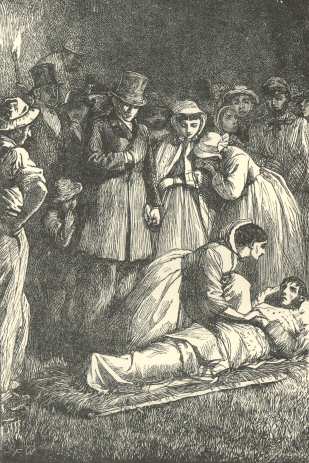
‘It ha’ shined upon me,’ he said reverently,‘in my pain and trouble down below. It ha’shined into my mind. I ha’ look’n at ’tand thowt o’ thee, Rachael, till the muddle in my mind havecleared awa, above a bit, I hope. If soom ha’ beenwantin’ in unnerstan’in me better, I, too, ha’been wantin’ in unnerstan’in them better. WhenI got thy letter, I easily believen that what the yoong ledy senand done to me, and what her brother sen and done to me, was one,and that there were a wicked plot betwixt ’em. When Ifell, I were in anger wi’ her, an’ hurryin ont’ be as onjust t’ her as oothers was t’me. But in our judgments, like as in our doins, we mun bearand forbear. In my pain an’ trouble, lookin upyonder,—wi’ it shinin on me—I ha’ seenmore clear, and ha’ made it my dyin prayer that awth’ world may on’y coom toogether more, an’ geta better unnerstan’in o’ one another, than when Iwere in ’t my own weak seln.’
Louisa hearing what he said, bent over him on the oppositeside to Rachael, so that he could see her.
‘You ha’ heard?’ he said, after a fewmoments’ silence. ‘I ha’ not forgot you,ledy.’
‘Yes, Stephen, I have heard you. And your prayeris mine.’
‘You ha’ a father. Will yo tak’ amessage to him?’
‘He is here,’ said Louisa, with dread. ‘Shall I bring him to you?’
‘If yo please.’
Louisa returned with her father. Standing hand-in-hand,they both looked down upon the solemn countenance.
‘Sir, yo will clear me an’ mak my name goodwi’ aw men. This I leave to yo.’
Mr. Gradgrind was troubled and asked how?
‘Sir,’ was the reply: ‘yor son will tell yohow. Ask him. I mak no charges: I leave none ahintme: not a single word. I ha’ seen an’spok’n wi’ yor son, one night. I ask no moreo’ yo than that yo clear me—an’ I trust to yoto do ’t.’
The bearers being now ready to carry him away, and the surgeonbeing anxious for his removal, those who had torches or lanterns,prepared to go in front of the litter. Before it wasraised, and while they were arranging how to go, he said toRachael, looking upward at the star:
‘Often as I coom to myseln, and found it shinin’on me down there in my trouble, I thowt it were the star asguided to Our Saviour’s home. I awmust think it bethe very star!’
They lifted him up, and he was overjoyed to find that theywere about to take him in the direction whither the star seemedto him to lead.
‘Rachael, beloved lass! Don’t let go myhand. We may walk toogether t’night, mydear!’
‘I will hold thy hand, and keep beside thee, Stephen,all the way.’
‘Bless thee! Will soombody be pleased to coover myface!’
They carried him very gently along the fields, and down thelanes, and over the wide landscape; Rachael always holding thehand in hers. Very few whispers broke the mournfulsilence. It was soon a funeral procession. The starhad shown him where to find the God of the poor; and throughhumility, and sorrow, and forgiveness, he had gone to hisRedeemer’s rest.
p.208CHAPTER VII
WHELP-HUNTING
Before the ring formed round theOld Hell Shaft was broken, one figure had disappeared from withinit. Mr. Bounderby and his shadow had not stood near Louisa,who held her father’s arm, but in a retired place bythemselves. When Mr. Gradgrind was summoned to the couch,Sissy, attentive to all that happened, slipped behind that wickedshadow—a sight in the horror of his face, if there had beeneyes there for any sight but one—and whispered in hisear. Without turning his head, he conferred with her a fewmoments, and vanished. Thus the whelp had gone out of thecircle before the people moved.
When the father reached home, he sent a message to Mr.Bounderby’s, desiring his son to come to himdirectly. The reply was, that Mr. Bounderby having missedhim in the crowd, and seeing nothing of him since, had supposedhim to be at Stone Lodge.
‘I believe, father,’ said Louisa, ‘he willnot come back to town to-night.’ Mr. Gradgrind turnedaway, and said no more.
In the morning, he went down to the Bank himself as soon as itwas opened, and seeing his son’s place empty (he had notthe courage to look in at first) went back along the street tomeet Mr. Bounderby on his way there. To whom he said that,for reasons he would soon explain, but entreated not then to beasked for, he had found it necessary to employ his son at adistance for a little while. Also, that he was charged withthe duty of vindicating Stephen Blackpool’s memory, anddeclaring the thief. Mr. Bounderby quite confounded, stoodstock-still in the street after his father-in-law had left him,swelling like an immense soap-bubble, without its beauty.
Mr. Gradgrind went home, locked himself in his room, and keptit all that day. When Sissy and Louisa tapped at his door,he said, without opening it, ‘Not now, my dears; in theevening.’ On their return in the evening, he said,‘I am not able yet—to-morrow.’ He atenothing all day, and had no candle after dark; and they heard himwalking to and fro late at night.
But, in the morning he appeared at breakfast at the usualhour, and took his usual place at the table. Aged and benthe looked, and quite bowed down; and yet he looked a wiser man,and a better man, than in the days when in this life he wantednothing—but Facts. Before he left the room, heappointed a time for them to come to him; and so, with his grayhead drooping, went away.
‘Dear father,’ said Louisa, when they kept theirappointment, ‘you have three young children left. They will be different, I will be different yet, withHeaven’s help.’
She gave her hand to Sissy, as if she meant with her helptoo.
‘Your wretched brother,’ said Mr. Gradgrind. ‘Do you think he had planned this robbery, when he wentwith you to the lodging?’
‘I fear so, father. I know he had wanted moneyvery much, and had spent a great deal.’
‘The poor man being about to leave the town, it cameinto his evil brain to cast suspicion on him?’
‘I think it must have flashed upon him while he satthere, father. For I asked him to go there with me. The visit did not originate with him.’
‘He had some conversation with the poor man. Didhe take him aside?’
‘He took him out of the room. I asked himafterwards, why he had done so, and he made a plausible excuse;but since last night, father, and when I remember thecircumstances by its light, I am afraid I can imagine too trulywhat passed between them.’
‘Let me know,’ said her father, ‘if yourthoughts present your guilty brother in the same dark view asmine.’
‘I fear, father,’ hesitated Louisa, ‘that hemust have made some representation to StephenBlackpool—perhaps in my name, perhaps in hisown—which induced him to do in good faith and honesty, whathe had never done before, and to wait about the Bank those two orthree nights before he left the town.’
‘Too plain!’ returned the father. ‘Tooplain!’
He shaded his face, and remained silent for somemoments. Recovering himself, he said:
‘And now, how is he to be found? How is he to besaved from justice? In the few hours that I can possiblyallow to elapse before I publish the truth, how is he to be foundby us, and only by us? Ten thousand pounds could not effectit.’
‘Sissy has effected it, father.’
He raised his eyes to where she stood, like a good fairy inhis house, and said in a tone of softened gratitude and gratefulkindness, ‘It is always you, my child!’
‘We had our fears,’ Sissy explained, glancing atLouisa, ‘before yesterday; and when I saw you brought tothe side of the litter last night, and heard what passed (beingclose to Rachael all the time), I went to him when no one saw,and said to him, “Don’t look at me. See whereyour father is. Escape at once, for his sake and yourown!” He was in a tremble before I whispered to him,and he started and trembled more then, and said, “Where canI go? I have very little money, and I don’t know whowill hide me!” I thought of father’s oldcircus. I have not forgotten where Mr. Sleary goes at thistime of year, and I read of him in a paper only the otherday. I told him to hurry there, and tell his name, and askMr. Sleary to hide him till I came. “I’ll getto him before the morning,” he said. And I saw himshrink away among the people.’
‘Thank Heaven!’ exclaimed his father. ‘He may be got abroad yet.’
It was the more hopeful as the town to which Sissy haddirected him was within three hours’ journey of Liverpool,whence he could be swiftly dispatched to any part of theworld. But, caution being necessary in communicating withhim—for there was a greater danger every moment of hisbeing suspected now, and nobody could be sure at heart but thatMr. Bounderby himself, in a bullying vein of public zeal, mightplay a Roman part—it was consented that Sissy and Louisashould repair to the place in question, by a circuitous course,alone; and that the unhappy father, setting forth in an oppositedirection, should get round to the same bourne by another andwider route. It was further agreed that he should notpresent himself to Mr. Sleary, lest his intentions should bemistrusted, or the intelligence of his arrival should cause hisson to take flight anew; but, that the communication should beleft to Sissy and Louisa to open; and that they should inform thecause of so much misery and disgrace, of his father’s beingat hand and of the purpose for which they had come. Whenthese arrangements had been well considered and were fullyunderstood by all three, it was time to begin to carry them intoexecution. Early in the afternoon, Mr. Gradgrind walkeddirect from his own house into the country, to be taken up on theline by which he was to travel; and at night the remaining twoset forth upon their different course, encouraged by not seeingany face they knew.
The two travelled all night, except when they were left, forodd numbers of minutes, at branch-places, up illimitable flightsof steps, or down wells—which was the only variety of thosebranches—and, early in the morning, were turned out on aswamp, a mile or two from the town they sought. From thisdismal spot they were rescued by a savage old postilion, whohappened to be up early, kicking a horse in a fly: and so weresmuggled into the town by all the back lanes where the pigslived: which, although not a magnificent or even savouryapproach, was, as is usual in such cases, the legitimatehighway.
The first thing they saw on entering the town was the skeletonof Sleary’s Circus. The company had departed foranother town more than twenty miles off, and had opened therelast night. The connection between the two places was by ahilly turnpike-road, and the travelling on that road was veryslow. Though they took but a hasty breakfast, and no rest(which it would have been in vain to seek under such anxiouscircumstances), it was noon before they began to find the billsof Sleary’s Horse-riding on barns and walls, and oneo’clock when they stopped in the market-place.
A Grand Morning Performance by the Riders, commencing at thatvery hour, was in course of announcement by the bellman as theyset their feet upon the stones of the street. Sissyrecommended that, to avoid making inquiries and attractingattention in the town, they should present themselves to pay atthe door. If Mr. Sleary were taking the money, he would besure to know her, and would proceed with discretion. If hewere not, he would be sure to see them inside; and, knowing whathe had done with the fugitive, would proceed with discretionstill.
Therefore, they repaired, with fluttering hearts, to thewell-remembered booth. The flag with the inscription Sleary’s Horse-riding was there; andthe Gothic niche was there; but Mr. Sleary was not there. Master Kidderminster, grown too maturely turfy to be received bythe wildest credulity as Cupid any more, had yielded to theinvincible force of circumstances (and his beard), and, in thecapacity of a man who made himself generally useful, presided onthis occasion over the exchequer—having also a drum inreserve, on which to expend his leisure moments and superfluousforces. In the extreme sharpness of his look out for basecoin, Mr. Kidderminster, as at present situated, never sawanything but money; so Sissy passed him unrecognised, and theywent in.
The Emperor of Japan, on a steady old white horse stencilledwith black spots, was twirling five wash-hand basins at once, asit is the favourite recreation of that monarch to do. Sissy, though well acquainted with his Royal line, had nopersonal knowledge of the present Emperor, and his reign waspeaceful. Miss Josephine Sleary, in her celebrated gracefulEquestrian Tyrolean Flower Act, was then announced by a new clown(who humorously said Cauliflower Act), and Mr. Sleary appeared,leading her in.
Mr. Sleary had only made one cut at the Clown with his longwhip-lash, and the Clown had only said, ‘If you do itagain, I’ll throw the horse at you!’ when Sissy wasrecognised both by father and daughter. But they gotthrough the Act with great self-possession; and Mr. Sleary,saving for the first instant, conveyed no more expression intohis locomotive eye than into his fixed one. The performanceseemed a little long to Sissy and Louisa, particularly when itstopped to afford the Clown an opportunity of telling Mr. Sleary(who said ‘Indeed, sir!’ to all his observations inthe calmest way, and with his eye on the house) about two legssitting on three legs looking at one leg, when in came four legs,and laid hold of one leg, and up got two legs, caught hold ofthree legs, and threw ’em at four legs, who ran away withone leg. For, although an ingenious Allegory relating to abutcher, a three-legged stool, a dog, and a leg of mutton, thisnarrative consumed time; and they were in great suspense. At last, however, little fair-haired Josephine made her curtseyamid great applause; and the Clown, left alone in the ring, hadjust warmed himself, and said, ‘Now I’ll havea turn!’ when Sissy was touched on the shoulder, andbeckoned out.
She took Louisa with her; and they were received by Mr. Slearyin a very little private apartment, with canvas sides, a grassfloor, and a wooden ceiling all aslant, on which the box companystamped their approbation, as if they were coming through. ‘Thethilia,’ said Mr. Sleary, who had brandy andwater at hand, ‘it doth me good to thee you. You wathalwayth a favourite with uth, and you’ve done uth crediththinth the old timeth I’m thure. You mutht thee ourpeople, my dear, afore we thpeak of bithnith, or they’llbreak their hearth—ethpethially the women. Here’th Jothphine hath been and got married to E. W. B.Childerth, and thee hath got a boy, and though he’th onlythree yearth old, he thtickth on to any pony you can bringagaintht him. He’th named The Little Wonder ofThcolathtic Equitation; and if you don’t hear of that boyat Athley’th, you’ll hear of him at Parith. Andyou recollect Kidderminthter, that wath thought to be ratherthweet upon yourthelf? Well. He’th marriedtoo. Married a widder. Old enough to be hithmother. Thee wath Tightrope, thee wath, and nowthee’th nothing—on accounth of fat. They’ve got two children, tho we’re thtrong in theFairy bithnith and the Nurthery dodge. If you wath to theeour Children in the Wood, with their father and mother both adyin’ on a horthe—their uncle a retheiving of’em ath hith wardth, upon a horthe—themthelvth both agoin’ a black-berryin’ on a horthe—and theRobinth a coming in to cover ’em with leavth, upon ahorthe—you’d thay it wath the completetht thing athever you thet your eyeth on! And you remember Emma Gordon,my dear, ath wath a’motht a mother to you? Of courtheyou do; I needn’t athk. Well! Emma, thee lothther huthband. He wath throw’d a heavy back-fall off aElephant in a thort of a Pagoda thing ath the Thultan of theIndieth, and he never got the better of it; and thee married athecond time—married a Cheethemonger ath fell in love withher from the front—and he’th a Overtheer andmakin’ a fortun.’
These various changes, Mr. Sleary, very short of breath now,related with great heartiness, and with a wonderful kind ofinnocence, considering what a bleary and brandy-and-watery oldveteran he was. Afterwards he brought in Josephine, and E.W. B. Childers (rather deeply lined in the jaws by daylight), andthe Little Wonder of Scholastic Equitation, and in a word, allthe company. Amazing creatures they were in Louisa’seyes, so white and pink of complexion, so scant of dress, and sodemonstrative of leg; but it was very agreeable to see themcrowding about Sissy, and very natural in Sissy to be unable torefrain from tears.
‘There! Now Thethilia hath kithd all the children,and hugged all the women, and thaken handth all round with allthe men, clear, every one of you, and ring in the band for thethecond part!’
As soon as they were gone, he continued in a low tone. ‘Now, Thethilia, I don’t athk to know any thecreth,but I thuppothe I may conthider thith to be MithThquire.’
‘This is his sister. Yes.’
‘And t’other on’th daughter. That’h what I mean. Hope I thee you well, mith. And I hope the Thquire’th well?’
‘My father will be here soon,’ said Louisa,anxious to bring him to the point. ‘Is my brothersafe?’
‘Thafe and thound!’ he replied. ‘Iwant you jutht to take a peep at the Ring, mith, throughhere. Thethilia, you know the dodgeth; find a thpy-hole foryourthelf.’
They each looked through a chink in the boards.
‘That’h Jack the Giant Killer—piethe ofcomic infant bithnith,’ said Sleary. ‘There’th a property-houthe, you thee, for Jack tohide in; there’th my Clown with a thauthepan-lid and athpit, for Jack’th thervant; there’th little Jackhimthelf in a thplendid thoot of armour; there’th two comicblack thervanth twithe ath big ath the houthe, to thtand by itand to bring it in and clear it; and the Giant (a veryecthpenthive bathket one), he an’t on yet. Now, doyou thee ’em all?’
‘Yes,’ they both said.
‘Look at ’em again,’ said Sleary,‘look at ’em well. You thee em all? Verygood. Now, mith;’ he put a form for them to sit on;‘I have my opinionth, and the Thquire your father hathhith. I don’t want to know what your brother’thbeen up to; ith better for me not to know. All I thay ith,the Thquire hath thtood by Thethilia, and I’ll thtand bythe Thquire. Your brother ith one them blackthervanth.’
Louisa uttered an exclamation, partly of distress, partly ofsatisfaction.
‘Ith a fact,’ said Sleary, ‘and evenknowin’ it, you couldn’t put your finger onhim. Let the Thquire come. I thall keep your brotherhere after the performanth. I thant undreth him, nor yetwath hith paint off. Let the Thquire come here after theperformanth, or come here yourthelf after the performanth, andyou thall find your brother, and have the whole plathe to talk tohim in. Never mind the lookth of him, ath long athhe’th well hid.’
Louisa, with many thanks and with a lightened load, detainedMr. Sleary no longer then. She left her love for herbrother, with her eyes full of tears; and she and Sissy went awayuntil later in the afternoon.
Mr. Gradgrind arrived within an hour afterwards. He toohad encountered no one whom he knew; and was now sanguine withSleary’s assistance, of getting his disgraced son toLiverpool in the night. As neither of the three could behis companion without almost identifying him under any disguise,he prepared a letter to a correspondent whom he could trust,beseeching him to ship the bearer off at any cost, to North orSouth America, or any distant part of the world to which he couldbe the most speedily and privately dispatched.
This done, they walked about, waiting for the Circus to bequite vacated; not only by the audience, but by the company andby the horses. After watching it a long time, they saw Mr.Sleary bring out a chair and sit down by the side-door, smoking;as if that were his signal that they might approach.
‘Your thervant, Thquire,’ was his cautioussalutation as they passed in. ‘If you want meyou’ll find me here. You muthn’t mind your thonhaving a comic livery on.’
They all three went in; and Mr. Gradgrind sat down forlorn, onthe Clown’s performing chair in the middle of thering. On one of the back benches, remote in the subduedlight and the strangeness of the place, sat the villainous whelp,sulky to the last, whom he had the misery to call his son.
In a preposterous coat, like a beadle’s, with cuffs andflaps exaggerated to an unspeakable extent; in an immensewaistcoat, knee-breeches, buckled shoes, and a mad cocked hat;with nothing fitting him, and everything of coarse material,moth-eaten and full of holes; with seams in his black face, wherefear and heat had started through the greasy composition daubedall over it; anything so grimly, detestably, ridiculouslyshameful as the whelp in his comic livery, Mr. Gradgrind nevercould by any other means have believed in, weighable andmeasurable fact though it was. And one of his modelchildren had come to this!
At first the whelp would not draw any nearer, but persisted inremaining up there by himself. Yielding at length, if anyconcession so sullenly made can be called yielding, to theentreaties of Sissy—for Louisa he disownedaltogether—he came down, bench by bench, until he stood inthe sawdust, on the verge of the circle, as far as possible,within its limits from where his father sat.
‘How was this done?’ asked the father.
‘How was what done?’ moodily answered the son.
‘This robbery,’ said the father, raising his voiceupon the word.
‘I forced the safe myself over night, and shut it upajar before I went away. I had had the key that was found,made long before. I dropped it that morning, that it mightbe supposed to have been used. I didn’t take themoney all at once. I pretended to put my balance away everynight, but I didn’t. Now you know all aboutit.’
‘If a thunderbolt had fallen on me,’ said thefather, ‘it would have shocked me less thanthis!’
‘I don’t see why,’ grumbled the son. ‘So many people are employed in situations of trust; somany people, out of so many, will be dishonest. I haveheard you talk, a hundred times, of its being a law. Howcan Ihelp laws? You have comforted others with suchthings, father. Comfort yourself!’
The father buried his face in his hands, and the son stood inhis disgraceful grotesqueness, biting straw: his hands, with theblack partly worn away inside, looking like the hands of amonkey. The evening was fast closing in; and from time totime, he turned the whites of his eyes restlessly and impatientlytowards his father. They were the only parts of his facethat showed any life or expression, the pigment upon it was sothick.
‘You must be got to Liverpool, and sentabroad.’
‘I suppose I must. I can’t be more miserableanywhere,’ whimpered the whelp, ‘than I have beenhere, ever since I can remember. That’s onething.’
Mr. Gradgrind went to the door, and returned with Sleary, towhom he submitted the question, How to get this deplorable objectaway?
‘Why, I’ve been thinking of it, Thquire. There’th not muth time to lothe, tho you muth thay yeth orno. Ith over twenty mileth to the rail. There’th a coath in half an hour, that goeth totherail, ‘purpothe to cath the mail train. That trainwill take him right to Liverpool.’
‘But look at him,’ groaned Mr. Gradgrind. ‘Will any coach—’
‘I don’t mean that he thould go in the comiclivery,’ said Sleary. ‘Thay the word, andI’ll make a Jothkin of him, out of the wardrobe, in fiveminutes.’
‘I don’t understand,’ said Mr.Gradgrind.
‘A Jothkin—a Carter. Make up your mindquick, Thquire. There’ll be beer to feth. I’ve never met with nothing but beer ath’ll everclean a comic blackamoor.’
Mr. Gradgrind rapidly assented; Mr. Sleary rapidly turned outfrom a box, a smock frock, a felt hat, and other essentials; thewhelp rapidly changed clothes behind a screen of baize; Mr.Sleary rapidly brought beer, and washed him white again.
‘Now,’ said Sleary, ‘come along to thecoath, and jump up behind; I’ll go with you there, andthey’ll thuppothe you one of my people. Thay farewellto your family, and tharp’th the word.’ Withwhich he delicately retired.
‘Here is your letter,’ said Mr. Gradgrind. ‘All necessary means p. 216will be provided for you. Atone, by repentance and better conduct, for the shocking actionyou have committed, and the dreadful consequences to which it hasled. Give me your hand, my poor boy, and may God forgiveyou as I do!’
The culprit was moved to a few abject tears by these words andtheir pathetic tone. But, when Louisa opened her arms, herepulsed her afresh.
‘Not you. I don’t want to have anything tosay to you!’
‘O Tom, Tom, do we end so, after all my love!’
‘After all your love!’ he returned,obdurately. ‘Pretty love! Leaving old Bounderbyto himself, and packing my best friend Mr. Harthouse off, andgoing home just when I was in the greatest danger. Prettylove that! Coming out with every word about our having goneto that place, when you saw the net was gathering round me. Pretty love that! You have regularly given me up. Younever cared for me.’
‘Tharp’th the word!’ said Sleary, at thedoor.
They all confusedly went out: Louisa crying to him that sheforgave him, and loved him still, and that he would one day besorry to have left her so, and glad to think of these her lastwords, far away: when some one ran against them. Mr.Gradgrind and Sissy, who were both before him while his sisteryet clung to his shoulder, stopped and recoiled.
For, there was Bitzer, out of breath, his thin lips parted,his thin nostrils distended, his white eyelashes quivering, hiscolourless face more colourless than ever, as if he ran himselfinto a white heat, when other people ran themselves into aglow. There he stood, panting and heaving, as if he hadnever stopped since the night, now long ago, when he had run themdown before.
‘I’m sorry to interfere with your plans,’said Bitzer, shaking his head, ‘but I can’t allowmyself to be done by horse-riders. I must have young Mr.Tom; he mustn’t be got away by horse-riders; here he is ina smock frock, and I must have him!’
By the collar, too, it seemed. For, so he tookpossession of him.
CHAPTER VIII
PHILOSOPHICAL
They went back into the booth,Sleary shutting the door to keep intruders out. Bitzer,still holding the paralysed culprit by the collar, stood in theRing, blinking at his old patron through the darkness of thetwilight.
‘Bitzer,’ said Mr. Gradgrind, broken down, andmiserably submissive to him, ‘have you a heart?’
‘The circulation, sir,’ returned Bitzer, smilingat the oddity of the question, ‘couldn’t be carriedon without one. No man, sir, acquainted with the factsestablished by Harvey relating to the circulation of the blood,can doubt that I have a heart.’
‘Is it accessible,’ cried Mr. Gradgrind, ‘toany compassionate influence?’
‘It is accessible to Reason, sir,’ returned theexcellent young man. ‘And to nothing else.’
They stood looking at each other; Mr. Gradgrind’s faceas white as the pursuer’s.
‘What motive—even what motive in reason—canyou have for preventing the escape of this wretched youth,’said Mr. Gradgrind, ‘and crushing his miserablefather? See his sister here. Pity us!’
‘Sir,’ returned Bitzer, in a very business-likeand logical manner, ‘since you ask me what motive I have inreason, for taking young Mr. Tom back to Coketown, it is onlyreasonable to let you know. I have suspected young Mr. Tomof this bank-robbery from the first. I had had my eye uponhim before that time, for I knew his ways. I have kept myobservations to myself, but I have made them; and I have gotample proofs against him now, besides his running away, andbesides his own confession, which I was just in time tooverhear. I had the pleasure of watching your houseyesterday morning, and following you here. I am going totake young Mr. Tom back to Coketown, in order to deliver him overto Mr. Bounderby. Sir, I have no doubt whatever that Mr.Bounderby will then promote me to young Mr. Tom’ssituation. And I wish to have his situation, sir, for itwill be a rise to me, and will do me good.’
‘If this is solely a question of self-interest withyou—’ Mr. Gradgrind began.
‘I beg your pardon for interrupting you, sir,’returned Bitzer; ‘but I am sure you know that the wholesocial system is a question of self-interest. What you mustalways appeal to, is a person’s self-interest. It’s your only hold. We are so constituted. Iwas brought up in that catechism when I was very young, sir, asyou are aware.’
‘What sum of money,’ said Mr. Gradgrind,‘will you set against your expected promotion?’
‘Thank you, sir,’ returned Bitzer, ‘forhinting at the proposal; but I will not set any sum againstit. Knowing that your clear head would propose thatalternative, I have gone over the calculations in my mind; and Ifind that to compound a felony, even on very high terms indeed,would not be as safe and good for me as my improved prospects inthe Bank.’
‘Bitzer,’ said Mr. Gradgrind, stretching out hishands as though he would have said, See how miserable I am! ‘Bitzer, I have but one chance left to soften you. You were many years at my school. If, in remembrance of thepains bestowed upon you there, you can persuade yourself in anydegree to disregard your present interest and release my son, Ientreat and pray you to give him the benefit of thatremembrance.’
‘I really wonder, sir,’ rejoined the old pupil inan argumentative manner, ‘to find you taking a position sountenable. My schooling was paid for; it was a bargain; andwhen I came away, the bargain ended.’
It was a fundamental principle of the Gradgrind philosophythat everything was to be paid for. Nobody was ever on anyaccount to give anybody anything, or render anybody help withoutpurchase. Gratitude was to be abolished, and the virtuesspringing from it were not to be. Every inch of theexistence of mankind, from birth to death, was to be a bargainacross a counter. And if we didn’t get to Heaven thatway, it was not a politico-economical place, and we had nobusiness there.
‘I don’t deny,’ added Bitzer, ‘that myschooling was cheap. But that comes right, sir. I wasmade in the cheapest market, and have to dispose of myself in thedearest.’
He was a little troubled here, by Louisa and Sissy crying.
‘Pray don’t do that,’ said he,‘it’s of no use doing that: it only worries. You seem to think that I have some animosity against young Mr.Tom; whereas I have none at all. I am only going, on thereasonable grounds I have mentioned, to take him back toCoketown. If he was to resist, I should set up the cry ofStop thief! But, he won’t resist, you may depend uponit.’
Mr. Sleary, who with his mouth open and his rolling eye asimmovably jammed in his head as his fixed one, had listened tothese doctrines with profound attention, here steppedforward.
‘Thquire, you know perfectly well, and your daughterknowth perfectly well (better than you, becauthe I thed it toher), that I didn’t know what your thon had done, and thatI didn’t want to know—I thed it wath better not,though I only thought, then, it wath thome thkylarking. However, thith young man having made it known to be a robbery ofa bank, why, that’h a theriouth thing; muth too theriouth athing for me to compound, ath thith young man hath very properlycalled it. Conthequently, Thquire, you muthn’tquarrel with me if I take thith young man’th thide, andthay he’th right and there’th no help for it. But I tell you what I’ll do, Thquire; I’ll drive yourthon and thith young man over to the rail, and prevent expothurehere. I can’t conthent to do more, but I’ll dothat.’
Fresh lamentations from Louisa, and deeper affliction on Mr.Gradgrind’s part, followed this desertion of them by theirlast friend. But, Sissy glanced at him with greatattention; nor did she in her own breast misunderstand him. As they were all going out again, he favoured her with one slightroll of his movable eye, desiring her to linger behind. Ashe locked the door, he said excitedly:
‘The Thquire thtood by you, Thethilia, and I’llthtand by the Thquire. More than that: thith ith aprethiouth rathcal, and belongth to that bluthtering Cove that mypeople nearly pitht out o’ winder. It’ll be adark night; I’ve got a horthe that’ll do anything butthpeak; I’ve got a pony that’ll go fifteen mile anhour with Childerth driving of him; I’ve got a dogthat’ll keep a man to one plathe four-and-twentyhourth. Get a word with the young Thquire. Tell him,when he theeth our horthe begin to danthe, not to be afraid ofbeing thpilt, but to look out for a pony-gig coming up. Tell him, when he theeth that gig clothe by, to jump down, andit’ll take him off at a rattling pathe. If my dogleth thith young man thtir a peg on foot, I give him leave togo. And if my horthe ever thtirth from that thpot where hebeginth a danthing, till the morning—I don’t knowhim?—Tharp’th the word!’
The word was so sharp, that in ten minutes Mr. Childers,sauntering about the market-place in a pair of slippers, had hiscue, and Mr. Sleary’s equipage was ready. It was afine sight, to behold the learned dog barking round it, and Mr.Sleary instructing him, with his one practicable eye, that Bitzerwas the object of his particular attentions. Soon afterdark they all three got in and started; the learned dog (aformidable creature) already pinning Bitzer with his eye, andsticking close to the wheel on his side, that he might be readyfor him in the event of his showing the slightest disposition toalight.
The other three sat up at the inn all night in greatsuspense. At eight o’clock in the morning Mr. Slearyand the dog reappeared: both in high spirits.
‘All right, Thquire!’ said Mr. Sleary, ‘yourthon may be aboard-a-thip by thith time. Childerth took himoff, an hour and a half after we left there latht night. The horthe danthed the polka till he wath dead beat (he wouldhave walthed if he hadn’t been in harneth), and then I gavehim the word and he went to thleep comfortable. When thatprethiouth young Rathcal thed he’d go for’ard afoot,the dog hung on to hith neck-hankercher with all four legth inthe air and pulled him down and rolled him over. Tho hecome back into the drag, and there he that, ’till I turnedthe horthe’th head, at half-patht thixth thithmorning.’
Mr. Gradgrind overwhelmed him with thanks, of course; andhinted as delicately as he could, at a handsome remuneration inmoney.
‘I don’t want money mythelf, Thquire; butChilderth ith a family man, and if you wath to like to offer hima five-pound note, it mightn’t be unactheptable. Likewithe if you wath to thtand a collar for the dog, or a thetof bellth for the horthe, I thould be very glad to take’em. Brandy and water I alwayth take.’ Hehad already called for a glass, and now called for another. ‘If you wouldn’t think it going too far, Thquire, tomake a little thpread for the company at about three and thixthahead, not reckoning Luth, it would make ’emhappy.’
All these little tokens of his gratitude, Mr. Gradgrind verywillingly undertook to render. Though he thought them fartoo slight, he said, for such a service.
‘Very well, Thquire; then, if you’ll only give aHorthe-riding, a bethpeak, whenever you can, you’ll morethan balanthe the account. Now, Thquire, if your daughterwill ethcuthe me, I thould like one parting word withyou.’
Louisa and Sissy withdrew into an adjoining room; Mr. Sleary,stirring and drinking his brandy and water as he stood, wenton:
‘Thquire,—you don’t need to be told thatdogth ith wonderful animalth.’
‘Their instinct,’ said Mr. Gradgrind, ‘issurprising.’
‘Whatever you call it—and I’m bletht ifIknow what to call it’—said Sleary, ‘itith athtonithing. The way in whith a dog’ll findyou—the dithtanthe he’ll come!’
‘His scent,’ said Mr. Gradgrind, ‘being sofine.’
‘I’m bletht if I know what to call it,’repeated Sleary, shaking his head, ‘but I have had dogthfind me, Thquire, in a way that made me think whether that doghadn’t gone to another dog, and thed, “Youdon’t happen to know a perthon of the name of Thleary, doyou? Perthon of the name of Thleary, in the Horthe-Ridingway—thtout man—game eye?” And whetherthat dog mightn’t have thed, “Well, I can’tthay I know him mythelf, but I know a dog that I think would belikely to be acquainted with him.” And whether thatdog mightn’t have thought it over, and thed,“Thleary, Thleary! O yeth, to be thure! Afriend of mine menthioned him to me at one time. I can getyou hith addreth directly.” In conthequenth of mybeing afore the public, and going about tho muth, you thee, theremutht be a number of dogth acquainted with me, Thquire, thatIdon’t know!’
Mr. Gradgrind seemed to be quite confounded by thisspeculation.
‘Any way,’ said Sleary, after putting his lips tohis brandy and water, ‘ith fourteen month ago, Thquire,thinthe we wath at Chethter. We wath getting up ourChildren in the Wood one morning, when there cometh into ourRing, by the thtage door, a dog. He had travelled a longway, he wath in a very bad condithon, he wath lame, and prettywell blind. He went round to our children, one afteranother, as if he wath a theeking for a child he know’d;and then he come to me, and throwd hithelf up behind, and thtoodon hith two forelegth, weak ath he wath, and then he wagged hithtail and died. Thquire, that dog wathMerrylegth.’
‘Sissy’s father’s dog!’
‘Thethilia’th father’th old dog. Now,Thquire, I can take my oath, from my knowledge of that dog, thatthat man wath dead—and buried—afore that dog comeback to me. Joth’phine and Childerth and me talked itover a long time, whether I thould write or not. But weagreed, “No. There’th nothing comfortable totell; why unthettle her mind, and make her unhappy?” Tho, whether her father bathely detherted her; or whether hebroke hith own heart alone, rather than pull her down along withhim; never will be known, now, Thquire, till—no, not tillwe know how the dogth findth uth out!’
‘She keeps the bottle that he sent her for, to thishour; and she will believe in his affection to the last moment ofher life,’ said Mr. Gradgrind.
‘It theemth to prethent two thingth to a perthon,don’t it, Thquire?’ said Mr. Sleary, musing as helooked down into the depths of his brandy and water: ‘one,that there ith a love in the world, not all Thelf-interetht afterall, but thomething very different; t’other, that it hath away of ith own of calculating or not calculating, whith thomehowor another ith at leatht ath hard to give a name to, ath thewayth of the dogth ith!’
Mr. Gradgrind looked out of window, and made no reply. Mr. Sleary emptied his glass and recalled the ladies.
‘Thethilia my dear, kith me and good-bye! MithThquire, to thee you treating of her like a thithter, and athithter that you trutht and honour with all your heart and more,ith a very pretty thight to me. I hope your brother maylive to be better detherving of you, and a greater comfort toyou. Thquire, thake handth, firtht and latht! Don’t be croth with uth poor vagabondth. People muthtbe amuthed. They can’t be alwayth a learning, nor yetthey can’t be alwayth a working, they an’t made forit. You muththave uth, Thquire. Do the withething and the kind thing too, and make the betht of uth; not thewurtht!’
‘And I never thought before,’ said Mr. Sleary,putting his head in at the door again to say it, ‘that Iwath tho muth of a Cackler!’
p.222CHAPTER IX
FINAL
It is a dangerous thing to seeanything in the sphere of a vain blusterer, before the vainblusterer sees it himself. Mr. Bounderby felt that Mrs.Sparsit had audaciously anticipated him, and presumed to be wiserthan he. Inappeasably indignant with her for her triumphantdiscovery of Mrs. Pegler, he turned this presumption, on the partof a woman in her dependent position, over and over in his mind,until it accumulated with turning like a great snowball. Atlast he made the discovery that to discharge this highlyconnected female—to have it in his power to say, ‘Shewas a woman of family, and wanted to stick to me, but Iwouldn’t have it, and got rid of her’—would beto get the utmost possible amount of crowning glory out of theconnection, and at the same time to punish Mrs. Sparsit accordingto her deserts.
Filled fuller than ever, with this great idea, Mr. Bounderbycame in to lunch, and sat himself down in the dining-room offormer days, where his portrait was. Mrs. Sparsit sat bythe fire, with her foot in her cotton stirrup, little thinkingwhither she was posting.
Since the Pegler affair, this gentlewoman had covered her pityfor Mr. Bounderby with a veil of quiet melancholy andcontrition. In virtue thereof, it had become her habit toassume a woful look, which woful look she now bestowed upon herpatron.
‘What’s the matter now, ma’am?’ saidMr. Bounderby, in a very short, rough way.
‘Pray, sir,’ returned Mrs. Sparsit, ‘do notbite my nose off.’
‘Bite your nose off, ma’am?’ repeated Mr.Bounderby. ‘Yournose!’ meaning, as Mrs.Sparsit conceived, that it was too developed a nose for thepurpose. After which offensive implication, he cut himselfa crust of bread, and threw the knife down with a noise.
Mrs. Sparsit took her foot out of her stirrup, and said,‘Mr. Bounderby, sir!’
‘Well, ma’am?’ retorted Mr. Bounderby. ‘What are you staring at?’
‘May I ask, sir,’ said Mrs. Sparsit, ‘haveyou been ruffled this morning?’
‘Yes, ma’am.’
‘May I inquire, sir,’ pursued the injured woman,‘whether Iam the unfortunate cause of your havinglost your temper?’
‘Now, I’ll tell you what, ma’am,’ saidBounderby, ‘I am not come here to be bullied. Afemale may be highly connected, but she can’t be permittedto bother and badger a man in my position, and I am not going toput up with it.’ (Mr. Bounderby felt it necessary toget on: foreseeing that if he allowed of details, he would bebeaten.)
Mrs. Sparsit first elevated, then knitted, her Coriolanianeyebrows; gathered up her work into its proper basket; androse.
‘Sir,’ said she, majestically. ‘It isapparent to me that I am in your way at present. I willretire to my own apartment.’
‘Allow me to open the door, ma’am.’
‘Thank you, sir; I can do it for myself.’
‘You had better allow me, ma’am,’ saidBounderby, passing her, and getting his hand upon the lock;‘because I can take the opportunity of saying a word toyou, before you go. Mrs. Sparsit, ma’am, I ratherthink you are cramped here, do you know? It appears to me,that, under my humble roof, there’s hardly opening enoughfor a lady of your genius in other people’saffairs.’
Mrs. Sparsit gave him a look of the darkest scorn, and saidwith great politeness, ‘Really, sir?’
‘I have been thinking it over, you see, since the lateaffairs have happened, ma’am,’ said Bounderby;‘and it appears to my poor judgment—’
‘Oh! Pray, sir,’ Mrs. Sparsit interposed,with sprightly cheerfulness, ‘don’t disparage yourjudgment. Everybody knows how unerring Mr.Bounderby’s judgment is. Everybody has had proofs ofit. It must be the theme of general conversation. Disparage anything in yourself but your judgment, sir,’said Mrs. Sparsit, laughing.
Mr. Bounderby, very red and uncomfortable, resumed:
‘It appears to me, ma’am, I say, that a differentsort of establishment altogether would bring out a lady ofyourpowers. Such an establishment as your relation,Lady Scadgers’s, now. Don’t you think you mightfind some affairs there, ma’am, to interferewith?’
‘It never occurred to me before, sir,’ returnedMrs. Sparsit; ‘but now you mention it, should think ithighly probable.’
‘Then suppose you try, ma’am,’ saidBounderby, laying an envelope with a cheque in it in her littlebasket. ‘You can take your own time for going,ma’am; but perhaps in the meanwhile, it will be moreagreeable to a lady of your powers of mind, to eat her meals byherself, and not to be intruded upon. I really ought toapologise to you—being only Josiah Bounderby ofCoketown—for having stood in your light so long.’
‘Pray don’t name it, sir,’ returned Mrs.Sparsit. ‘If that portrait could speak, sir—butit has the advantage over the original of not possessing thepower of committing itself and disgusting others,—it wouldtestify, that a long period has elapsed since I first habituallyaddressed it as the picture of a Noodle. Nothing that aNoodle does, can awaken surprise or indignation; the proceedingsof a Noodle can only inspire contempt.’
Thus saying, Mrs. Sparsit, with her Roman features like amedal struck to commemorate her scorn of Mr. Bounderby, surveyedhim fixedly from head to foot, swept disdainfully past him, andascended the staircase. Mr. Bounderby closed the door, andstood before the fire; projecting himself after his old explosivemanner into his portrait—and into futurity.
Into how much of futurity? He saw Mrs. Sparsit fightingout a daily fight at the points of all the weapons in the femalearmoury, with the grudging, smarting, peevish, tormenting LadyScadgers, still laid up in bed with her mysterious leg, andgobbling her insufficient income down by about the middle ofevery quarter, in a mean little airless lodging, a mere closetfor one, a mere crib for two; but did he see more? Did hecatch any glimpse of himself making a show of Bitzer tostrangers, as the rising young man, so devoted to hismaster’s great merits, who had won young Tom’s place,and had almost captured young Tom himself, in the times when byvarious rascals he was spirited away? Did he see any faintreflection of his own image making a vain-glorious will, wherebyfive-and-twenty Humbugs, past five-and-fifty years of age, eachtaking upon himself the name, Josiah Bounderby of Coketown,should for ever dine in Bounderby Hall, for ever lodge inBounderby buildings, for ever attend a Bounderby chapel, for evergo to sleep under a Bounderby chaplain, for ever be supported outof a Bounderby estate, and for ever nauseate all healthystomachs, with a vast amount of Bounderby balderdash andbluster? Had he any prescience of the day, five years tocome, when Josiah Bounderby of Coketown was to die of a fit inthe Coketown street, and this same precious will was to begin itslong career of quibble, plunder, false pretences, vile example,little service and much law? Probably not. Yet theportrait was to see it all out.
Here was Mr. Gradgrind on the same day, and in the same hour,sitting thoughtful in his own room. How much of futuritydid hesee? Did he see himself, a white-haireddecrepit man, bending his hitherto inflexible theories toappointed circumstances; making his facts and figures subservientto Faith, Hope, and Charity; and no longer trying to grind thatHeavenly trio in his dusty little mills? Did he catch sightof himself, therefore much despised by his late politicalassociates? Did he see them, in the era of its being quitesettled that the national dustmen have only to do with oneanother, and owe no duty to an abstraction called a People,‘taunting the honourable gentleman’ with this andwith that and with what not, five nights a-week, until the smallhours of the morning? Probably he had that muchforeknowledge, knowing his men.
Here was Louisa on the night of the same day, watching thefire as in days of yore, though with a gentler and a humblerface. How much of the future might arise before hervision? Broadsides in the streets, signed with herfather’s name, exonerating the late Stephen Blackpool,weaver, from misplaced suspicion, and publishing the guilt of hisown son, with such extenuation as his years and temptation (hecould not bring himself to add, his education) might beseech;were of the Present. So, Stephen Blackpool’stombstone, with her father’s record of his death, wasalmost of the Present, for she knew it was to be. Thesethings she could plainly see. But, how much of theFuture?
A working woman, christened Rachael, after a long illness onceagain appearing at the ringing of the Factory bell, and passingto and fro at the set hours, among the Coketown Hands; a woman ofpensive beauty, always dressed in black, but sweet-tempered andserene, and even cheerful; who, of all the people in the place,alone appeared to have compassion on a degraded, drunken wretchof her own sex, who was sometimes seen in the town secretlybegging of her, and crying to her; a woman working, ever working,but content to do it, and preferring to do it as her natural lot,until she should be too old to labour any more? Did Louisasee this? Such a thing was to be.
A lonely brother, many thousands of miles away, writing, onpaper blotted with tears, that her words had too soon come true,and that all the treasures in the world would be cheaply barteredfor a sight of her dear face? At length this brother comingnearer home, with hope of seeing her, and being delayed byillness; and then a letter, in a strange hand, saying ‘hedied in hospital, of fever, such a day, and died in penitence andlove of you: his last word being your name’? DidLouisa see these things? Such things were to be.
Herself again a wife—a mother—lovingly watchful ofher children, ever careful that they should have a childhood ofthe mind no less than a childhood of the body, as knowing it tobe even a more beautiful thing, and a possession, any hoardedscrap of which, is a blessing and happiness to the wisest? Did Louisa see this? Such a thing was never to be.
But, happy Sissy’s happy children loving her; allchildren loving her; she, grown learned in childish lore;thinking no innocent and pretty fancy ever to be despised; tryinghard to know her humbler fellow-creatures, and to beautify theirlives of machinery and reality with those imaginative graces anddelights, without which the heart of infancy will wither up, thesturdiest physical manhood will be morally stark death, and theplainest national prosperity figures can show, will be theWriting on the Wall,—she holding this course as part of nofantastic vow, or bond, or brotherhood, or sisterhood, or pledge,or covenant, or fancy dress, or fancy fair; but simply as a dutyto be done,—did Louisa see these things of herself? These things were to be.
Dear reader! It rests with you and me, whether, in ourtwo fields of action, similar things shall be or not. Letthem be! We shall sit with lighter bosoms on the hearth, tosee the ashes of our fires turn gray and cold.
FOOTNOTES
[0] Reprinted Pieceswasreleased as a separate eText by Project Gutenberg, and is notincluded in this eText.
Like! (5)
Related articles
- The Shape of Fear, by Elia Wilkinson Peattie
- The Tempest
- The Project Gutenberg eBook of The New McGuffey First Reader, by William Holmes McGuffey
- The Project Gutenberg eBook of Sir Thomas More, by
- The Project Gutenberg eBook of The Sonnets, by William Shakespeare
- The Breaking Point, by Mary Roberts Rinehart
- Measure for Measure
- All’s Well That Ends Well
- Some Roundabout Papers, by William Makepeace Thackeray
- The Project Gutenberg eBook of The Imitation of Christ, by Thomas à Kempis
Hot articles
Editor's picks


Friendly links
- fort building kits for 14 year olds under 25 dollars
- best coding robots for 5 year olds under 30 dollars
- easter basket gift ideas with tummy time toys
- stacking rings for 2 year olds
- best magnetic building sticks for 5 year olds
- music boxes for 11 year olds under 50 dollars
- educational kids bowling sets for 5 year olds
- toddler dolls for 13 year olds under 100 dollars
- baby dolls for 13 year olds under 50 dollars
- animal toys for babies
- Alice’s Adventures in Wonderland
- The Mayflower Compact
- Through the Looking
- The United States Bill of Rights
- Lincoln's Gettysburg Address
- John F. Kennedy's Inaugural Address
- The United States' Constitution
- Lincoln’s First Inaugural Address
- Give Me Liberty Or Give Me Death
- The Declaration of Independence of the United States of America